Until recently, theorists spoke of the end of the era of military conflict and confined the word war to the realm of culture, using an instrument called nationwide media. But the Russia–Ukraine war and then the Zionist regime and Palestine drew a line through all these hypotheses. We saw that types of media are not only a cultural instrument but, when necessary, can also be a military arm. During both wars, the different approach of the media in composing narratives and publishing news showed well how, by controlling the flows of information transfer, a convenient path can be paved for military aggression against a country.
In this note we want, with a statistical view, to compare the Islamic Republic of Iran Broadcasting (IRIB) organization, as Iran's largest media base, with the two networks BBC and Al Jazeera, in order to measure their status and performance as actors on the global stage.
IRIB (Islamic Republic of Iran Broadcasting) budget
An examination of the culture budget of Iran's government agencies shows that the IRIB 1402 (2023/24) budget, by a wide margin, stood at the top of all cultural institutions. This means that IRIB's financial mechanism relies to a large extent on government support. IRIB's share in 1402 (2023/24) was set at 7 thousand and 938 billion tomans, which compared with the previous year had an increase of more than 42 percent. IRIB's budget in 1401 (2022/23) was equal to 5 thousand and 289 billion and the IRIB budget figure for 1400 (2021/22) was 2 thousand and 619 billion tomans (Tasnim News Agency, 1401 (2022/23)).No official statistics are available on the number of IRIB employees. But some sources have put this number at between 35 and 50 thousand people. If we take the number of Iran's IRIB staff as 42 thousand people, that is a figure between the highest and lowest numbers cited, it still indicates that this organization is bloated.
Number of Islamic Republic of Iran Broadcasting channels
Of course this organization's activities are notable in terms of quantity. The Islamic Republic of Iran Broadcasting organization in the television section has 20 nationwide channels, 20 international channels, 30 provincial channels, and 4 local channels. In the radio section it also has 18 nationwide radio networks, 6 international radio networks, and 42 provincial and local radio networks. But at what level is the quality and productivity of this crowded organization with such a large cultural budget?
Number of IRIB (Islamic Republic of Iran Broadcasting) viewers
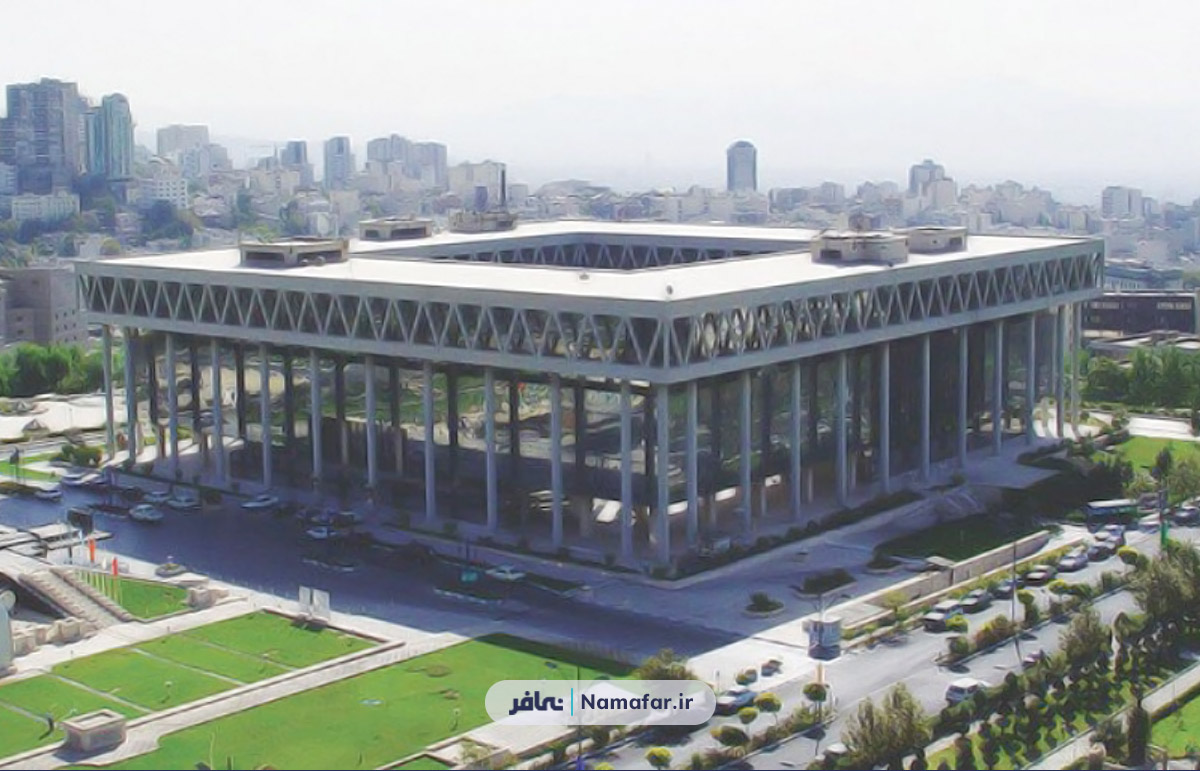
Iran's IRIB in recent years has provided no transparent statistics on the number of its viewers. But in the latest report that the IRIB Research Center published from the results of a survey on the special programs of the first decade of Muharram 1402 (2023/24). The program "Hosseinieh Moalla" on Channel 3, with 30.6 percent of viewers, was introduced as television's most-watched program. After that, "Haj Mahmoud Karimi's mourning recitation" stood at 10.7 percent (Farhikhtegan newspaper, 1402 (2023/24)).
Based on an IRIB survey in another report published by IRIB's Public Relations General Department, the series "Bazpors" on Channel 1 had 22.5 percent, "Eshq-e Kufi" on Channel 3 13.4 percent, and the rerun of the series "Gando 2" on the iFilm channel 11.1 percent of the audience (ISNA, 1402 (2023/24)). Although these statistics and the method of calculating the number of television viewers are full of ambiguity and contradiction, and unofficial statistics indicate a decline in IRIB viewers. Assuming the announced figures are correct, IRIB's performance in Iran can be placed on a comparative measure with rival media.
Number of BBC viewers
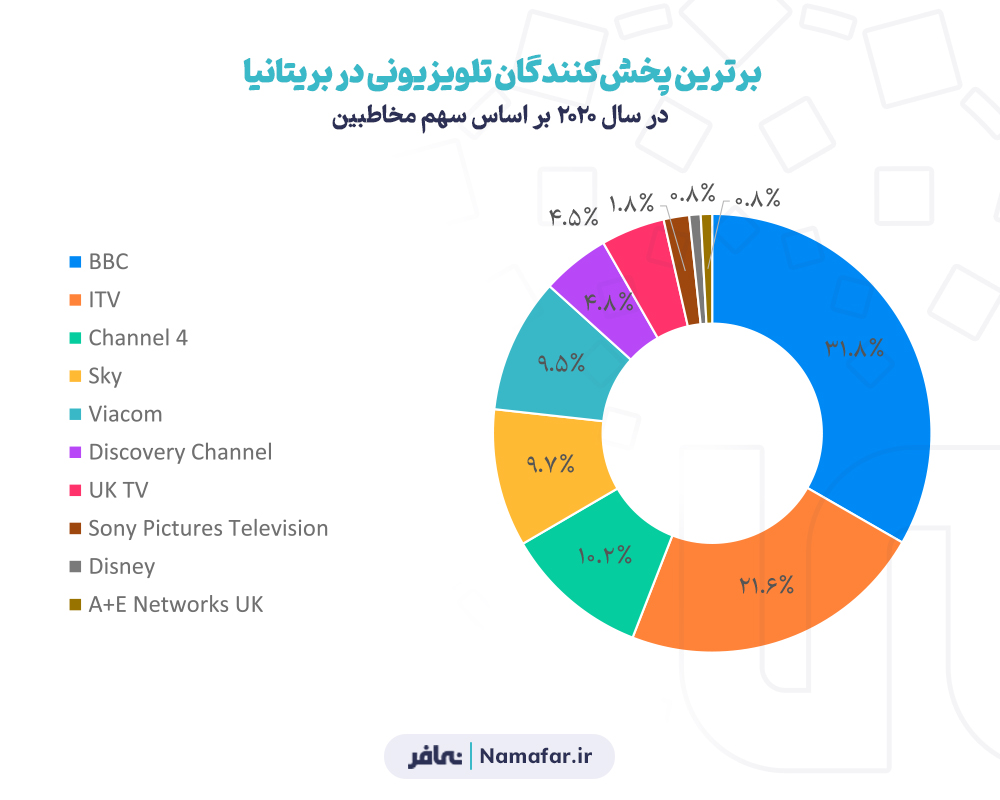
On this basis, the BBC, with 31.8, stands at the top of all British broadcasts. After that, ITV and Channel 4 stand at 21.6 and 10.2 percent respectively.
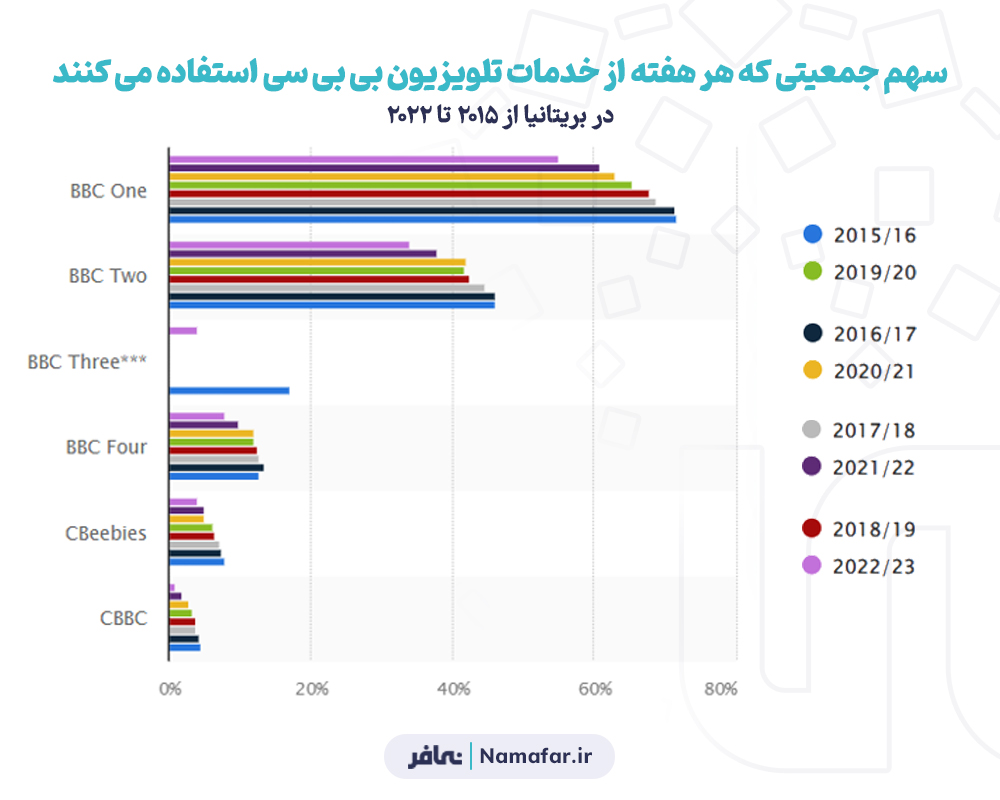
As we see, BBC One in the financial year ending 31 March 2023 had the highest weekly reach among BBC television services. The noteworthy point in the chart is that all the ranked channels over the past six years have experienced a downward trend of audience decline. For example, viewers of the popular BBC One channel fell from 71.8 percent in 2015 to 55 percent in 2023. Viewers of BBC Two also fell from 46 percent in 2015 to 34 percent in 2023.
On this basis it can be acknowledged that the decline in IRIB viewers in recent years is not confined to the Islamic Republic of Iran Broadcasting. Rather, this is an international phenomenon for all broadcasts in the world, which can arise from the expansion of social media. Even so, the BBC World Service has announced its weekly reach as 365 million people worldwide. All the statistics indicate that despite the decline in viewership figures of the BBC's British broadcast service, this global network has been able to maintain its authority not only in Britain but at the world level.
History of the BBC
The oldest media organization in the world is the BBC, which was founded in 1922. The BBC World Service provides news in more than 40 languages via television, radio and public services. This news service in the television section has 8 nationwide channels, 8 regional channels, 12 local channels, 7 UKTV channels and 14 international channels. Also in the BBC radio section, 13 national stations, 9 regional stations and 4 local stations operate. This volume of activity with the highest productivity is while the number of BBC employees is only 21 thousand people, that is half the number of employees of Iran's IRIB.
BBC revenues and budget
The situation of this British broadcaster is also noteworthy in terms of financial mechanism. More than 70 percent of the BBC's costs are funded through the sale of the television viewing license (TV License). This annual BBC viewing fee is now 159 pounds per user, which will increase to 169.50 pounds for 2024. In the financial year ending 2023, BBC revenue was 5 billion and 725 million pounds, of which about 3 billion and 700 million pounds was attributed to revenue from license payments by British households.
In addition, the BBC's revenue generation has other streams as well. Part of its revenue is obtained through subsidiary companies, which includes commercial activities such as broadcasting advertising on the BBC, selling programs and BBC network services. It is worth noting that the BBC World Service, according to its original charter, has separated public service broadcasting (PSB) activities from commercial activities, and PSB revenue is obtained solely through the sale of BBC subscription rights. The chart below shows the amount of annual BBC revenue in the years 2010–2023 by source of revenue. As we see, over the past fourteen years about three-quarters of the BBC's revenue each year has come from license sales.
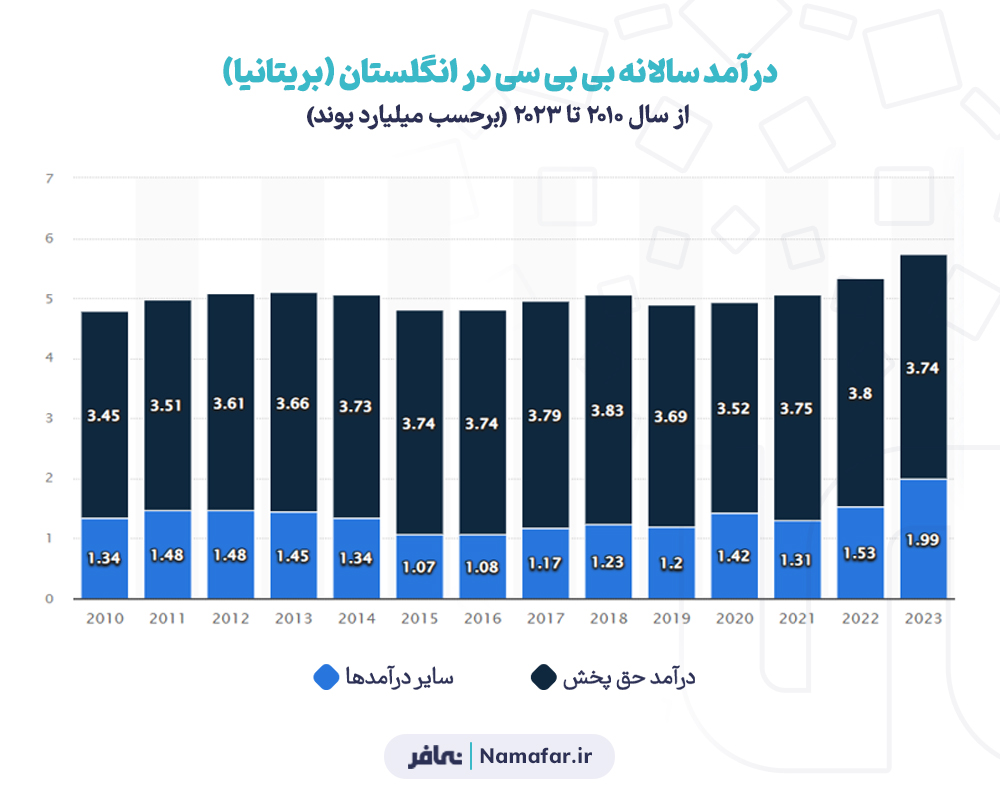
Although total BBC revenue this year increased by 395 million pounds, its costs also increased significantly. Such that in 2022–2023 there was an operating deficit of 220 million pounds. This deficit often occurs in years when there are major television events such as the Summer Olympic Games and the FIFA World Cup. Rising inflation has also affected the increase in energy and staff costs. The BBC broadcaster this year spent 1.3 billion pounds on BBC television channels, 498 million pounds on radio and 234 million pounds on BBC online. In total, PSB group costs, with a four percent increase, reached about 3 billion pounds. In the BBC performance report, this cost increase was attributed to coverage of major sporting events and the funeral of Queen Elizabeth II.
Global cash and in-kind support for the BBC
Although existing reports indicate an independent financial mechanism based on license sales, the extensive global support for the BBC cannot be ignored. According to the BBC's own announcement, this service is the recipient of cash and in-kind support from national governments, the United Nations and other international organizations, foundations, commercial partners and individuals. The UK Foreign, Commonwealth and Development Office, several United Nations agencies, the Bill Gates Foundation, the International Development Cooperation Agency, the Swedish International Development Cooperation Agency, and Global Affairs Canada are among the BBC's major supporters. For example, in 2021 "FCDO," with the start of the Russia–Ukraine war, donated 8 million pounds to the BBC, claiming to help preserve global democratic values through impartial news reports and countering disinformation.
Al Jazeera, the largest Arabic media outlet
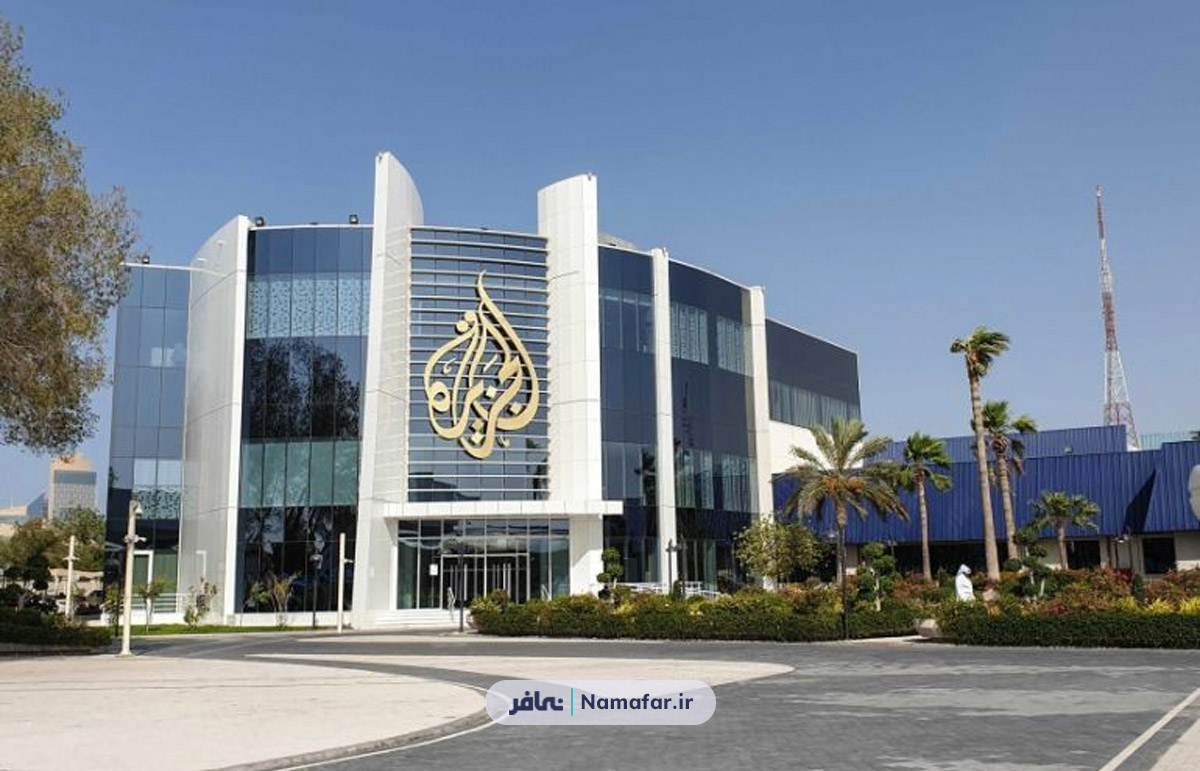
It is still too soon to judge. Before we want to attribute the BBC's successes, in the most simplistic form possible, solely to global support, it is worth also taking a look at the largest Arabic media outlet, namely the Al Jazeera network. A network that has many viewers not only among Arabs but also among English-speakers. Al Jazeera, unlike the BBC which has transparent financial reports, never provides information about the Al Jazeera network's budget and financial revenues. But it is evident that this media outlet is fully under the support of the Qatari government. On this basis it can be said that Al Jazeera's financial mechanism is to a large extent similar to that of the Islamic Republic of Iran Broadcasting (IRIB).
The Arabic-language Al Jazeera media, which was founded in 1996, within five years was able to become the most-watched Arabic television network for news. After ten years it was able to become the first or second choice as a news source for three-quarters of Arabs. In 2023 Al Jazeera English, for the seventh consecutive year, was selected as the best broadcaster of the year by the New York Film and Television Festival. In this year Al Jazeera Balkans was also selected as the best regional news website. This is only a corner of the awards that the Al Jazeera network has registered in its name so far.
Performance of the Arabic Al Jazeera network
Regarding Al Jazeera's content independence from other governments of the world and of course the extent of its influence, it is enough to know that in 2017, during the Qatar diplomatic crisis, several countries including Saudi Arabia, the UAE, Bahrain and Egypt cut their relations with Qatar. One of these countries' demands was the closure of Al Jazeera! In fact the distinguishing feature of Qatar's Al Jazeera's activities is its commitment to regional reporting, especially in West Asia. The Al Jazeera news agency always, with the help of its journalists around the world, tries to cover events and topics that may be ignored by West-centric media. In addition, by exposing cases of corruption and human rights violations it has been able to establish its place in investigative journalism. One example is the confidential documents that in 2011 it published from the Fatah organization's negotiations in Ramallah with the Zionist regime. These documents revealed Ramallah's conspiracies through security coordination with the Zionist regime and Israel's aggressions against the residents of the Gaza Strip. These cases show the Arabic Al Jazeera media's commitment to exposing the truth.The Arabic-language Al Jazeera news network now runs five television channels including Al Jazeera Arabic, Al Jazeera English, Al Jazeera Balkans, Al Jazeera Mubasher and Al Jazeera Documentary, along with a separate internet site for each. In addition, five bodies operate under this network; including AJ+ (social media publisher), Al Jazeera Podcasts (podcast network), Dorosteh (online news channel), the Al Jazeera Training Center and the Al Jazeera Centre for Studies. The number of Al Jazeera network employees has been announced as only 3 thousand people.
The reason for the popularity of Al Jazeera and BBC networks from the audience's viewpoint
Now that we have become aware of the extent of the number of BBC and Al Jazeera viewers, let us examine audiences' assessment of the activities of these two networks. The chart below shows 7 selected news networks in Britain in 2020, among which the names of the BBC and Al Jazeera are also seen.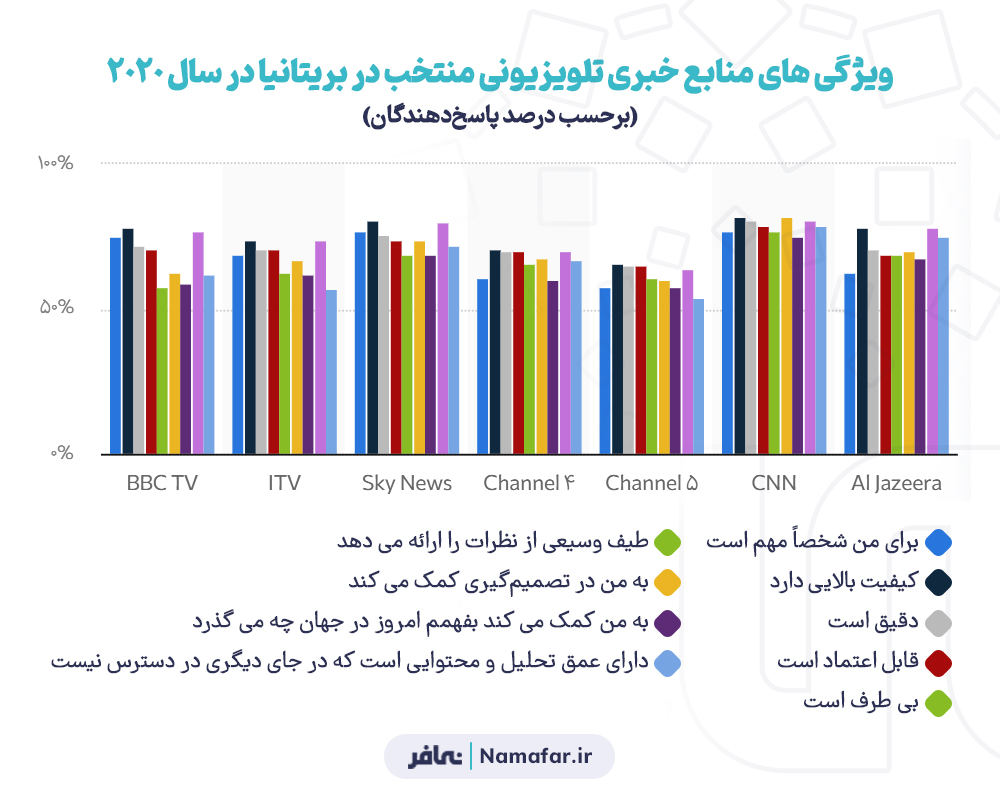
Now that we have become aware of the extent of BBC and Al Jazeera audiences, let us examine audiences' assessment of the activities of these two networks. The chart above shows 7 selected news networks in Britain in 2020, among which the names of the BBC and Al Jazeera are also seen.
According to the chart, audiences' assessment of the BBC is as follows: 78 percent it is of high quality, 77 percent it helps me understand what is happening in the world, 75 percent it is personally important to me, 72 percent it is accurate, 71 percent it is trustworthy, 63 percent it presents a wide range of opinions, 62 percent it has depth of analysis and content that is not available elsewhere, 59 percent it helps me make my decision, 58 percent it is impartial.
Audiences' assessment of Al Jazeera is as follows: 78 percent it helps me understand what is happening in the world, 78 percent it is of high quality, 75 percent it has depth of analysis and content that is not available elsewhere, 71 percent it is accurate, 70 percent it presents a wide range of opinions, 69 percent it is trustworthy, 69 percent it is impartial, 68 percent it helps me make my decision, 63 percent it is personally important to me.
Regardless of how far audiences' assessment matches expert opinions, we can discern the audience metrics for following a news media outlet.
Final word
With the statistics presented in this note in hand, several points can be raised. By examining the transparent, precise and highly detailed financial reports that exist of the BBC, it can be considered an independent media outlet whose bulk of costs is funded through license sales. This financial independence, even if in practice it has not been able to make the BBC an impartial media outlet, has at least created such an image of it in the minds of the world. Whereas Al Jazeera and IRIB (Islamic Republic of Iran Broadcasting) are considered state media. The difference between IRIB and Al Jazeera is that IRIB, because of financial dependence, has become a government podium and the breadth of views presented on it has reached the minimum possible. Whereas Al Jazeera has been able to preserve its prestige as a global media outlet. To the point that in its manifesto it explicitly writes that it is a free media outlet and is not supposed to reflect the views of the Qatari government.In terms of number of employees too, Iran's IRIB is considered not a large organization but a bloated institution. Because, with minimum productivity, it has twice the employees of the world's oldest media company (the BBC) and fourteen times those of the largest Arab media company (Al Jazeera). If, in justification of employing this number of staff, the number of its channels is raised, it must be said that a media outlet whose most-watched program on its most popular channel, according to the organization's own announcement, has at best 30 percent of the audience, what insistence is there on running more than a hundred channels? This is while Al Jazeera, as one of the most-watched news media worldwide, has only five television channels.
Also, by examining the number of BBC viewers we found that even the BBC's most popular channel (BBC 1) has in recent years faced a decline in viewers. Even so, it has still been able, with a reach of 365 people per week, to maintain its authority still at the world level. In contrast, officials of Iran's IRIB, while they evade providing a report on the number of their viewers, deny the drop in their viewers.
Finally, examining the status of the Al Jazeera network calls into question all the theories that IRIB officials express in justification of the organization's situation. Perhaps global support for the BBC has been able to help its growth, but the absence of these aids for Al Jazeera has by no means resulted in stagnation. Al Jazeera, with only 5 television channels and 3 thousand employees, and that despite financial and content independence from other governments, in the shortest possible time has been able to become a global authority. Whereas Iran's IRIB, with the greatest number of channels and employees relative to the BBC and Al Jazeera and the heaviest budget relative to other domestic cultural institutions, even its being national is still a matter of doubt.
Machine-translated from Persian by Namafar; the Persian original is authoritative. Read the original in Persian