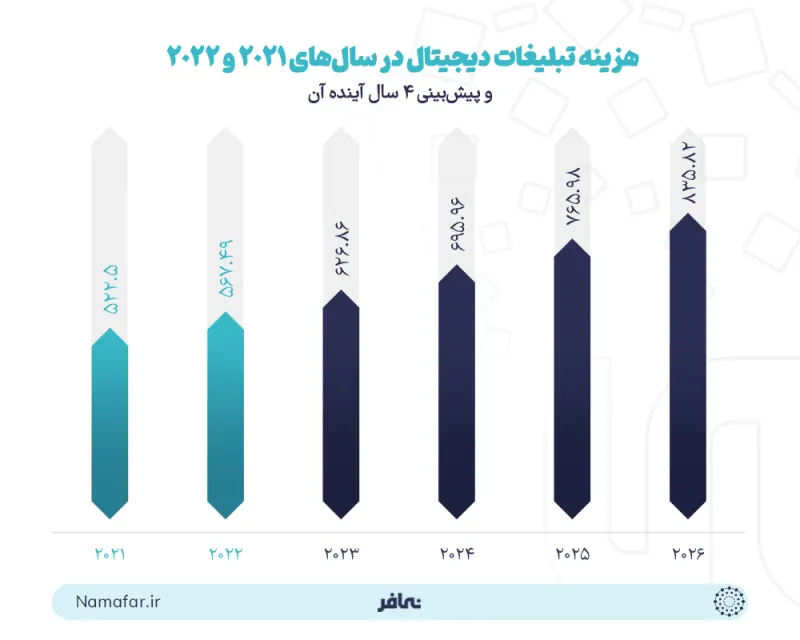
Developments in the advertising industry have been tied to technology; whenever a technology has emerged or been developed, the advertising industry has also taken a step forward in step with it. From the invention of the printing press to entering the world of the internet, as we have moved forward, advertising has come at us more powerfully every day. Meanwhile, digital advertising is completing its dominance over the world of advertising every day, such that digital advertising spending in 2022 reached 567 billion dollars, a figure that accounted for a share equivalent to 62 percent of the advertising industry's revenue.
Advertising industry specialists consider recent advances in digital advertising the result of efforts to integrate big data and scientific studies on AI-based systems. Artificial intelligence has many capabilities, among the most important and relevant of which is the possibility of personalizing advertising at a large scale using data such as users' behavioral information on platforms such as Facebook, YouTube and Google. As a result, with the growth of artificial intelligence the world of advertising is also evolving, and artificial intelligence is transforming the advertising landscape and will probably change it completely in the near future. Under these conditions, having an up-to-date understanding for planning and implementing artificial intelligence in advertising is important. For this reason, this article, using interviews with advertising and marketing specialists, studies and examines the impact of artificial intelligence on advertising.
Artificial intelligence and advertising: a nascent acquaintance
Although it has been several years that artificial intelligence has entered many commercial and operational domains and its use is growing, there is nonetheless a considerable research gap in this field and few studies have been conducted in this area. In the past, concepts related to advertising have been addressed in detail, but their intersection with artificial intelligence and the emergence of an unprecedented situation in this industry require the production of knowledge. Because scholarly research can highlight the role of artificial intelligence in the advertising industry and be effective in its rapid implementation.

Factors affecting the use of artificial intelligence in advertising
Competitive pressure is the main driver that forces advertising companies to use artificial intelligence in their activities. Many of them have felt the need to use artificial intelligence because of competition. Although elements such as media hype, the trend of digital transformation and customers' demands also create pressures for adopting artificial intelligence capabilities.
Benefits of using artificial intelligence in the advertising industry
Improved efficiency, savings in time and cost, and optimization of advertising processes are the main benefits of using artificial intelligence in the advertising industry. Advertising companies and actors in this field, by using artificial intelligence, can obtain appropriate data and insights from customers and make informed choices on that basis. Also, artificial intelligence's ability to improve return on investment (ROI), appropriate data analysis, forecasting through modeling, and providing better services to customers are among other advantages that have been mentioned.
Challenges of the advertising industry's use of artificial intelligence
Technical compatibility has been raised as the most difficult aspect of using artificial intelligence in the advertising industry, such that advertising companies that use artificial intelligence are always trying to make their system compatible with AI-based programs. Complex software and information technology systems are part of these challenges. Access to and having appropriate data is the next challenge, because data are the most important component of artificial intelligence activity, and to use artificial intelligence successfully one must have appropriate data. Also, the weakness of advertising teams' technical capabilities is another problem that advertising companies face after adopting artificial intelligence. Organizational transformation is one of the important prerequisites for adopting new technologies such as artificial intelligence, which must be carried out through means such as employee training.

An ethical look at the use of artificial intelligence in advertising
Although advertising companies claim that they collect and use data anonymously, the most important ethical consideration in using artificial intelligence in the advertising industry is the issue of data and protecting customers' privacy. Ensuring ethical practices such as not collecting personal data without consent and being transparent about them are important issues in the use of data.
The role of artificial intelligence in advertising performance
Artificial intelligence improves the performance efficiency of companies and actors in the advertising field. Advertising experts consider artificial intelligence a transformative technology that, throughout their advertising activities, brings about the optimization of processes, analyses and strategies. This widespread adoption shows that artificial intelligence is an important factor in increasing advertising performance and a driver of this industry's growth.

Advertising strategies before and after artificial intelligence
Strategies before the use of artificial intelligence mainly focused on expanding advertising resources and increasing product supply, but after the adoption of artificial intelligence, a shift has been made toward using business intelligence and developing predictive models for future trends based on data. Increased focus on using artificial intelligence to access customer insights through social media, personalization, data collection, search optimization and sales are examples of these changes and transformations. Also, using artificial intelligence to improve service quality and responsiveness, investing in areas related to artificial intelligence, and so on, are other instances of the change in strategies before and after artificial intelligence in the advertising industry.
Summary and conclusion
This article has examined the impact of artificial intelligence on the advertising industry from the viewpoint of specialists in this field. The findings show that artificial intelligence is transforming the advertising industry, and then a roadmap for implementing artificial intelligence in this industry has been presented. Benefits such as savings in time and cost and optimization in advertising processes, and barriers such as issues and technical compatibility in the use of artificial intelligence by advertising companies, have been identified.
Also, the necessity of attention to data ethics and protecting privacy, and the improvement of advertising performance by artificial intelligence, are among other matters that have been mentioned. In general it can be said: artificial intelligence has changed the advertising environment and helps in modernizing it, and advertising companies must pay attention to the aspects and issues of using artificial intelligence in advertising.
Machine-translated from Persian by Namafar; the Persian original is authoritative. Read the original in Persian