It was mid-1401 (2022/23) in the Solar Hijri calendar, or late 2022 in the Gregorian calendar, when the catastrophic coronavirus pandemic, which had left many bereaved, mourning, and ill, and many others unemployed and some bored and depressed, was gradually subsiding so that people across this planet could slowly return to their ordinary work and lives, but a sudden event occurred; the release of the initial version of an AI chatbot named ChatGPT set off an explosion in cyberspace and public opinion. Everyone was either busy asking this chat strange questions and hard tasks or showing this artificial intelligence's extraordinary abilities to their friends. After public attention was drawn to this efficient tool, other programs that worked using artificial intelligence also shone, and this explosion gradually turned into the artificial intelligence revolution. When a volcano explodes it shakes, burns, and turns over all the surrounding land, destroys some creatures, but provides the opportunity for other creatures to come into being. Creative industries are like land that, with the explosion of artificial intelligence, is shaking and changing shape, and amid this, music has a special place in this nascent revolution.
What artificial intelligence is and why it exploded in the creative industries
Artificial intelligence (Artificial Intelligence) means the ability of machines to perform tasks that normally require human intelligence; including learning, decision-making, problem-solving, creativity, and production. On the basis of this range, artificial intelligence is built in different forms and of course is used for diverse applications. Among the various types of artificial intelligence, generative AI (Generative AI) has had the greatest impact on creative industries. This type of artificial intelligence enables machines to produce new and creative content. Because of the creative and inventive nature of creative industries, they require the production of innovative and artistic content on an ongoing basis. Generative AI, with the ability to understand patterns and produce fresh content, meets exactly this need. In creative industries such as music, cinema, design, and advertising, generative AI has enabled artists and designers to turn new and diverse ideas into reality faster and sometimes at lower cost than before.
The transformation of the landscape of creative industries, especially the music industry, after the AI revolution
Generative AI technology has created a striking transformation in creative industries and has provided the capacity to create an innovative revolution in this field. From the automatic production of pieces of music to the design of images and animations, generative AI as a novel tool has been able to transform methods of creativity and content production from the ground up. For example, research by the McKinsey studies company shows that by 2030 more than 45 percent of creative productions may benefit in some way from generative AI. This trend clearly indicates the growing role this technology will play in the future of creative industries and that it will transform their face.
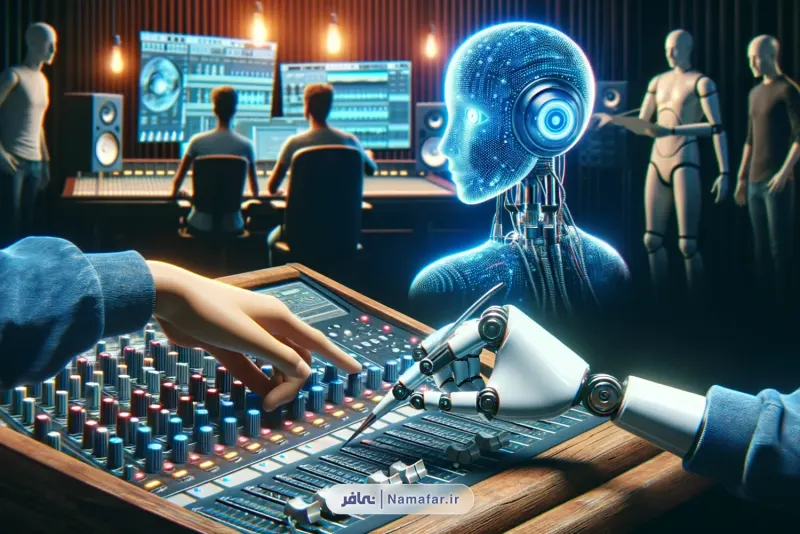
But the transformation of these industries does not necessarily have a positive meaning for all those involved in them or even for their nature. The production of any technology that leads to a revolution in human life brings many consequences for that life, some of which are considered positive and some negative, and artificial intelligence is no exception. In creative industries too, artificial intelligence will act like a double-edged sword and will reveal its opportunities and threats. In the music industry, artificial intelligence has so far been well received, because of its high merits in dealing with music.
Of the opportunities created by artificial intelligence for the music industry we briefly mention these: rapid creation of works, customization of content for consumers, improvement of the production process. Likewise one should not overlook the dark and threat-like aspects of this technology for the music industry, cases such as: reduction of artistic job opportunities, the possibility of the loss of artistic authenticity and the artist's individuality in artworks. In what follows we will examine these opportunities and threats more carefully.
Opportunities and positive effects
Generative AI, given the many capabilities it has, has been able to transform methods of producing, distributing, and consuming music significantly. These transformations have created new opportunities for musicians, instrumentalists, singers, producers, and ultimately music listeners at the global level. We examine some of these opportunities further:
-
Music creation by artificial intelligence
The power to create artworks was something that before generative AI only humans could accomplish, but now with this technology one can even produce music. Music creation by artificial intelligence is one of the most attractive developments of this technology. Tools based on generative AI can create new pieces of music by analyzing past music data and learning from patterns. These tools can produce music in various styles, from classical to electronic and pop, and this means that music audiences themselves can also, without being specialists in the art of music, set about creating various songs. We introduce some of these AI production tools:
AIVA: an advanced artificial intelligence designed for composing. This algorithm was developed in 2016 and was able to be registered as the first AI composer. AIVA can, on the basis of analyzing the works of great musicians of the past, produce music in various styles, but its focus is on classical and orchestral music. Using this artificial intelligence it has released two music albums in the classical genre named "Genesis" in 2016 and "Among the Stars" in 2018.
Amper Music: a platform based on artificial intelligence that allows its users to create pieces of music without having musical knowledge. This platform is especially designed for people who have no specialization in composing or playing an instrument. Amper Music enables users to choose among various music styles and, with only a few clicks, make songs suited to their needs (such as background music for videos, podcasts, or advertising).
OpenAI Jukebox: an AI model capable of producing music with lyrics and various styles. This program is OpenAI's dedicated program for producing music and sound; OpenAI is also the creator of ChatGPT and therefore it benefits from that company's advanced technologies, although the purpose and data training of the two are different.
After users' abundant reception of AI music-generation programs, large technology companies also set about launching such a tool in their own programs. Google unveiled its music AI tool named "Music AI Sandbox." Google built this artificial intelligence with the help of its own AI division, DeepMind, and YouTube. Google's new artificial intelligence has been described as a toolbox that allows singers and instrumentalists to make music in new ways. Google has built this AI service so as to be a versatile tool for professional musicians, not a replacement for them. In this way artists' creativity will still be the dominant force in the music-production process. Of course Google has announced that this tool is only a small part of Google's large projects for music and artificial intelligence. Meta (Facebook) has also entered this arena by adding a tool; "Meta Music AI" is the name of a tool this company has recently added to its programs.
After Google and Meta, TikTok has also entered the arena of producing music with artificial intelligence. TikTok has experimentally added an AI bot named "AI Song" to its app. AI Song uses a large language model (LLM) named BLOOM and generates song lyrics. TikTok also last year released the Ripple program, which is a free program for producing music. This program has two key features: melody-to-song AI (Melody to Song) and a virtual recording studio.
But it was not only the giant digital technology companies that are thinking of benefiting from artificial intelligence in the music industry. In this regard, the Coca-Cola beverage company has also entered this arena and has released a new musical instrument! Some time ago this company unveiled a musical instrument named "Coke SoundZ." With the help of artificial intelligence, this musical instrument converts Coca-Cola's iconic sounds, such as the sound of a bottle opening, pouring soda, and so on, into various musical notes, rhythms, and melodies. Coca-Cola officials believe that Coke SoundZ will create a new and entertaining experience for Coca-Cola fans and allow them to create their own music. This initiative is part of Coca-Cola's recent efforts to use artificial intelligence to enhance consumers' experience.
-
Helping produce and distribute music
Aside from creating music by means of artificial intelligence, this technology can be a great help in producing and distributing music in global markets. By production in this section we mean music production by professional producers and its distribution by professional publishers. For example, this technology can, by increasing precision and reducing production time, greatly help mixing sound in the process of producing a track. Or artificial intelligence can be used to find the audience's taste and distribute music better in the market.
Increasing the quantitative and qualitative productivity of music production:
Reducing production costs: According to a report by the WiFiTalents website, the use of AI tools has led to a 30 percent reduction in music production costs. This cost reduction is especially doubly important for independent artists and small music-production companies. For this reason 45 percent of independent musicians use artificial intelligence to enhance their creative process.
Increasing production speed: Artificial intelligence is able to carry out time-consuming processes such as composing, arranging, and mixing automatically. 72 percent of the top music producers use AI tools to accelerate production.
Increasing production quality with precision in mixing and mastering: AI tools can carry out mixing and mastering processes with 90 percent precision, which leads to improvement of the final quality of the music.
Impact on music distribution:
Data analysis for successful music distribution: By analyzing market data and audience preferences, artificial intelligence can identify pieces of music that have a higher probability of commercial success. Prediction of the commercial success of music tracks is performed with 80 percent accuracy by AI algorithms. In this way music distributors go after tracks that have a higher probability of success in the market. Also, using artificial intelligence, music companies can analyze market trends and optimize their distribution strategies.
Targeted advertising by artificial intelligence: This technology can identify the appropriate audiences for each piece of music and display advertising related to them in a targeted way, which has led to a 50 percent increase in the efficiency of advertising campaigns.
Enlarging the music market: Platforms such as Amper Music allow people without musical knowledge to produce music. This has led to a 36.8 percent increase in the number of independent music producers, and this has been able to grow the music market. Over the past 5 years artificial intelligence has helped increase the overall output of new music by 40 percent.
Improving the discovery of new artists: Artificial intelligence, by analyzing users' listening data, can introduce emerging artists to audiences. This has led to a 30 percent increase in users' discovery of new artists.
Fighting rights violations by identifying copyright infringement: AI tools can identify copied or unlicensed music with 98 percent accuracy, which helps protect artists' rights.
-
Customizing and optimizing content for consumers
Using artificial intelligence, music streaming services such as Spotify and Apple Music are able to analyze listener data and recommend music tailored to each user's taste. For example, using its algorithms, Spotify recommends more than 30% of the music that users listen to, which improves the user experience and increases their engagement with the platform. Artificial intelligence can analyze a song's structure and genre with 70 to 80 percent accuracy, and for that reason recommended tracks can be delivered to individual listeners with 95 percent accuracy. According to a study, AI-based music platforms have seen a 40 percent increase in user engagement compared with traditional platforms.
Artificial intelligence can also make a substantial contribution to automating the management of virtual music streaming platforms. AI tools are able to create playlists tailored to users' moods and activities, which has led to a 60 percent increase in the use of streaming platforms. Artificial intelligence can be used to provide better and more precise customer support. The use of chatbots and virtual assistants to answer users' questions has led to a 70 percent reduction in waiting time and an improved user experience.
Threats and negative effects
Whenever humanity has obtained a new technology, it has at first been excited and seen only the opportunities and benefits, but over time it has realized that every opportunity also brings threats with it. Artificial intelligence technology in the creative industries is no exception to this rule. Examining the possible civilizational and philosophical negative effects of artificial intelligence on humanity is beyond the scope of this article and must be discussed at length. But in our own discussion, we examine several of the possible threats of artificial intelligence to the music industry.
-
Automation and the decline of artistic jobs
The reduction of job opportunities is one of the most important negative effects of artificial intelligence on the music industry. This phenomenon is related to the concept of creative destruction (Creative Destruction) in economics. Creative destruction refers to a process in which new technologies render old methods and jobs obsolete, while they may at the same time create new jobs and innovative opportunities. With the arrival of artificial intelligence in the music industry, 45 percent of people working in music are concerned that it will replace human creativity and reduce job opportunities. As music-generation algorithms advance, it is likely that many of the creative tasks that were previously performed by humans will now be carried out by machines.
Over the next ten years, AI-generated music will take a large share of the global music market, which will unfortunately be a losing competition for traditional music producers. Forecasts show that by 2028, AI-generated music will take $3.1 billion of the global market, whereas in 2023 it accounts for only $300 million of the global market. In the chart below you can see that music's share of the global market for AI-generated creative output in 2023 is only eight percent, and according to forecasts this amount will increase more than tenfold by 2028 and will see a 60 percent compound annual growth rate.
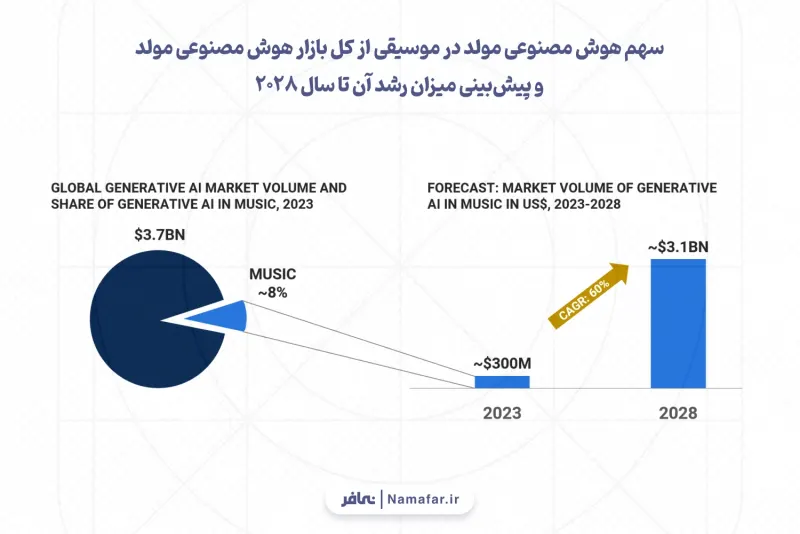
A new report by the APRA AMCOS institute, based on interviews with songwriters, musicians, and publishers, claims that by 2028 artificial intelligence could wipe out 23 percent of this group's income. For example, in the Australia and New Zealand music market this lost income will be 153 million.
-
Issues related to intellectual property rights (copyright)
Another important challenge is the issue of copyright and intellectual property. Music produced by artificial intelligence can raise questions about who owns it. For example, is a song produced by an algorithm considered a "creative work," and if so, who owns the rights to it. Does the work belong to the creator of the algorithm, the person who entered the data, or the company that produces the AI tool? According to reports, AI technology itself can detect copyright infringements with 98 percent accuracy, but the legal challenges of determining ownership of generated works remain unresolved and require the creation of new regulations.
In addition to issues related to ownership of generated works, another issue concerns works produced by artificial intelligence that closely resemble original works. This challenge arises especially when artificial intelligence uses data from previous music to generate new pieces, which sometimes leads to songs that unintentionally copy or imitate original works. This situation not only creates complex legal issues, but also makes it difficult to determine the boundary between inspiration and copying.
-
Loss of authenticity and individuality in artistic works
Some critics believe that the widespread use of artificial intelligence in creating music could lead to the loss of artistic authenticity and individuality. Algorithms typically work on the basis of past data and pattern analysis, and this may diminish human creativity and the emotions embedded in artistic works. Stricter critics raise the point that because artificial intelligence is not created from within a human being, it lacks the ability needed to create an artistic spirit in a piece of music—an artistic spirit that only a human can breathe into the body of a work.
According to a survey that the bedroomproducersblog site conducted of 1,500 music producers, the concern of more than 29 percent of them about the entry of artificial intelligence into this industry is that "AI music production tools may lead to less creativity and originality," and after that 24 percent were concerned about "ethical and legal issues of AI-generated music, such as concerns related to copyright and ownership." So among producers themselves, the loss of human artistic creativity is considered the most important concern. Additional information can be seen in the chart below.
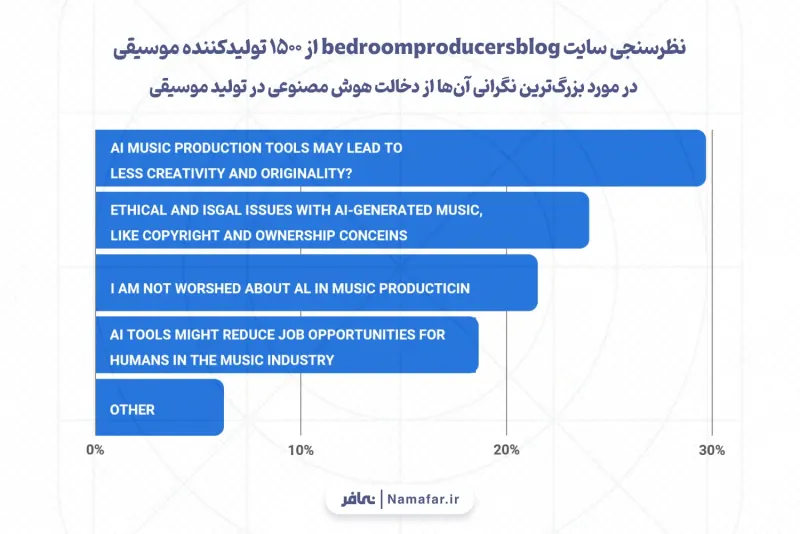
Not long ago, the Artist Rights Alliance and more than 200 singers called in a letter for the use of artificial intelligence to be stopped. They believe that the unethical use of artificial intelligence destroys the value of music. In this protest campaign, which artists including Billie Eilish, Nicki Minaj, and Katy Perry have supported, digital music makers are asked to "stop the use of artificial intelligence because it violates and devalues the rights of human artists." Of course, the protesting artists are not calling for a complete ban on the use of artificial intelligence. Rather, in this letter they pointed to the high potential of artificial intelligence in the music industry. The main issue for these artists is "the use of artificial intelligence to destroy creativity and undermine artists, songwriters, musicians, and rights holders."
Final word
Artificial intelligence technology has brought about a huge transformation in the production, distribution, and consumption of music that is expanding every day. Its many benefits, such as faster production, lower costs, and personalization of content for audiences, should not cause us to forget its threats, such as fewer job opportunities, the loss of artistic authenticity, and issues related to intellectual property rights. Although artificial intelligence itself can be of great help to us in addressing its own threats, this field requires public and private support, intelligent policymaking, and novel and precise legislation.
The parable of artificial intelligence is like that of a volcano: for a long time many people, looking at the smoke that rose from it from time to time, predicted a huge explosion and eruption, but its timing and the speed of the eruption could not be predicted. This volcano finally erupted two years ago and since then has been transforming the entire world. The lava of artificial intelligence will probably destroy the old surface of the earth; but it will itself create a new surface for the earth. Artificial intelligence may be as hot as a volcano's magma and lava, but it will never be as ruthless.
Sources:
Machine-translated from Persian by Namafar; the Persian original is authoritative. Read the original in Persian