Imagine that artificial intelligence, with a simple command, composes a listenable piece of music for you, uploads it to a website it has itself designed, shares it on social networks and brings it to the ears of thousands of listeners. Even beyond that, it produces and distributes its music video as well. In this way, without having the slightest knowledge of music or of playing an instrument, by using artificial intelligence in music you have bypassed this entire industry and its practitioners, from composer and lyricist to instrumentalist and sound engineer and finally a music production company. Now imagine that every member of society could, with this artificial-intelligence trick, have their own track or album; it would be a dire situation!
The major music companies, to escape this chaotic situation that lies in wait for them, have turned to superfans, or die-hard music fans. In this piece, we examine the role of these die-hard fans in the success of music artists. Then we turn to their capacity for developing the economy of Iran's music industry. Expanding online music streaming services and creating mechanisms to increase live performances are among the measures that, relying on die-hard fans, can lead to strengthening Iran's music industry.
Patrons of the culture industry in the modern era
In the premodern era, the aristocracy and the wealthy played the main role in supporting artists and poets. Works of art, in limited copies, were available only to the aristocratic and wealthy class of society. Ordinary people had to be lucky to enjoy masterpieces of the visual arts in magnificent public architecture such as religious sites. In the modern period, the culture industry made possible the wide distribution of cultural products through new media such as the press, photography, radio, cinema and television and so on, and cultural and artistic works became available to the public.The industrialization of culture gave rise to the cultural economy, whose audiences, instead of the wealthy class, were the mass of consumers. Its patrons, instead of the aristocracy, were investors who, alongside a return on capital, also had their eyes on profit. These developments affected the world of music more than anything else and turned music from a high art into a popular cultural industry.

These days investors, that is music production companies, to reduce risk in a period of artificial-intelligence dominance over part of the culture industry and the creative industries, have thought of investing in artists who have fans who, though few, are die-hard. These die-hard fans, or in Western parlance superfans ( Superfans ), play in a sense the same role as the patrons ( sponsors ) of the premodern period, with different goals and reasons.
Who are die-hard fans?
The Cambridge dictionary defines a "superfan" as follows: someone who admires and supports a person, singer, athlete, team and so on in a very enthusiastic way. These die-hard fans have a special share in the economy of sport and the cultural industries. A clear example of these die-hard supporters in the cultural industries is fans of comic-book stories. Some become so immersed in these illustrated comic stories such as Tintin, Superman and Batman that it is as if they live in these stories. They are the ones who, to obtain whatever is brought to market on the subject of these stories' heroes, from films and series to toys and clothing, wait in line for hours.
There is no shortage of this kind of die-hard fan in the field of music. We had a colleague who had a long and distinguished record in media and was an authority on cinema. He was of advanced age and respected by all. Even so, he had a strange trait that made him notorious among everyone and that, in our view, conflicted with his cultural standing: he was a die-hard fan of one of the expatriate music artists. He was known for being tight-fisted, but he spent all his income to attend that artist's concerts. From his remarks I understood that people like him are not few, and expatriate artists count especially on their presence at their concerts in neighboring countries.
The role of die-hard fans in the music economy
Now the world's largest music companies such as Sony have also given die-hard fans a special place in the music industry. Some experts even refer to them as the saviors of the music industry in the post-artificial-intelligence era. Their importance has grown still more with the rise of online music consumption. For example, Universal Music Group claims that 30 percent of music-streaming subscribers are die-hard fans of one or more of the company's artists. Goldman Sachs has been less generous and estimates that 20 percent of music-streaming subscribers are die-hard supporters.In any case, most studies classify 18 to 20 percent of an artist's fans as die-hard fans. According to Goldman Sachs's report, die-hard fans, who in total spend 80 percent more per month on music than ordinary listeners, are now considered a "4.2 billion dollar market" for the music industry. They spend on average 68 percent more per month on music than most music fans, spend 126 percent more than other audiences on goods and works related to their favorite artist, and pay 76 percent more than others for physical music.
Die-hard music fans in Iran
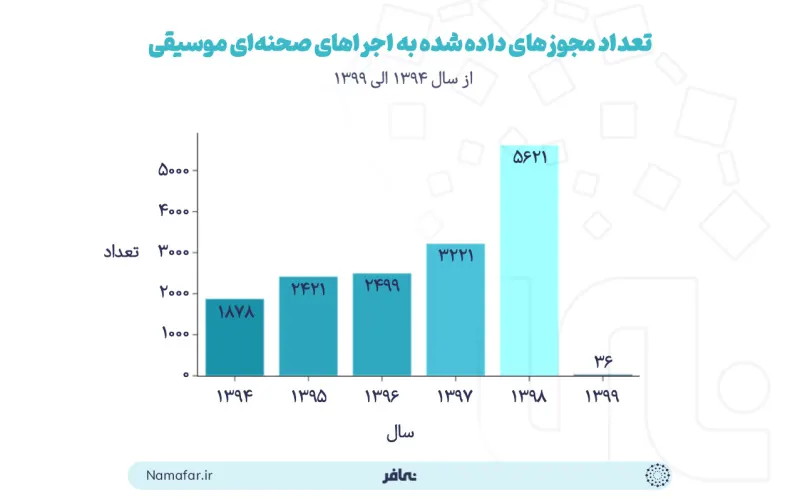
According to Goldman Sachs's estimate, the music industry's gross revenue worldwide will reach 153 billion dollars by 2030. This company had forecast 94.9 billion dollars of gross revenue for this industry in 2023. Iran's share of the world's 95-billion music revenue is very small. This has numerous causes that are not the subject of this piece. Even so, one of the factors behind the lag of Iran's music-industry economy is the disregard for authors' rights, or copyright, which has made music-industry revenue in Iran dependent on holding concerts and live performances.In 2023 recorded music, with 31.2 billion dollars, was the highest-earning segment of the music industry, while live music in the same year had 28.86 billion dollars in revenue. But contrary to the global trend, the main burden of the music industry in Iran rests on live performance. The rapid 19-fold growth of music performances from 1385 to 1397 (2006–2019), as well as the issuance of concert permits in Iran and live performance from 1,878 permits in 1394 (2015/16) to 5,621 permits in 1398 (2019/20), attests to this (Chart 1).
Perhaps the best experience in this field belongs to Mohsen Rajabpour, manager of the Taraneh-ye Sharqi company, who introduced the Arian band to Iranian audiences in the early 80s. In 95 and 96 he introduced Hamed Homayoun as his company's star to Iran's music market and was able to assemble die-hard audiences for this artist. According to him, "in a country that the world thinks does not hold music concerts, the singer under contract with us had about 239 performances in only five months." The author in 95 had a long conversation with him and Hamed Homayoun to discover the secret of this Iranian music producer's and his artist's success. In fact, his secret is his expertise in attracting die-hard fans and drawing them into the concert hall.
With all this said, since there are no official and transparent statistics on Iran's music market and the music industry's turnover in Iran, one cannot give specific figures on die-hard music fans. Even so, their number is not small, and this can be understood from audiences who even endured the hardship of traveling to Turkey to attend a live performance by a singer such as Amir Tataloo and accepted a heavy financial cost to obtain tickets for Amir Tataloo's concert.
Why should die-hard music fans be taken seriously?
Die-hard music fans should be considered and taken seriously from two perspectives. First, from an economic perspective and the fan's role in the survival of the music industry, and second from a sociological perspective, because in their lives they are more influenced by artists.Alongside the experience of Hamed Homayoun, who was introduced to Iran's music market by a prominent music production company in Iran, it is worth mentioning the experience of a capable and promising artist who was unable to achieve success in the music market and whose name I refrain from mentioning, as well as the Bamrani band, which through effort, persistence and a focus on Bamrani's die-hard fans was able over 10 years to become one of the best music groups in Iran.

That talented young artist independently released a respectable music album. He also had a small but successful concert at the Azadi complex hall. At his second live performance, which was held in a large hall, half the seats remained empty. He admitted that to cover the costs of the live performance he had put concert tickets on sale at a discount of more than 50 percent. He complained that half the audience, without knowing him, had been drawn to the performance solely because of the steep discount he had put on concert tickets. This very fact caused his disappointment, as he was trying with personal capital to enter the music industry. In fact, instead of focusing on die-hard fans, he quickly tried to attract a wide audience, which was unsuccessful.
By contrast, the Bamrani band started by performing in small halls and cafes and gradually, over three or four years, was able to assemble fans for itself. After this band appeared on the Khandevaneh program, it took the risk of staging Bamrani concerts in large halls. Today the Bamrani band is one of the most successful music groups in Iran.
From a sociological perspective, too, die-hard music fans should be taken seriously. These individuals' modeling themselves on and identifying with music has led to the formation of subcultures that are most visible in pop, rock and rap music. Leaving die-hard music fans to themselves not only has economic costs but may also have social harms. The case of Amir Tataloo and his fans, who called themselves Tatalliti, is among the cases that should always be kept in view by the country's cultural policymakers.
Suggestions for Iran's music policymakers
Some international music experts claim that an artist's success in the music industry is not conditional on having millions of listeners, but that a thousand true fans pave an artist's path to success; fans each of whom would be willing to spend 100 dollars to buy concert tickets for their favorite singer, and that artist's album and online tracks.A policy of investing in die-hard fans can be one of the ways to increase the revenue of Iran's music industry alongside promoting a culture of respect for authors' rights. These days cyberspace is full of sites and channels that put the latest music albums or artists' new singles up for free download on their music site or channel.
The cinema industry and home video in Iran also faced this problem, and with the cooperation of the relevant institutions a considerable number of these sites and channels for free film and series downloads were forced to respect authors' rights. This policy can also be implemented for the music industry, and online music-distribution platforms can also come to this industry's aid.
Today a considerable share of music revenue comes from this very music streaming or online music-playback services. Actors in this field have also counted especially on die-hard fans. Spotify, in a report that examines its audiences' music-consumption patterns, states that 18 percent of them are die-hard listeners and that artists should pay special attention to these listeners. On this basis, investing in the platforms needed for online music consumption is among today's necessities of the music industry in Iran. Encouraging music audiences to use streams and online music-playback services can certainly also lead to promoting the legal consumption of works and respect for authors' rights.
The survival of Iran's music industry depends on live performances, but unfortunately part of the potential financial resources that could enter this industry's cycle, through the presence of die-hard fans of expatriate artists at their performances, goes into the pockets of other countries. Creating a mechanism for the presence of some of these artists who have no hostility toward the system of the Islamic Republic of Iran, and encouraging them to hold concerts inside the country, can have two benefits: one, that it prevents those artists' fans from traveling to neighboring countries and stops the outflow of foreign currency from the country. The other, that it opens the way for Iranian enthusiasts living in neighboring countries, and even the region's Persian-speakers, to come to Iran to attend those artists' concerts. Iran's neighboring countries have increased their tourism-industry boom by holding foreign concerts. For example, Saudi Arabia every year, by inviting prominent music artists, attracts their audiences from neighboring countries. Iran, too, by facilitating concert performances by prominent regional and world artists, can, in addition to Iranian audiences, also attract their regional die-hard fans and give a boost to the tourism industry.
Sources:
Namafar, Concert organizers' share of concert revenue in Iran-1400 (2021/22), Namafar, 30 Ordibehesht (April–May) 1402 (2023/24)
Namafar, Music industry report in 2023, 17 Bahman (January–February) 1402 (2023/24),
Namafar, Number of concert permits issued in Iran from 94 to 99, 27 Esfand (February–March) 1401 (2022/23)
Namafar, Number of music performances from 1385 (2006/07) to 1397 (2018/19), 30 Mehr (September–October) 1399 (2020/21)
Music Ally, Report: 20% of US music listeners see themselves as superfans
Music Business Worldwide, Superfans and Supine Fans: The Music Industry Is Getting Its Priorities the Wrong Way Around, 17 Oct 2023,
Machine-translated from Persian by Namafar; the Persian original is authoritative. Read the original in Persian