Our country has good facilities and infrastructure in the transport sector. Also on a cross-border scale, Iran is located on the region's transit artery and has land borders with seven countries and maritime borders with eight countries. For this reason there are many potential opportunities to focus on the transport sector, generate income for the country and create employment. On this path, removing political obstacles in order to develop trade exchanges and the possibility of mass-producing the transport fleet needed inside the country or facilitating their import are among the main needs of this sector.
Share of types of transport in Iran
The freight and passenger transport system, by a large margin relative to other modes of transport, relies on land transport and via road; land transport itself includes road and rail transport, and according to the statistics obtained the share of rail transport compared with road is very low. Traffic, air pollution and road accidents are among the consequences of the transport system being road-centered. Also, rail transport is recognized as a safe, clean and low-consumption mode among other modes of transport; despite this, its share in Iran fluctuates between 5 and 6 percent, which compared with most developed and developing economies is low. A comparison of Iran's rank in rail transport in 2020 among 60 countries shows that Iran's worst performance, with rank 60, was recorded in the length of electrified lines and its best performance, with rank 16, in "productivity per passenger coach" and "productivity per heavy freight locomotive". Also, the performance of Iran's air transport in a per-capita comparison of 1401 (2022/23) and 1402 (2023/24) shows that in the passenger-movement sector there was an 11.3 percent increase and conversely in the mail and freight sectors there was respectively a 39.1 24.9 percent decrease in performance. Also, the standing of Iran's air transport among developed countries in 2021, based on information obtained from the World Bank, has taken rank 27 on the passenger-transport indicator. In road transport, according to studies that have compared the standing of Iran's road transport with 7 countries bordering this country, it is shown that Iran by a large margin has accounted for a large volume on the two branches of trips and passengers (road) compared with other countries.
Comparing per-capita air, road and rail transport in Iran
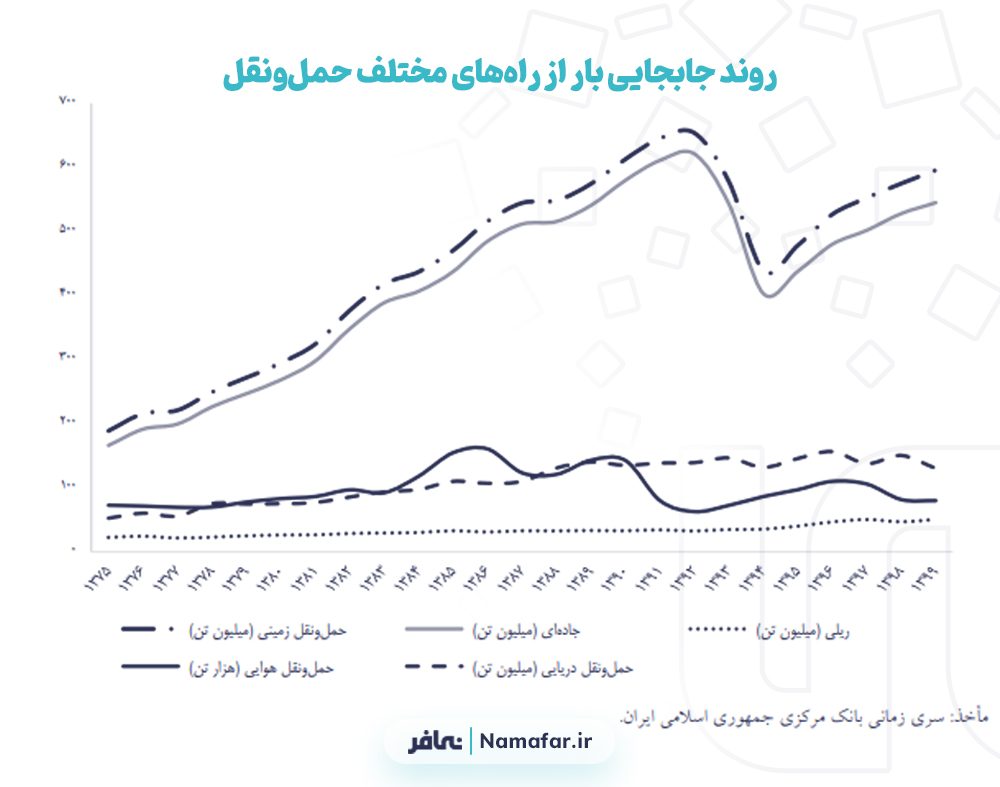
The trend of freight and passenger movement by the country's various modes of transport is displayed in the charts below. On this basis the greatest freight movement in the country is carried out over land and via road. In the passenger-movement sector too, land transport via road has the greatest share in passenger movement. Therefore the freight and passenger transport system, by a large margin relative to other modes of transport, relies on land transport and via road. Land transport itself includes road and rail transport, and based on the information in the charts below the share of rail transport compared with road is very low. Traffic, air pollution and road accidents above the global average are among the consequences of the transport system being road-centered. The Sixth 5-Year Economic, Social and Cultural Development Plan of the Islamic Republic of Iran has addressed the transport sector in detail and emphasized its development, especially rail transport. The share of rail transport in Iran fluctuates between 5 and 6 percent, which compared with most developed and developing economies is low. For example, 54 percent of Austria's total transport takes place by rail.
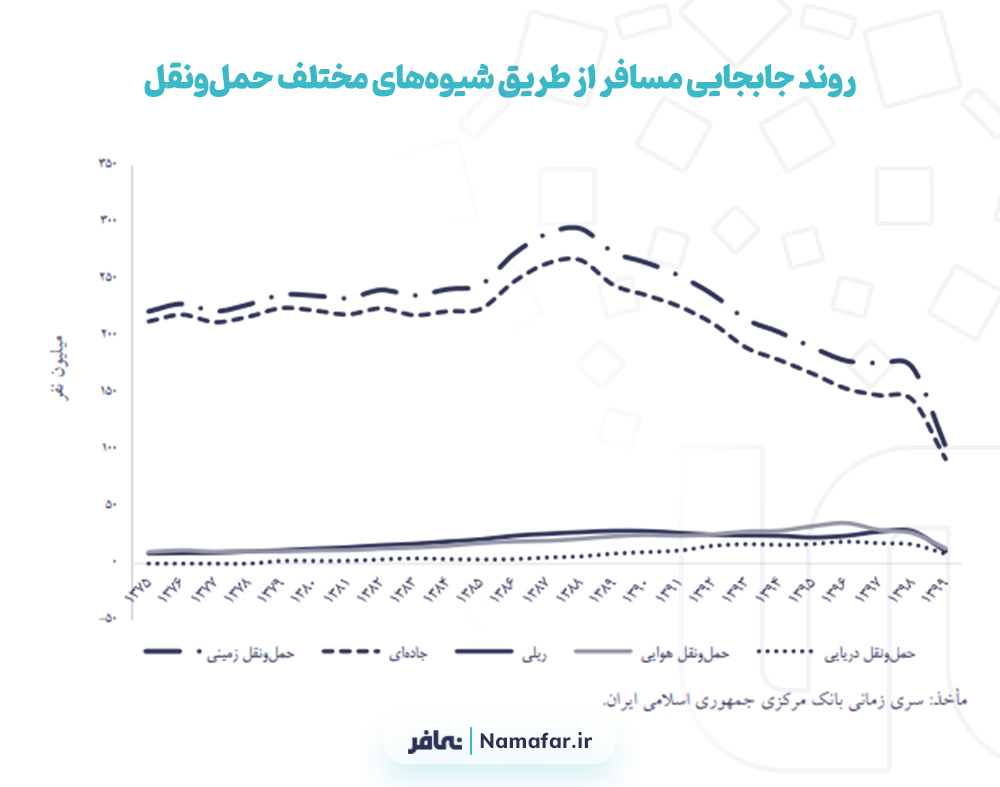
Chart 1: Trend of passenger movement through various modes of transport
Rail transport in most developed countries and also countries of the region has faced greater speed and transformation, especially in double-tracking electrification, high-speed railways and raising the productivity of rail transport, and the share of the railway in the fast and high-volume passenger and freight transport of other countries has increased greatly.
The average age of the country's intercity freight vehicles is about 17.5 years and the average age of intercity passenger vehicles, including buses, minibuses and hire cars, is respectively 13, 25.6 and 8.5 years. This situation, in addition to reducing the productivity of this sector, has caused an ever-increasing rise in fatalities and human and financial losses and has also increased the technological gap between Iran's transport sector and current global developments. Statistics indicate insufficient attention to the quantitative and qualitative development of the country's public transport. Over the course of each year, approximately one billion and 800 million person-trips take place; according to studies, from 1392 (2013/14) onward, specifically about 150 million person-trips have been lost from public transport and have declined each year; that is, a shift from public transport of this same amount toward private transport has taken place. In fact, we are losing passengers from road transport. These passengers also do not go to rail transport. A limited portion go to air transport, and the volume of movement at the public-transport level is constantly declining and being added to private transport. This issue, while increasing traffic and air pollution, has also increased road accidents and the deaths resulting from them, which in addition to increasing citizens' social dissatisfaction, its economic consequences are also substantial.
Status of per-capita rail transport domestically and a comparison of Iran's standing on this indicator with some developed countries
Rail transport is recognized as a safe, clean and low-consumption mode among other modes of transport. Among the important advantages of rail transport for economic development is facilitating producers' access to raw materials, intermediate goods and other resources, and also sending products to markets at low fares. A well-run railway supplies the services needed by many of the country's industries at costs far lower than road transport. Therefore this type of transport can facilitate trade, the realization of the economy and accelerating economic growth. This is while the initial investment cost for rail transport is heavy, and in most countries governments build the rail infrastructure. The chart below has compared the country's per-capita rail lines on indicators such as freight, passenger and transit in 1401 (2022/23) and 1402 (2023/24) based on the latest information available in the Statistical Yearbook of Rail Transport of the country.
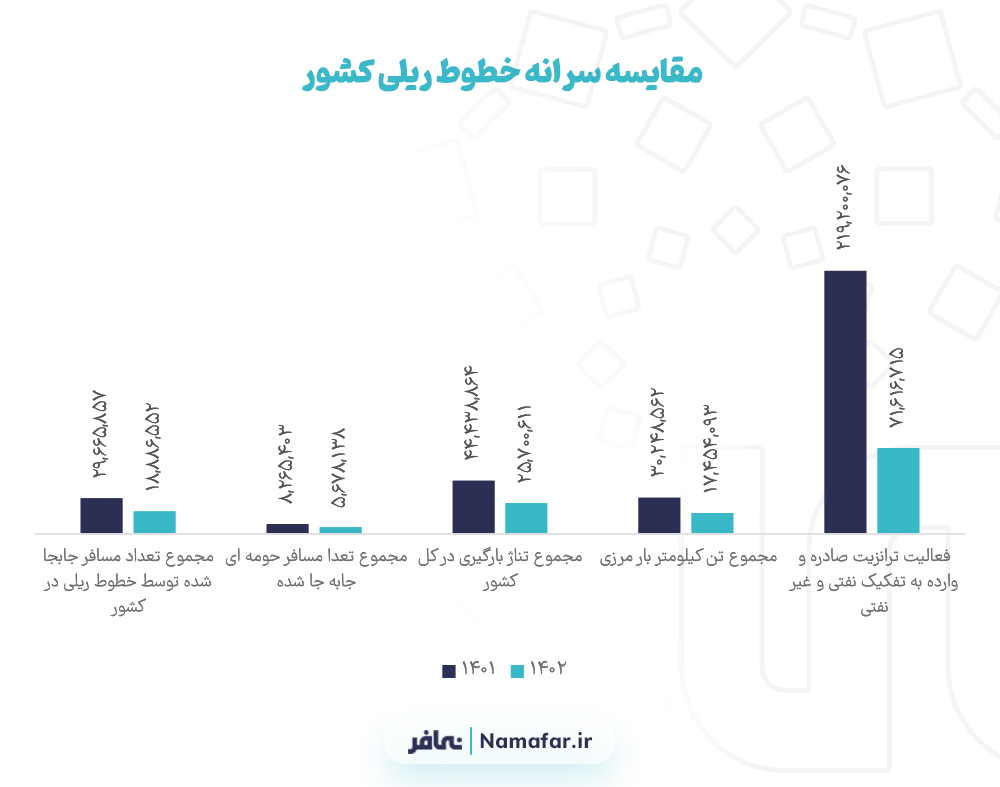
In the chart above the blue color represents the values related to rail transport indicators in 1401 (2022/23) and the orange color relates to the same values in 1402 (2023/24). As observed in the chart, rail transport on all indicators in 1402 (2023/24) relative to the previous year, namely 1401 (2022/23), has shown a downward trend.
Rail transport in most developed countries and also countries of the region has faced greater speed and transformation, especially in double-tracking and electrification, high-speed railways and raising the productivity of rail transport, and the share of the railway in the fast and high-volume passenger and freight transport of other countries has increased greatly. In the table below, Iran's rank compared with the 60 countries examined in rail transport in 2020 is presented. On this basis, Iran's worst performance, with rank 60 in the length of electrified lines, and its best performance, with rank 16 in "productivity per passenger coach" and "productivity per heavy freight locomotive", have been recorded.
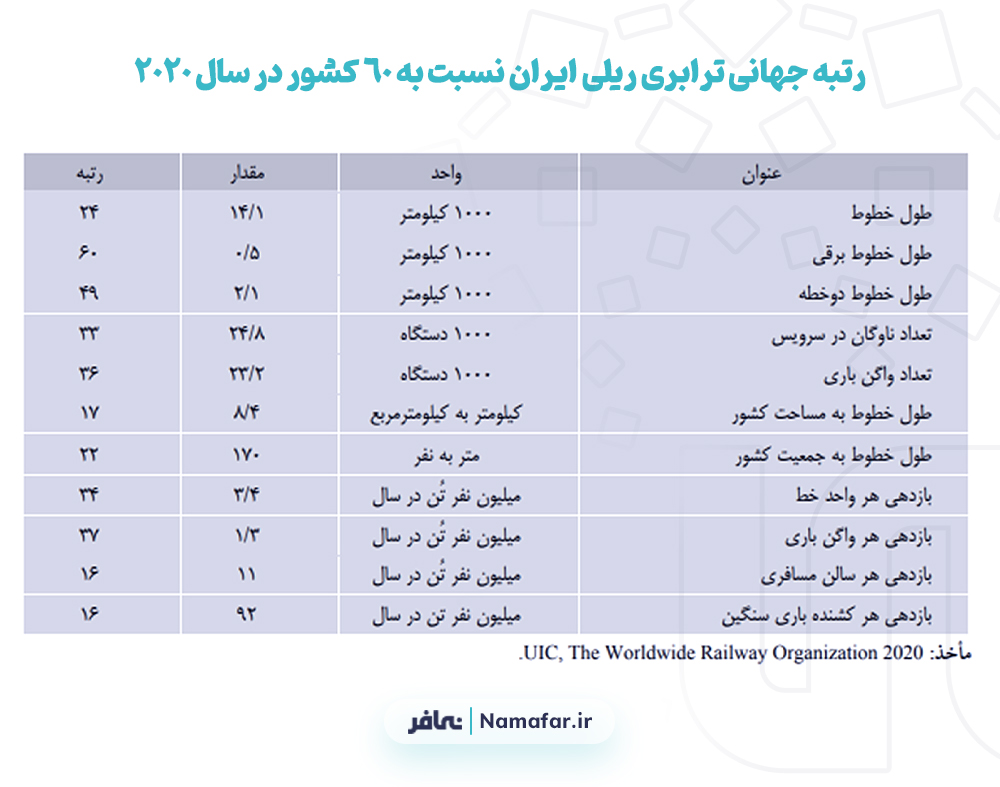
Table 1: Iran's global rank in rail transport relative to 60 countries in 2020
Also the chart below shows the share of the rail system of total freight moved in Iran and several selected countries. It is observed that the country's situation in the share of the rail transport system of the total transport system in moving freight relative to the countries examined is not favorable.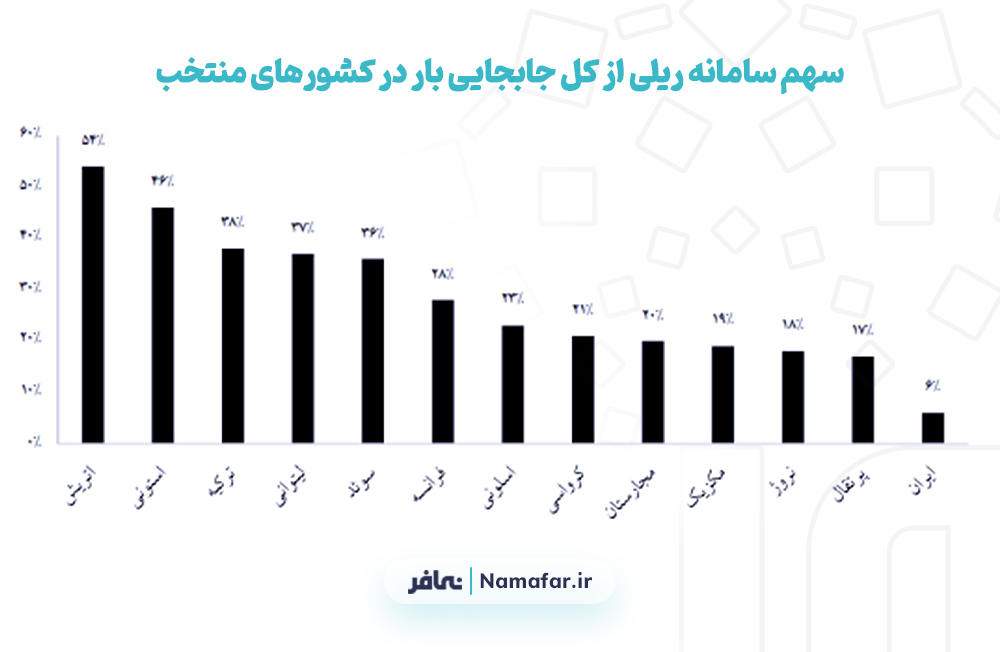
Chart 3: Share of the rail system of total freight movement in selected countries
It is worth knowing that the share of the rail mode of total freight carried by road and rail in Iran is about 6 percent, in China and India more than 30 percent and in Russia 90 percent. Unfortunately, for the reasons indicated, the productivity trend of Iran's freight wagons in recent years has been downward. Such that in the first three months of 1401 (2022/23) the average monthly productivity of freight wagons fell 13/5 percent relative to the same period of 1400 (2021/22) and 24/8 percent relative to the same period of 1399 (2020/21). Meanwhile, from the beginning of 2020 and with the coronavirus pandemic, the rail passenger sector in most countries of the world, following the health protocols put in place, faced a substantial decline in the number of passengers. Some countries such as Iran in 2021 have experienced an improving trend in this respect relative to 2020, but some others, especially European countries because of stricter restrictions, have been returning to normal conditions at a slower pace.Status of per-capita air transport domestically and a comparison of Iran's standing on this indicator with some developed countries
The country's air transport industry has structural problems, and these problems stem from the low quality of services and the high average age of the fleet. Fleet obsolescence causes an increase in the risk coefficient for passengers, an increase in the amount of flight delays or their cancellation, the lack of a fixed flight schedule for all cities of the country, the problem of supplying parts and spare parts, a decline in inbound tourists to the country because of the unsafety of flight routes, a decline in transit flights through the country's airspace and ultimately a decline in our people's use of this service. In general the obstacles to air transport are:
- The low rate of air tickets relative to cost price
- Legal monopolies
- Determination of aviation and airport tariffs by the government and the worn-out state of the air fleet
Iranian airlines on domestic and international flights: a performance comparison
In this section, the activity of Iranian airlines on domestic flights in 1401 (2022/23) has been presented in the form of various comparative tables and statistics. Also, the performance of these companies in terms of share and annual growth with respect to passenger movement, freight and mail carriage at the country's airports has been analyzed. In 1401 (2022/23), the airlines Mahan Air, Aseman, Iran Air, Airtour, ATA, Kish Air, Zagros, Taban, Karun, Meraj, Caspian, Qeshm Air, Pouya Air, Varesh, Saha, Sepehran, Fly Persia, Pars Air, Chabahar and Asajet undertook the carriage of passengers, freight and mail at the country's airports.
In general, 17,413,844 passengers, 535 tons of mail and 10,404 tons of freight were moved nationwide, which relative to the previous year (15,650,228 passengers, 535 tons of mail and 10,404 tons of freight) had an 11.3 percent increase in the passenger-movement sector and conversely in the mail and freight sectors had respectively a 39.1 24.9 percent decrease in performance.
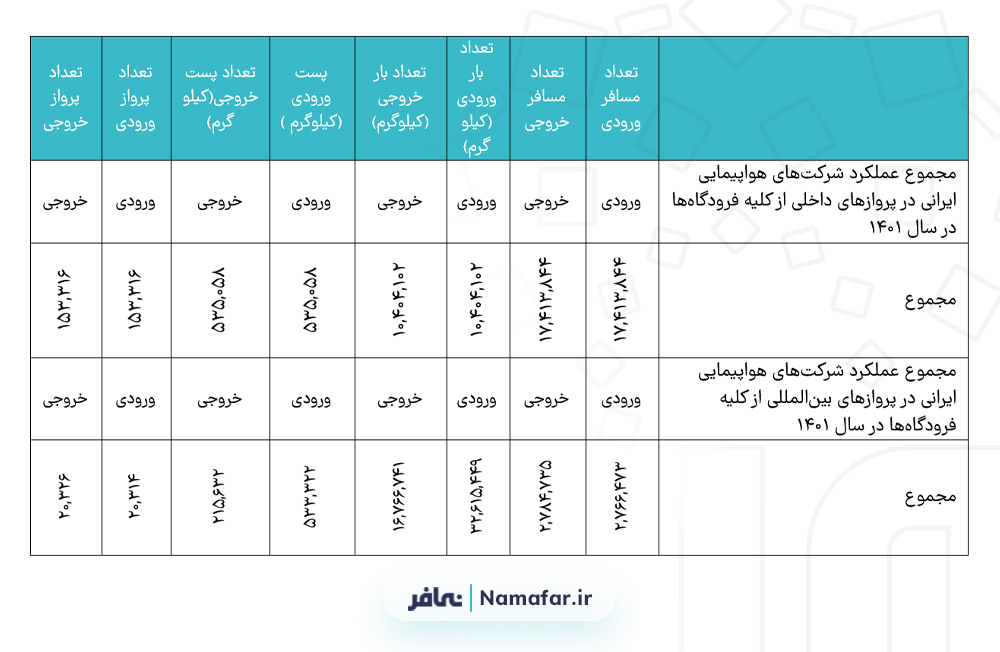
Also in the table below the total annual performance of domestic aircraft in terms of the passenger-number indicator in the two years 1401 (2022/23) and 1402 (2023/24) is compared.
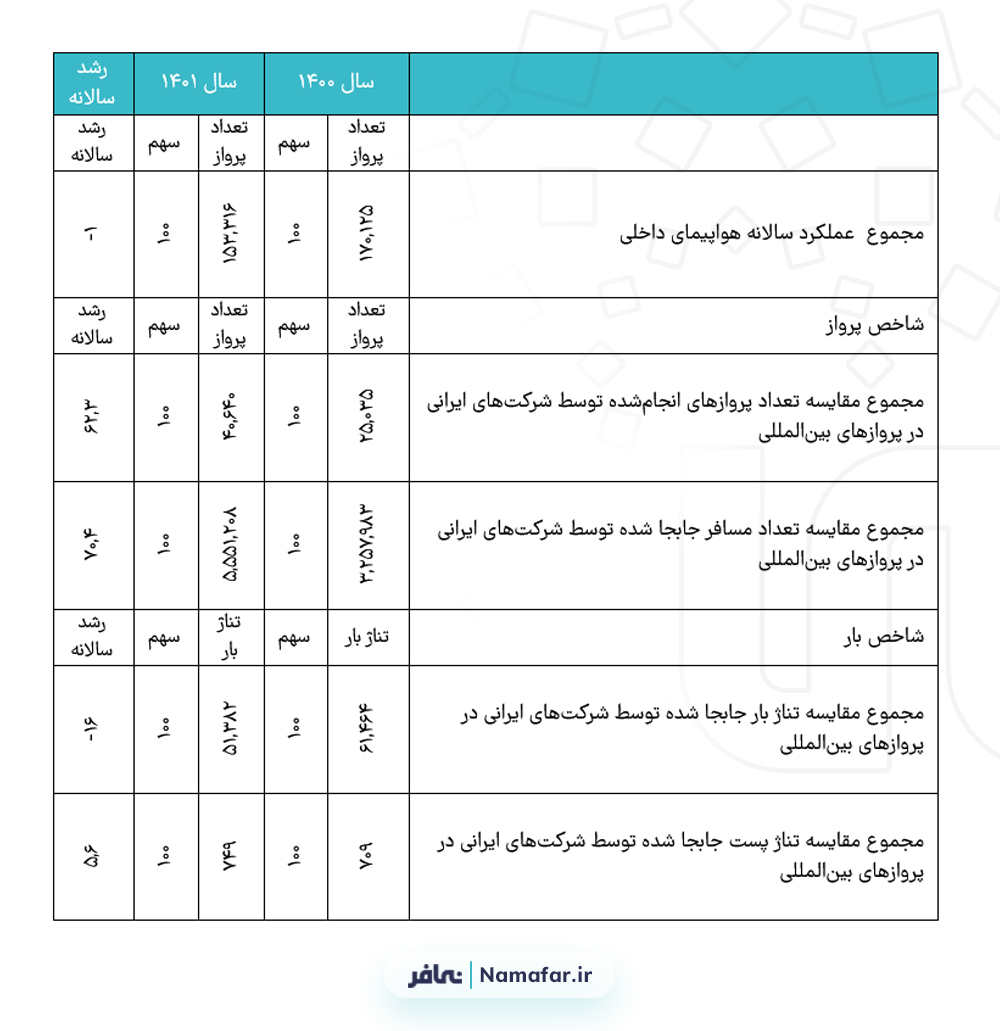
As observed in the table above, the total annual performance of domestic aircraft in 1401 (2022/23) relative to 1400 (2021/22) has shown negative growth. If we want to consider the indicators separately, annual growth on the indicators of number of flights performed and number of passengers moved and tonnage of freight moved in 1401 (2022/23) relative to 1400 (2021/22) has been assessed as positive. But on the indicator of tonnage of mail moved by Iranian companies on international flights, annual growth has been assessed as negative.
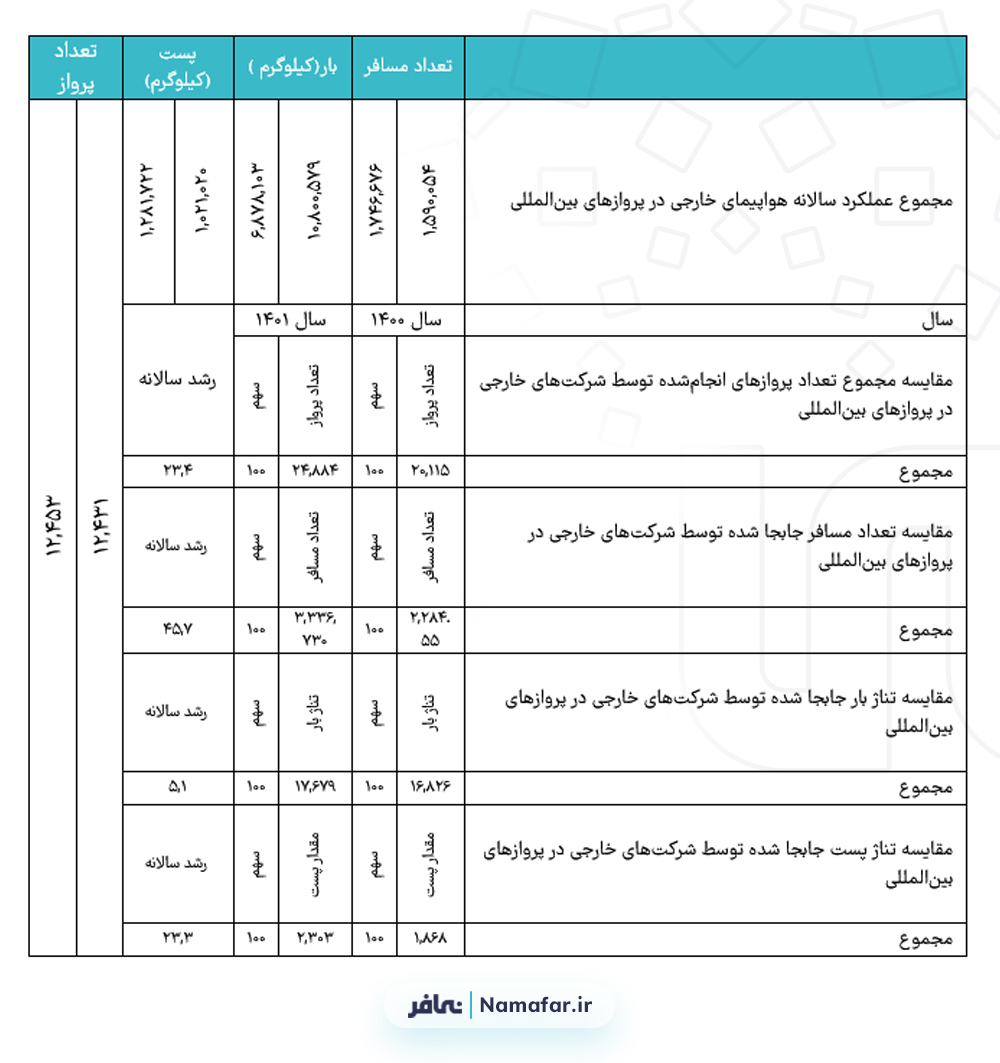
Also in the table above the total annual performance of foreign aircraft on international flights has been examined and evaluated. According to this table, the performance of foreign aircraft on international flights in Iran on all indicators including number of passengers moved, tonnage of freight moved and tonnage of mail moved on international flights of foreign aircraft in 1402 (2023/24) shows positive growth relative to 1401 (2022/23).
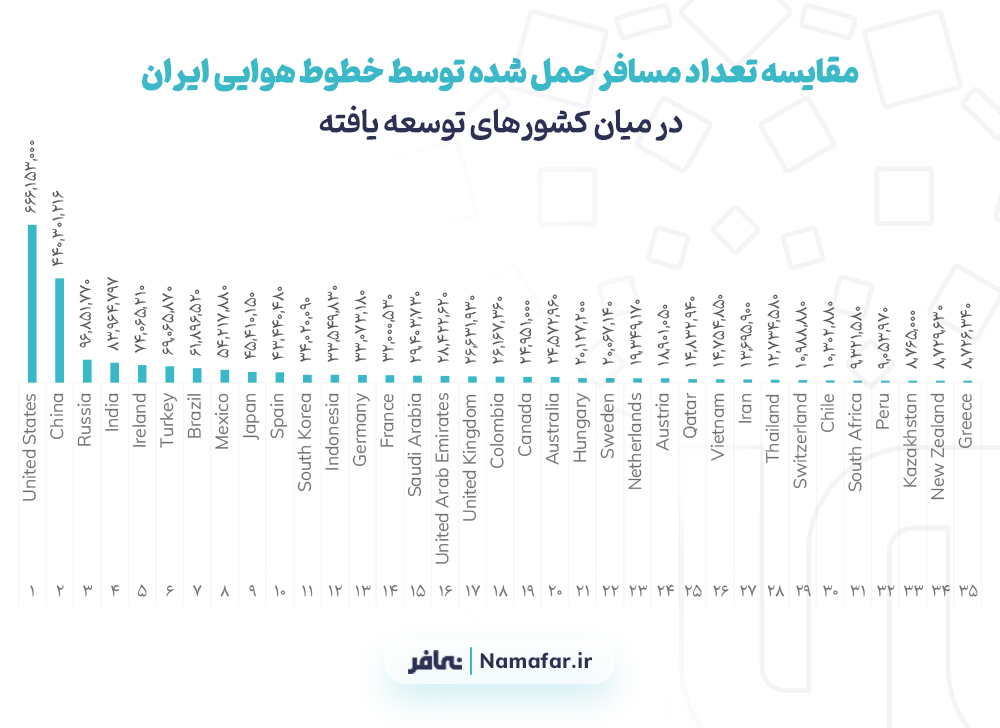
The chart above shows the standing of Iran's air transport among developed countries in 2021 based on information obtained from the World Bank. According to this chart, the United States of America, with a figure of 666 million, has accounted for the greatest number of passengers among the countries of the world. After that, China, with an amount of 440 million, has taken the second rank on this indicator. The third rank belongs to Russia with an amount of 96 million, and India with a figure of 83 million has taken the fourth rank. Meanwhile, Iran, with a number of 13 million flights, has taken rank 27 among these countries in 2021.
Status of per-capita road transport domestically and a comparison of Iran's standing on this indicator with some developed countries
As noted previously, the greatest freight movement in the country is carried out over land and via road. In the passenger-movement sector too, land transport via road has the greatest share in passenger movement. Therefore, the freight and passenger transport system, by a large margin relative to other modes of transport, relies on land transport and via road; land transport itself includes road and rail transport, and according to statistics obtained from the country's road transport system, the share of rail transport compared with road is very low. Traffic, air pollution and road accidents above the global average are among the consequences of Iran's transport system being road-centered.
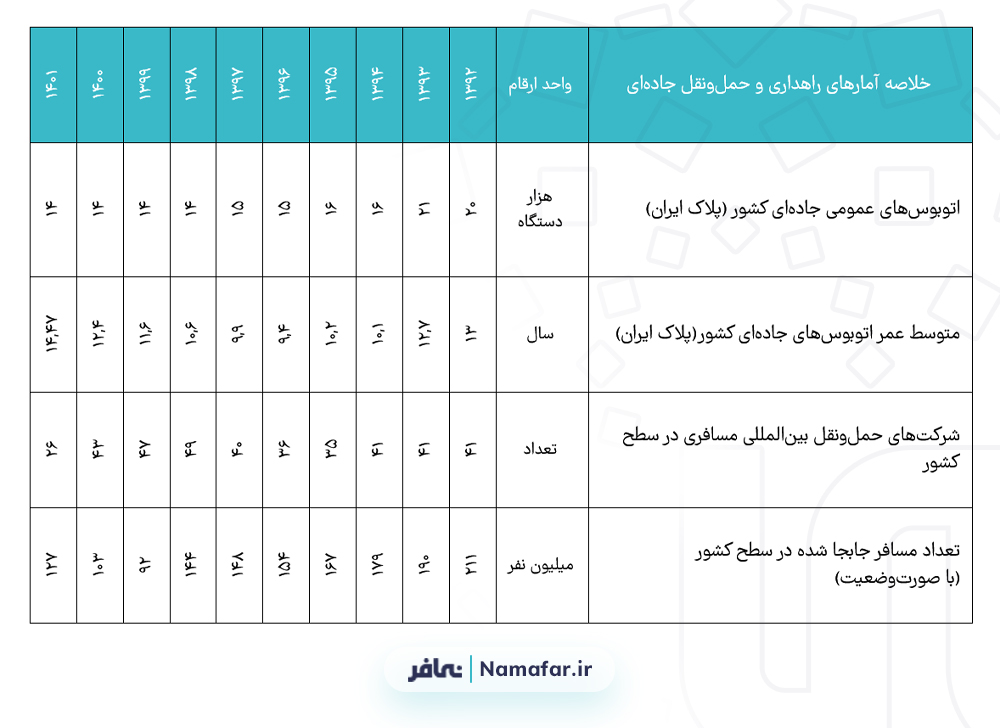
According to the table above, Iran's road transport statistics on the basis of the past 10 years, namely from 1392 (2013/14) to 1401 (2022/23), have been examined on some indicators. Based on this table, the number of road buses in Iran from 92 (2013/14) to 98 (2019/20) has had a downward trend. And from 98 (2019/20) onward their number has not changed. Also on the average fleet-age indicator, until 97 (2018/19) it had a good trend, but from 97 (2018/19) onward the values of this indicator have taken an upward trend. Certainly the circulation of these vehicles causes energy waste, reduced safety, increased pollution and repair and maintenance costs. This is while efforts have always been made so that, with various schemes, the age of the freight fleet in the country would fall below 15 years. In the passenger sector too, the average age of the passenger fleet including buses is about 15 years, and improvement of fleet-management methods under the supervision of the Ministry of Roads and Urban Development in recent years has caused the productivity of this field to increase. Such that the average distance traveled by the fleet in the past 5 years has increased from 52 thousand kilometers to 62 thousand kilometers.
Also the number of passengers moved via road transport in 92 (2013/14), which was reported as 211 million people, in 1401 (2022/23) has declined to 127 million people.
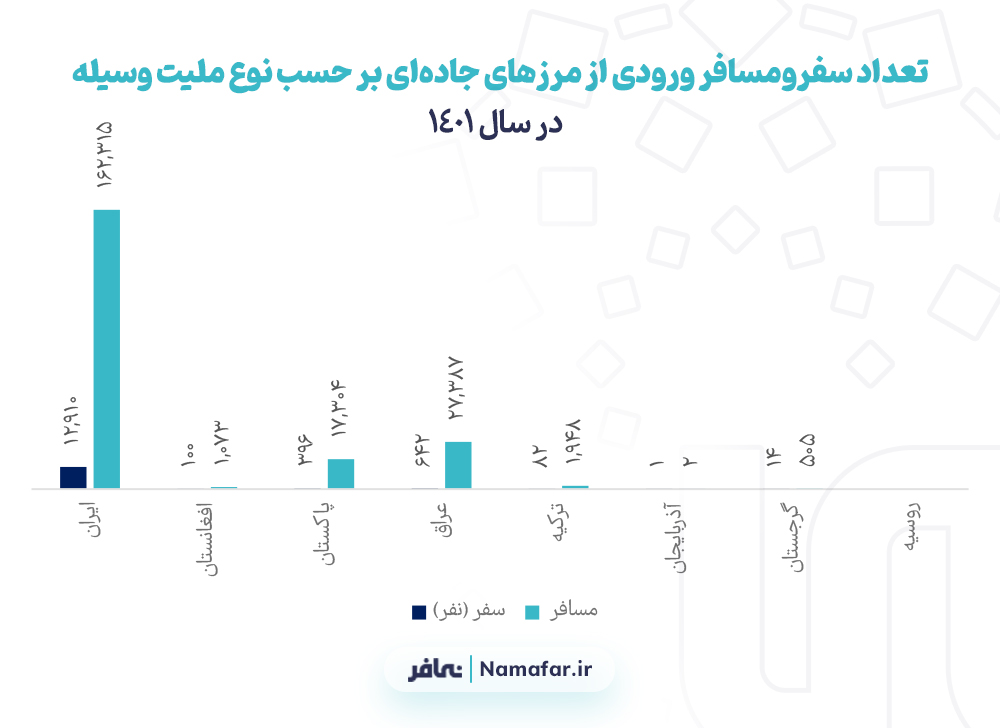
Also in the chart above, the number of trips and passengers that were moved via road transport (bus) in 1401 (2022/23) in Iran and other countries bordering Iran is compared. Based on the data of this chart, Iran on both indicators of trips and passengers moved via road transport has accounted for the highest amount among neighboring countries. These statistics indicate Iran's weakness in other modes of rail and air and maritime transport among other neighboring countries. The high statistics of road accidents and air pollution are among the side effects of the prominence of the road transport sector in the country.
Solutions for the development and improvement of the transport sector in Iran
In order to achieve greater productivity in the field of air, road and rail transport the following solutions are proposed;
- Facilitating processes and regulations for the presence of the private sector, financial support schemes for renewal, are among these items.
- Facilitating laws and amending regulations in the transport sector by the legislature
- Reducing political and non-expert pressures to obtain appropriations in order to develop in line with demand and avoiding non-expert prioritization of low-yield projects
- Interaction and coordination of the relevant agencies in order to solve the issue of supplying a suitable fleet; the lack of a suitable fleet will cause a decline in service quality and an increase in costs
Summary and conclusion
Today the importance of adopting a comprehensive and forward-looking view of the issues of the transport system as the country's vital infrastructure is hidden from no one. Given the sensitive position of the country of Iran on a cross-border scale, and its location on the region's transit artery and having a shared land border with seven countries and a shared maritime border with eight countries, there are many potential opportunities to focus and generate income and create employment in the country. On this path, removing political obstacles in order to develop trade exchanges and the possibility of mass-producing the transport fleet needed inside the country or facilitating their import are among the main needs of this sector.
Given the results obtained, a comparison of per-capita of the three sectors of road and land and air transport shows that the greatest freight movement in the country is carried out over land and via road. In the passenger-movement sector too, land transport via road has the greatest share in passenger movement. Therefore, the freight and passenger transport system, by a large margin relative to other modes of transport, relies on land transport and via road. Despite the importance of the share of rail transport in the country's economic development and reducing transport costs, Iran's share on this indicator is about 5 to 6 percent. And rail transport compared with road is very low. Traffic, air pollution and road accidents above the global average are among the consequences of the country's transport system being road-centered.
Statistics indicate insufficient attention to the quantitative and qualitative development of the country's public transport. Over the course of each year, approximately one billion and 800 million person-trips take place; according to studies, from 1392 (2013/14) onward, specifically about 150 million person-trips have been lost from public transport and have declined each year; that is, a shift from public transport of this same amount toward private transport has taken place. In fact, we are losing passengers from road transport. These passengers also do not go to rail transport. A limited portion go to air transport, and the volume of movement at the public-transport level is constantly declining and being added to private transport. This issue, while increasing traffic and air pollution, has also increased road accidents and the deaths resulting from them, which in addition to increasing citizens' social dissatisfaction, its economic consequences are also substantial.
A comparison of Iran's rank in rail transport in 2020 among 60 countries shows that Iran's worst performance, with rank 60 in the length of electrified lines, and its best performance, with rank 16 in "productivity per passenger coach" and "productivity per heavy freight locomotive", have been recorded.
The performance of Iran's air transport in 1401 (2022/23) shows that in general, 17,413,844 passengers, 535 tons of mail and 10,404 tons of freight were moved nationwide, which relative to the previous year (15,650,228 passengers, 535 tons of mail and 10,404 tons of freight) had an 11.3 percent increase in the passenger-movement sector and conversely in the mail and freight sectors had respectively a 39.1 24.9 percent decrease in performance. Also, Iran's air performance at the international level and in comparison with developed countries shows that the United States of America, with a figure of 666 million, has accounted for the greatest number of passengers among the countries of the world, and after that China, with an amount of 440 million, has taken the second rank on this indicator. The third rank belongs to Russia with an amount of 96 million, and India with a figure of 83 million has taken the fourth rank. Meanwhile, Iran, with a number of 13 million flights, has taken rank 27 among these countries in 2021.
In the road transport sector, the number of passengers moved in this way in year 92 (2013/14) was reported as 211 million people, while in 1401 (2022/23) it has declined to 127 million people. Also, the number of road buses in Iran from 92 (2013/14) to 98 (2019/20) has had a downward trend. And from 98 (2019/20) onward their number has not changed. On the average fleet-age indicator, until 97 (2018/19) it had a good trend, but from 97 (2018/19) onward the values of this indicator have taken an upward trend. Certainly the circulation of these vehicles causes energy waste, reduced safety, increased pollution and repair and maintenance costs.
And in conclusion, according to studies that have compared the standing of Iran's road transport with 7 countries bordering it, it is shown that Iran by a large margin has accounted for a large volume on the two indicators of trips and passengers (road) compared with other countries.
Somayeh Negini
Machine-translated from Persian by Namafar; the Persian original is authoritative. Read the original in Persian