Cultural and creative industries are receiving increasing attention from policymakers in various countries, and the development of the cultural economy is a concern of various governments in the field of culture. In our country too this matter is of interest, because concern for culture is an undeniable part of the country's policymaking body especially at the higher levels, and on the other hand the concern to create an independent and endogenous economy for the cultural arena, given the country's economic conditions and the state of the budget, is attractive to officials.
But the country is in an undesirable and chaotic situation in the governance of cultural and creative industries. Among the most serious evident harms in this governance is "multiple custodianship"; we are faced with numerous institutions that claim exclusive policymaking in the field of creative industries, from the Ministry of Culture and Islamic Guidance to the Ministry of Industry, Mine and Trade and the Vice Presidency for Science and Technology!
Add to the aforementioned harm the issue of the disarray of the country's cultural budget. The country's cultural budget in 1402 (2023/24) was reported as 74 hemt (trillion tomans) and was equivalent to approximately 3 percent of the total 1402 (2023/24) budget. Although the cultural budget almost every year has faced numerous controversies and questions are raised in the public sphere regarding how this budget is spent. But the well-placed question is this: the organization and raising of the productivity of this principal source of Iran's cultural economy is in the hands of which custodial and centralized institution? Is it not fitting that the dilapidated state of this strategic point of financing for the arena of culture and the arts be put in order? Not to mention that in cases such as recent approvals requiring agencies to allocate a percentage of their budget to the field of culture there is also an issue.
In circumstances in which we need a tangible transformation and advance in this field, this fragmentation of governance of the relatively nascent arena of cultural and creative industries inflicts serious harm on this strategic arena of culture. This situation appears more lamentable when we attend to the serious and concentrated programs of other countries, especially neighboring and regional countries, regarding the development of cultural and creative industries.
Successful countries in the orange economy
Here we mention several successful countries in the cultural and creative economy (known as the orange economy):- South Korea: According to the UNCTAD report in 2022, South Korea is the tenth leading creative economy in the world among "developed countries."
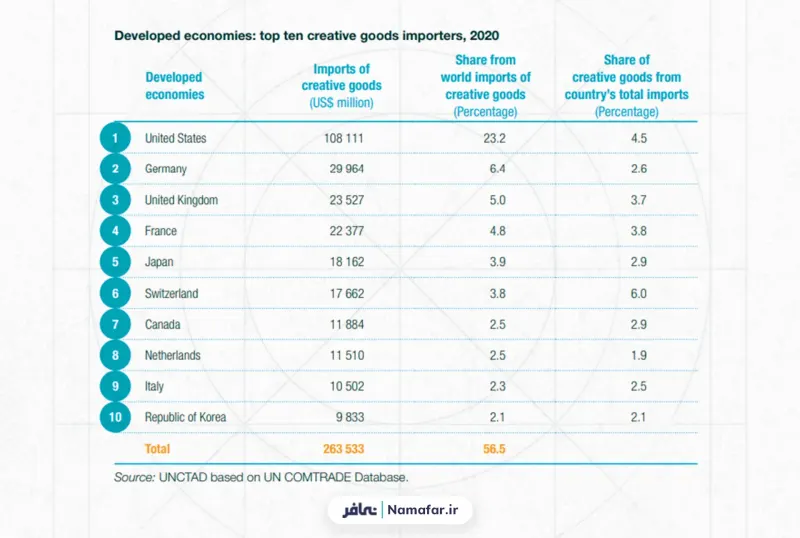
The Korea Creative Content Agency is one of the most important institutions of this country's creative economy. This agency, which has been established since 2009, by focusing on the generality of content fields such as music, animation, fashion and video games, has played a substantial role in the global spread of Hallyu, or the Korean cultural wave. Moreover the aforementioned agency, in line with its mission, has made special use of the capacity of startups and new technologies.
- England: This country too, as the third country in the aforementioned ranking, with the goal of becoming the world's center of creativity, has used the capacity of its "Department for Culture, Media and Sport" to realize this. The Ministry of Media, Tourism and Creative Industries under this department pursues England's national goals in the various branches of cultural and creative industries.
- China: This country ranks second in the creative economy of developing countries. This country, by placing the governance of its cultural industries under the custodianship of the Ministry of Culture, has pursued a set of measures to develop its cultural and creative industries. Among these measures is the establishment of the China Culture Industry Investment Fund.
- Saudi Arabia: This country has been introduced as the eighth leading creative economy among developing countries. The establishment of the General Entertainment Authority in Saudi Arabia is an important instance of this country's action to advance the governance of its cultural and creative industries. This authority was formed in 2016 in line with Vision 2030 of the Saudi Arabian monarchy and has stated the strengthening of activities and the economy related to leisure and entertainment as among its missions.
- United Arab Emirates: The third country on the latter list is the United Arab Emirates. The mission of pursuing the development of cultural and creative industries in the UAE has been entrusted to an institution under this country's Ministry of Culture and Youth. The said institution, which in this ministry's structure is known as "Special Assistant to the Undersecretary for Cultural and Creative Industries," itself comprises three pillars: the Department of Regulation of Cultural and Creative Industries, the Department of Promotion of National Cultural and Creative Industries, and the Department of the Creative Economy. The issue of cultural and creative industries is so serious and of such attention to the UAE government that it has also stipulated it in the mission of the Ministry of Culture and Youth. Moreover, in this same connection, it has prepared a strategic program with a ten-year outlook (for 2031) with the aim of developing cultural and creative industries.
An operational policy solution:
Creating a powerful driving institution for the governance of the cultural and creative economy:As was mentioned in the aforementioned global cases, many leading countries, by creating a concentrated and driving institution, have addressed the development of their cultural and creative industries. Therefore, with regard to these successful global experiences and also the necessity of resolving the challenge of chaos and multiple custodianship of the country's cultural and creative industries, let us devote ourselves to creating a single institution as the reference and driving custodian of this strategic and competitive field. This institution can achieve the capacity to organize and raise the productivity of the resources of the cultural economy, including the country's cultural budget, the budget arising from approvals requiring cultural spending by agencies, and also the budget obtained from companies' fulfillment of social responsibility.
But what characteristics should this driving institution have?
- Agility: This institution must have the agility necessary to play the driving role of the intended transformation in governance, and be free of the sluggishness and inertia of many of the country's existing cultural policymaking institutions.
- An appropriate position in the country's administrative and policy structure: This institution must have an appropriate position and authorities in the country's administrative and policy system so that, relying on it, it has the power necessary in advancing the administration of the affairs of this specialized field.
- The possibility of inter-agency activity and interaction: This institution must enjoy the necessary flexibility and the possibility of interacting with the various agencies and stakeholders of the field of cultural and creative industries so that, by adopting a networked approach to the aforementioned governance, it plays a role as the hub of this network.
- A cultural and creative nature: The nature of this apparatus, especially its human resources and its various management layers, must be cultural and creative so that it displays appropriate institutional action toward the ecosystem of the country's cultural and creative industries. Although this cultural nature does not mean denying the necessity of the presence of other approaches, especially an economic approach, in this apparatus.
In closing, a proposal worthy of raising and reflection is using the model of the "Vice Presidency for Science, Technology and Knowledge-Based Economy" to create the aforementioned driving institution. Perhaps using this model—which by the admission of people of various political tastes has had tangible successes—to create a similar institution, with titles such as "Vice Presidency for Cultural, Social and Culture-Based Economy," and that under the direct supervision of the presidency, would not be without merit. In truth, creating such an organization with this status similar to the Vice Presidency for Science can satisfy many of the characteristics necessary for a driving institution, while also forming a networked collaboration with other relevant institutions including the Supreme Council of the Cultural Revolution and the Ministry of Culture and Islamic Guidance, just as the Vice Presidency for Science has established such a relation with the Supreme Council of the Cultural Revolution and the Ministry of Science, Research and Technology.
Author: Mohammad Hossein Shafikhani
Short link: nmfr.ir/dpv
Machine-translated from Persian by Namafar; the Persian original is authoritative. Read the original in Persian