Pixar (Pixar Animation Studios) is an American animation studio and a subsidiary of the Walt Disney Company that made "Toy Story," the first fully computer-animated feature in history. Its headquarters is in Emeryville, California, and its emblem is that same small desk lamp that at the start of each of its films hops up and down on the letter I.
What does Pixar mean?
"Pixar" is a made-up word. The company's technical founders, Alvy Ray Smith and Loren Carpenter, were looking for a name for one of their graphics computers. Smith proposed a pseudo-Spanish verb meaning "to make pictures" (pixer) and Carpenter combined it with "radar"; the result was Pixar. The computer's name later became the name of the whole company.
Pixar at a glance
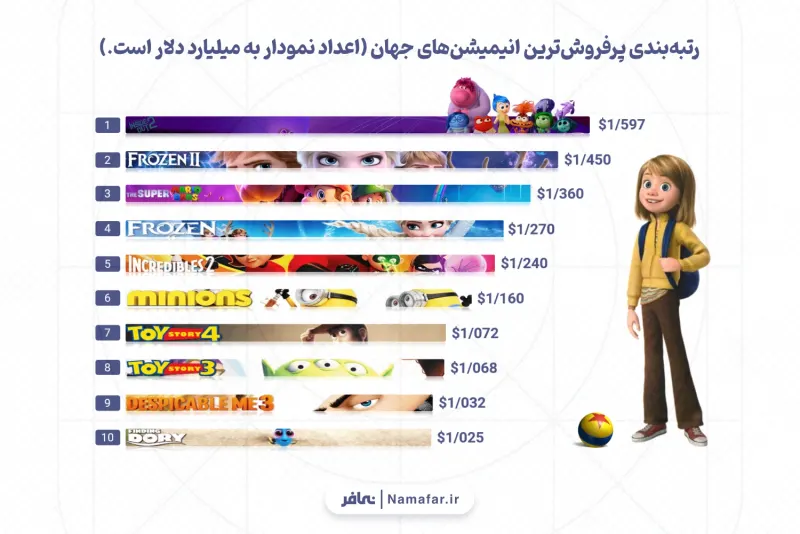
Pixar to date has made nearly thirty feature animations, and the worldwide box office of all of them together is more than $16 billion. Five of its films have each sold more than one billion dollars, and it has won the Academy Award for Best Animated Feature eleven times; more than any other studio since this award was created in 2001.
| Film | Year | Worldwide box office |
|---|---|---|
| Inside Out 2 | 2024 | about $1.7 billion |
| Incredibles 2 | 2018 | about $1.24 billion |
| Toy Story 4 | 2019 | about $1.07 billion |
| Toy Story 3 | 2010 | about $1.07 billion |
| Finding Dory | 2016 | about $1.03 billion |
A brief history of Pixar
Pixar was created in the 1970s (the 50s solar hijri) at the New York Institute of Technology (NYIT), where a team of computer scientists were working on computer graphics. Then Pixar was added to the filmmaking company Lucasfilm Ltd, the maker of the Star Wars franchise. In 1986 Steve Jobs, former CEO of Apple, bought Pixar from George Lucas, owner of Lucasfilm, for $5 million. In 1995 (1374) Pixar released the animation Toy Story, which was the first fully computer-animated feature and transformed the animation industry. Since then Pixar has released nearly thirty feature animations and dozens of short animations. In 2006, after several collaborations between Pixar and Disney, the Walt Disney Company decided to buy the Pixar company for $7.4 billion. The Pixar company is now a subsidiary of the Walt Disney Company and its CEO is Jim Morris.Worldwide box office; Pixar's winning card
In the Hollywood standard, films' box office is divided into two parts, domestic box office (Domestic Box Office) and worldwide box office. Comparing the domestic box office and worldwide box office of Pixar's works shows that most of the sales of Pixar's works have occurred outside North America, and worldwide box office has been one of the most important factors in the high sales of Pixar animations, and Pixar has been able to produce global works and attract diverse audiences from all countries to its works.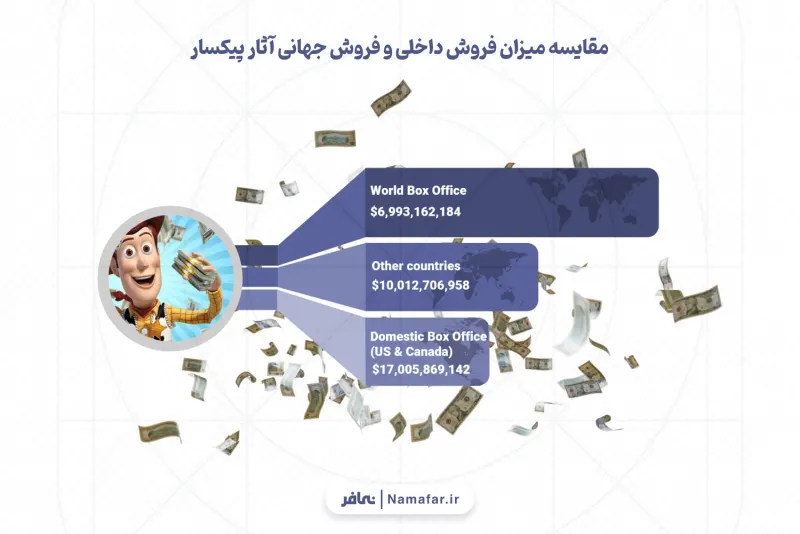
Pixar; combining an artistic and an industrial view of cinema
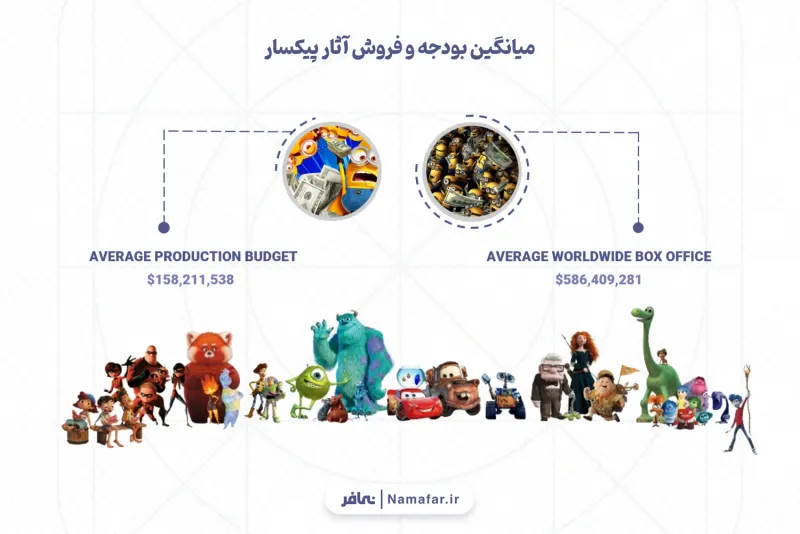
Pixar has been able, by combining an artistic and an industrial view of cinema, on the one hand to produce artistic works that have creative aspects, and also, given commercial and economic aspects and precise marketing, to achieve acceptable sales.The Pixar company, alongside various innovations and creativities in its animations, has on average invested $158 million (counting each dollar at 60 thousand tomans, equivalent to an amount of more than 9 thousand billion) to produce each animation, and also with precise marketing most of Pixar's works (except a few cases that were released during the COVID-19 pandemic) have reached profitability and on average have achieved about threefold sales ($586 million).
To create innovative and distinctive cinematic works, filmmakers must act boldly and use new and unexpected ideas. This requires that investors too, to support these projects, have greater risk-taking. Without risk-taking, the filmmaking industry will be limited to repeating previous works and producing commercial and clichéd films, and innovation and creativity will have no place in it.
In 1995, the world of animation witnessed an unprecedented revolution. Pixar, by releasing "Toy Story," the first fully computer-animated feature in history, opened a new page in cinema history. This extraordinary work opened a window onto a wondrous world; a place where toys came to life in the absence of humans and told their own stories.
"Toy Story" was more than a simple film. This animation not only won four Oscar nominations and the "Special Achievement Award," but also began a brilliant path for Pixar. The success of this work opened the way for three sequels, and its fifth installment was announced for 2026. But Pixar did not stop at "Toy Story" alone. This studio, by creating works such as "Inside Out," pushed the boundaries of storytelling and depicted deep concepts such as friendship, courage, family, and the importance of differences. Pixar, with an artistic combination of advanced technology and creative storytelling, taught its audiences to believe in their dreams, not to fear their differences, and to explore their inner and outer worlds.
Since 2001, when the Oscar for Best Animated Feature was created, Pixar has won this award eleven times: from "Finding Nemo" and "Ratatouille" to "Coco" and "Soul." It has also received numerous technical awards for its rendering and animation software.
Pixar's commercial success has also been as striking as its artistic achievements. Five animations from this studio, including "Inside Out 2," "Finding Dory," "Toy Story 3 and 4," and "Incredibles 2," have each had more than one billion dollars in sales and have been placed among the 50 highest-grossing films in cinema history.
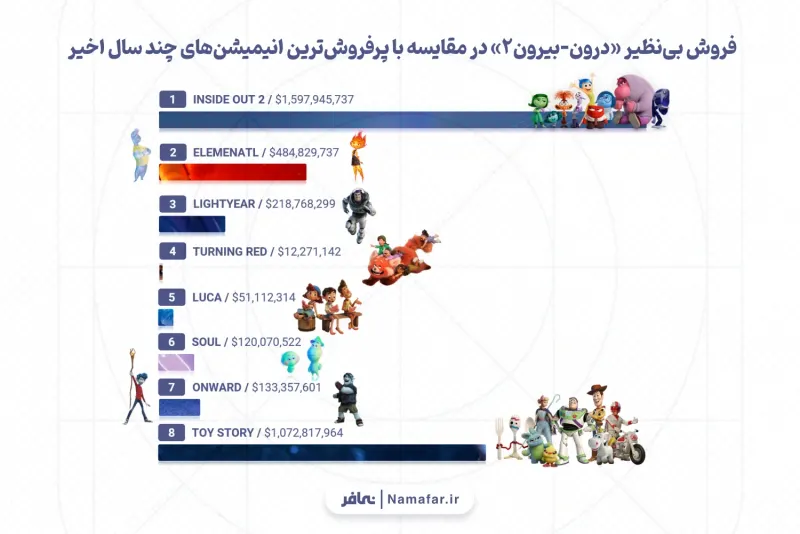
But Pixar's path has not always been smooth. The COVID-19 pandemic created a serious challenge for this studio. Animations that were released in this period faced a decline in sales. However, Pixar passed through this period with prudence and, with the release of "Inside Out 2" in 2024, rose again and made up for previous losses.
Pixar; a source of various revenues for Disney's media empire
Walt Disney has turned from a small animation studio into a vast media empire. This company, by buying large and small companies, gradually gained dominance over various parts of the entertainment industry. Disney today, besides its own animation studios, owns large companies such as Marvel, Lucasfilm, Pixar, and 20th Century Fox. This means that Disney has dominance over the world of Marvel superheroes, Star Wars, computer animations, and classic cinematic films. Also, Disney owns large television networks such as ABC and ESPN and has numerous amusement parks around the world. This extensive media empire enables Disney to offer its audiences a wide range of products and services and to have an audience at every age and taste. However, this extensive dominance has created concerns about monopoly and reduced diversity in the media industry.After the successful release of an animation, the production and sale of side products such as toys, clothing, books, video games, and so on become another source of revenue for Pixar. These products, using the popular characters and symbols of the films, achieve high sales.
The sale of television and online broadcasting rights of animations to television networks and online streaming platforms is another source of revenue for Pixar. Also, Disney, by launching the Disney+ platform, has made it possible for audiences to have direct access to Pixar animations.
Pixar, by granting licenses to use its characters and stories to other companies to produce various products, earns considerable revenue. For example, the use of Pixar characters in Disneyland Parks and food products are examples of this type of revenue.
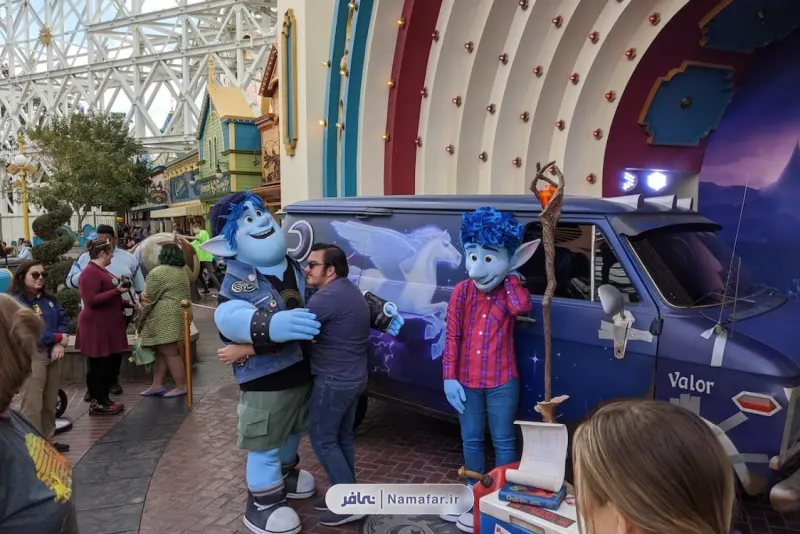
This company, by producing content and new attractions for Disney amusement parks, helps generate revenue for this part of Disney's business.
Pixar, using diverse and creative strategies, has been able to become a revenue-generating engine for Disney. This studio, by producing high-quality and popular animations, creating diverse side products, selling broadcasting rights, granting licenses to use its characters and stories, and producing content for amusement parks, has achieved considerable financial success.
Why did Pixar succeed?
Three things are repeated in most analyses. First, story: Pixar rewrites the screenplay many times, and a group of its directors (the "Braintrust") candidly critique early versions of one another's films. Second, technology: Pixar's rendering software (RenderMan) was for years the standard for Hollywood visual effects. Third, the global market: most of the sales of Pixar's films come from outside North America.
To compare Pixar with Disney, DreamWorks, and Ghibli, see the largest animation companies in Iran and the world.
Frequently asked questions about Pixar
Which country does Pixar belong to?
The United States. Pixar's headquarters is in Emeryville, California.
Who owns Pixar?
The Walt Disney Company, which bought Pixar in 2006 for $7.4 billion. Before that, Steve Jobs from 1986 was Pixar's principal shareholder.
What is Pixar's first animation?
Pixar's first feature film is "Toy Story" (1995). Before that Pixar made short films; the most famous of them is "Luxo Jr." (1986), that same desk lamp that became the company's emblem.
What is Pixar's highest-grossing animation?
"Inside Out 2" (2024) with about $1.7 billion in worldwide sales.
Machine-translated from Persian by Namafar; the Persian original is authoritative. Read the original in Persian