Imagine a virtual world in which billions of people, while in reality they are stretched out on the comfortable sofas of their own homes, live with one another in another world, work, shop, learn, and communicate. In this world, the computer screens that we use today to connect to the global information network have become a portal to a three-dimensional virtual realm in which everything is tangible; like a real life. The name of this world is the "metaverse," which does not yet exist. Everyone's curiosity about this term has grown so much in recent years that in 2021, searches for it on Google increased by 7200 percent; the year Facebook changed its corporate identity to Meta and announced it intended to invest at least 10 billion dollars in this technology. McKinsey research also indicates that in addition to Meta, other giants in the technology arena such as Microsoft, Google, NVIDIA, and Qualcomm will bring the value of the metaverse to 5 trillion dollars by 2030. But is it possible that, despite all the attractions and abundant profits, this virtual world has a dark side as well?
What is the metaverse world?
The metaverse is a three-dimensional digital space that, using technologies such as virtual reality and augmented reality, combines a person's online life with their real and simulated life. Neal Stephenson first used the term metaverse in 1992 in his science-fiction novel Snow Crash to describe a virtual world in which people live on the basis of the technical skills of their avatars.
In 2022, Lauren Lubetsky, a senior director at Bain & Company, at the MIT platform strategy summit, outlined three possible scenarios for the metaverse. According to the first scenario, the metaverse becomes a gaming and entertainment space for consumers; a space relatively far from cyberspace. In the second scenario, the metaverse is controlled by competing ecosystems—like the Meta worlds of Android and Apple—with limited interoperability. In the last scenario as well, the metaverse, just like the internet, forms an interactive, open, and dynamic space, but in three dimensions.
Marne Levine (Marne Levine), president of Meta's business division, says: "In the metaverse you will be able not only to teleport to any place, but also to travel in time. Suppose you have gone to ancient Rome. Imagine that you are standing in the streets, hearing the sounds, looking at the markets, and feeling up close the atmosphere of life 2000 years ago." The games Assassin's Creed Origins and Assassin's Creed Odyssey both offer a close experience of life 2000 years ago in various parts of themselves. Both games allow players to freely roam the vast designed worlds of Egypt and Greece, which includes standing in shops, observing famous mansions and structures, and even learning historical lessons from them. Now imagine that by putting on an augmented-reality or virtual-reality headset, you sense the world of these games up close and can interact up close with their characters and environment.

On this basis, and following the great appeal of the metaverse world, many depicted this world's ideas in their various books and films; as if they want to promise their audiences an emerging ideal world. For example, Steven Spielberg in 2018, adapting Ernest Cline's novel Ready Player One, depicts a future in which people, by entering the virtual world Oasis, escape their problems. On the other hand, the wider spread of smartphones and the popularity of games such as Pokémon Go have brought the metaverse closer than ever to the real world.
Meta's virtual reality: a major transformation at Facebook
On October 28, 2021, Mark Zuckerberg, founder and CEO of Facebook, in a live virtual conference informed his users of this company's name change to Meta. In his view, this change reflects major transformations for going beyond social media and entering the world of Web 3, cryptography (blockchain), non-fungible tokens (NFT), and the metaverse. Zuckerberg hoped that the metaverse, by attracting more than one billion people, would create a business worth hundreds of billions of dollars and hire millions of people in this decade.
From then on, Meta invested more than 63 billion dollars in virtual reality (Virtual Reality); including updated Quest virtual-reality headsets in which custom avatars (which were initially created without legs) wander in digital spaces; also a collaboration with the Ray-Ban brand to produce augmented-reality (AR) glasses. Such that virtual-reality revenue from these two segments, with 28 percent growth in the second quarter of 2024, reached 353 billion dollars.
Even so, the emergence and explosion of ChatGPT in November 2022 changed everything; of course Meta was prepared for it: this company's artificial intelligence research division, led by Yann LeCun, had been active for a long time. Such that in July 2024 Meta, by unveiling Llama 3.1, the largest open-source artificial intelligence model, acknowledged that other closed-source artificial intelligence models, including ChatGPT and Claude, had fallen relatively behind. According to the evidence, Meta intends to bring investment in this segment to 38 to 40 billion dollars, which by 2025 could even reach 50 billion dollars. Zuckerberg has said, "Artificial intelligence will affect almost every type of product we have." With all this, he did not give up his grand dreams for the metaverse. Such that after two-thirds of this company's value was wasted in 2022, Meta's share price almost tripled a year later and in 2024, with a 60 percent increase, reached 595.94 dollars per share.
A billion-dollar loss: the other side of Meta's virtual reality
Meta's ambitious move to be first in the world of the metaverse and virtual reality had another side as well, and that was billions of dollars in costs for this company; such that Meta's metaverse and virtual reality division (Meta's Reality Labs) incurred a 4.5 billion dollar loss in the second quarter of 2024, and that means more than 50 billion dollars in losses for this company since the launch of virtual reality.
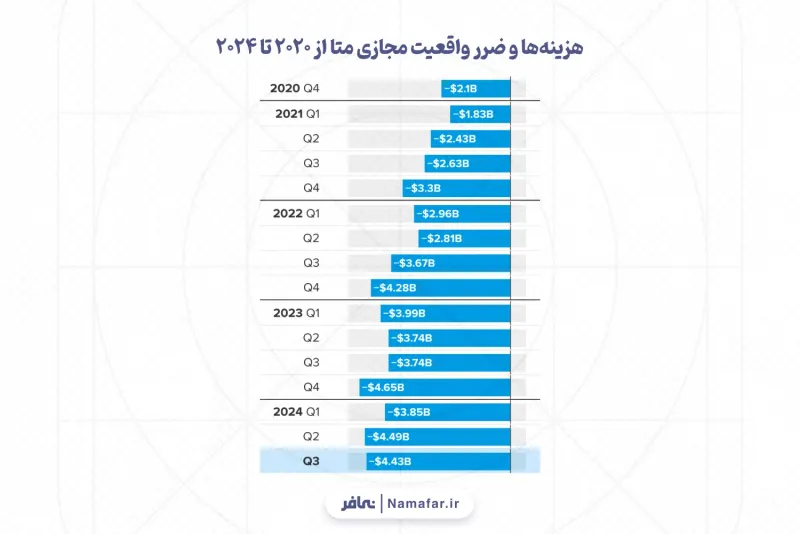
Reports show that while analysts expected Meta's virtual-reality revenue in this quarter to reach a figure equivalent to 310.4 million dollars, in practice this revenue reached only 270 million dollars. Instagram and Facebook have lost a larger share of their market, and the popularity of TikTok and Snapchat among adolescents has increased. Meta's main reason for these changes is the company's ongoing efforts to develop the product and investment to further expand Meta's virtual-reality and augmented-reality technologies.
This point and the failure of many ideas to materialize drew Zuckerberg's own attention as well. Mark Zuckerberg wrote in an email to his employees that he had regarded remote work, video calls, and e-commerce, which were the yields of the coronavirus era, as a permanent matter that would continue even after the end of the pandemic. "So I decided to increase our investments substantially. Unfortunately, this did not happen as I had expected; after the pandemic, it became clear that people still prefer meeting face to face or a video call to wearing an awkward virtual-reality headset and dragging a legless avatar into a virtual meeting room."
Meta tried in various ways, including workforce reductions (laying off more than 13 percent of the workforce, equivalent to roughly 11 thousand people), to reduce its costs; even though it still considers its current investments and their costs the right path. In this regard, Ash Jhaveri – vice president of partnerships at the virtual-reality labs – has said in an interview with CNBC: "Although we need more focus and oversight, this does not change the direction of our future efforts; it only helps focus its market more." But many Meta employees in an interview have reported that these measures are mistaken. In an anonymous survey, 58 percent of people regarding the widespread wave of employee layoffs said: "The metaverse is our slow and gradual death; Zuckerberg alone will destroy the company with the metaverse."
Analysts too in this regard have considered the presence of other powerful rivals such as Apple and its release of mixed-reality headsets another great danger facing Meta. On this basis Jhaveri believes that one of the goals should be reducing the costs of Meta Quest Pro virtual-reality headsets. Of course he says perhaps this will not happen anytime soon either, because this invention has been a huge upgrade in the history of technology: "If you look at every little component of this headset, you realize that the most advanced technology has been gathered in it. Almost like a computer."
He goes on, to better explain the future, to cite the example of the situation of flat-screen televisions:
"Do you remember 1999 or 2000, when flat-screen televisions came to market. The price of that 40-inch television was close to 10 thousand dollars, while it did not have high resolution either; but most people wanted this product, and now the price of this 70-inch television has reached 1800 dollars. We too have this path in mind; moving further toward consumer models. So we believe cost curves will decline in the future."
A possible future: the rise of a utopia or a dystopia?!
It has been predicted that by 2050 the metaverse will find high adoption across all strata of society. But this rapid transformation can provide the ground for a dystopia, not a desired ideal society.
Imagine a world in which the metaverse has blurred the border between in-person space and virtual space. Streets, without the presence of any individual, give way to virtual cities. Natural landscapes become merely a background for digital experiences, because the metaverse calls us to instant enjoyment of everything. In this dystopia, the work environment is nothing more than physical offices in which people are evaluated according to their digital performance. Social relations too are reduced to a collection of avatars and chatbots. Algorithms define friendship and love. Empathy and compassion diminish and give way to instant gratification, envy, and monotony. Privacy will no longer exist, because the data mining of this world will penetrate every corner of life.
In the shadow of this metaverse dystopia, even the most fundamental social institutions are transformed. Education is reduced to reconstructed experiences. Culture and art become more than ever a commodified matter, because the digital world leaves the least space for individual and artistic creativity.
Final word
In the present world, with the acceleration of technological transformations, the metaverse has become one of the most popular terms, a world in which the internet has found greater embodiment and blends real and virtual space more than ever. In the same direction, Facebook too, by changing its corporate name to Meta, made more noise in the metaverse world. Meta has invested more than 100 billion dollars in research and development in the metaverse world; but at the same time it has also inflicted many costs and losses on the body of the company: a loss of nearly 4.5 billion dollars in the second quarter of 2024. This has caused many to regard the rush toward the metaverse world as more accompanied by the emergence of a dystopia than an ideal society. In their view, trampling on human emotions is only one of the negative consequences of the expansion of this world. On this basis we can conclude that moving toward the metaverse world must also be accompanied by a complete understanding of its challenges and consequences; otherwise, apart from a dystopia, people drawing away from one another, and the imposition of great costs, it will yield nothing.
Machine-translated from Persian by Namafar; the Persian original is authoritative. Read the original in Persian