While the amount of traditional television viewing is continuously declining, estimates show that 99 percent of American households subscribe to at least one streaming service. The number of subscribers to the Netflix platform, which is known as the first VOD, has increased 14 percent relative to last year and has reached more than 282 million people. This striking growth indicates the rapid expansion of the use of video streaming services at the global level. These services, by providing the possibility of easy and fast access to desired content, have become an important part of content consumption practices in the digital age.
Why is streaming the future of content? From music to games and video
Over the past two decades, the method of content consumption has experienced fundamental changes and streaming (online broadcast) has become one of the main ways of accessing media. While in the past users, to watch a film, listen to music, or play video games, downloaded the content they wanted or obtained physical copies of it, today streaming technology has transformed this process. Video services such as Netflix, Disney+ and Amazon Prime Video, music platforms such as Spotify, Apple Music and YouTube Music, and cloud gaming services such as Xbox Cloud Gaming and NVIDIA GeForce NOW have provided users with fast access without the need to download. In addition, live streaming platforms such as Twitch and YouTube Gaming have made simultaneous interaction between gamers and audiences possible.
Streaming is the future of digital content. From broadcasting films and series to music and video games, this technology has changed how users interact with media. With increased bandwidth, improved internet infrastructure, and the development of artificial intelligence, streaming is expected in the future to become even more interactive, cheaper, and smarter. Therefore, it can be said that the era of long downloads and bulky storage has ended and everything is in the stream!
Video streaming has dramatically changed how digital content is accessed and consumed. With the progress of high-speed internet technology and the emergence of video-on-demand (VOD) services, users are now able to access video content at any time and place. These developments have rapidly caused the replacement of traditional media such as cable television and cinemas, and streaming services such as Netflix, Amazon Prime, and Disney+ have become the main players in the entertainment industry. The role of video streaming in the future, because of easier access to content and its diversity, is still growing and evolving.
This technology can be divided into two general categories: live streaming and on-demand streaming. Live streaming refers to providing content that is recorded and broadcast simultaneously, such as sports matches, live music events, and news. In contrast, on-demand streaming includes content stored on a server that users can access at any time, such as films and series offered on platforms such as Netflix (Netflix), Amazon Prime (Amazon Prime) and Disney+ (Disney+).
The value of the global video streaming market by the end of 2024 reached about 129.26 billion dollars, which indicates a considerable increase relative to the estimate of 106.83 billion dollars in 2023.
The market is predicted to continue its upward trend, with a compound annual growth rate of 21.5% from 2024 to 2030, which will likely reach 416.84 billion dollars by 2030.
At present, North America dominates the video streaming market and in 2023 holds a 31.6% share of this market.
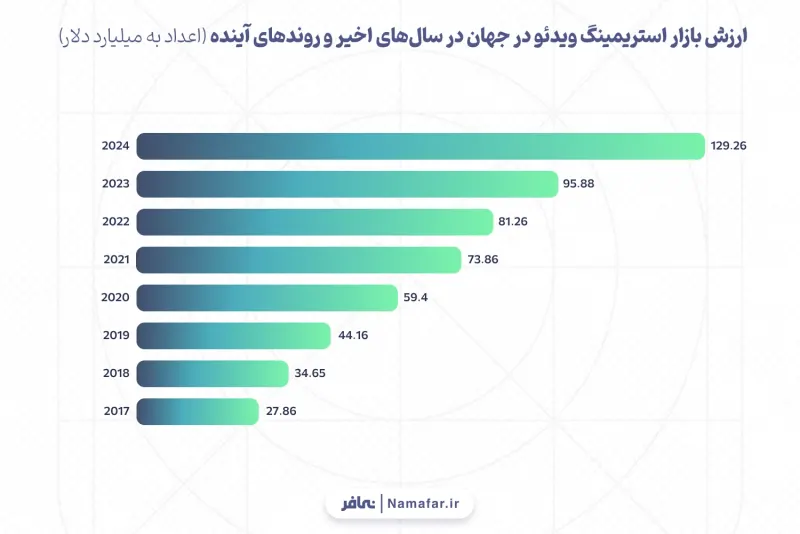
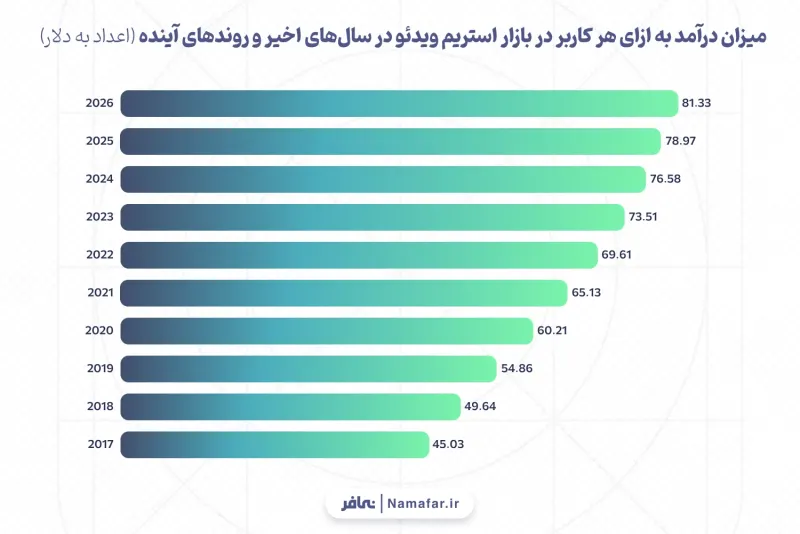
Average revenue per user in video streaming services has also, in an upward trend, reached its highest level in 2024, 76.58 dollars, and indicates the ever-growing growth and bright future of this industry.
VOD: the future of content consumption in the digital world
By the end of 2024, 1.4 billion people worldwide use VOD services; in comparison this industry in 2023 had 1.3 billion users, which indicates an estimated increase of 100 million VOD market users in 2024.
It is also predicted that in the coming years, in an upward trend, the use of video streaming services will increase and by 2026 will reach 1.6 billion people worldwide.
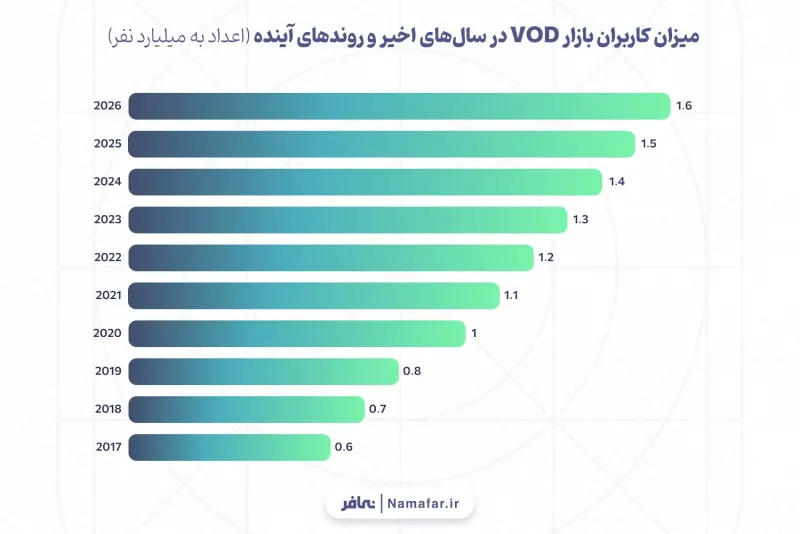
In today's digital world, VODs give users the ability to choose content and viewing time and in this way have been able to personalize the content consumption experience, and thanks to the progress of technology and the internet have become one of the most widely used methods of watching films, series, education, and news content.
VOD (Video on Demand) services have dramatically transformed how content is consumed by users and are becoming the main tool for watching films, series, and television programs. Compared with traditional media such as cable or satellite television that have a specified schedule, VOD services offer consumers unparalleled freedom and flexibility.
Consumers are increasingly moving toward personalized content experiences in the video broadcasting market, which indicates a desire for entertainment options tailored to individual needs. This trend is influenced by demographic changes, such as younger audiences who prefer to watch content on demand rather than traditional television programs.
The increased tendency toward binge-watching (watching content back to back) indicates a change in how digital content is consumed; people are looking for engaging narratives that align with their schedules, and this is driving platforms to invest in original series and localized content,
In Asia, localized content has become a necessity; in China, strict legal frameworks shape the availability of content and force platforms to create government-approved programs that align with local culture.
Post-COVID developments have had a deep effect on the entertainment industry and digital content consumption. Increased access to high-speed internet and the expansion of the use of smart devices have led to unprecedented growth in VOD users among diverse age groups and geographies. These changes, together with increased production of exclusive content, have caused video-on-demand platforms to consolidate their place in users' digital lifestyle.
The future of VOD services appears bright and growing. With the progress of communications technologies such as 5G internet, cloud processing, and artificial intelligence, these platforms will be able to provide a faster, higher-quality, and more personalized experience for users. It is expected that with increased competition among global and local platforms, investment in the production of exclusive content, and improvement of digital infrastructure, the video-on-demand industry will become more than ever one of the key components of digital media and entertainment.
The leaders of the VOD industry
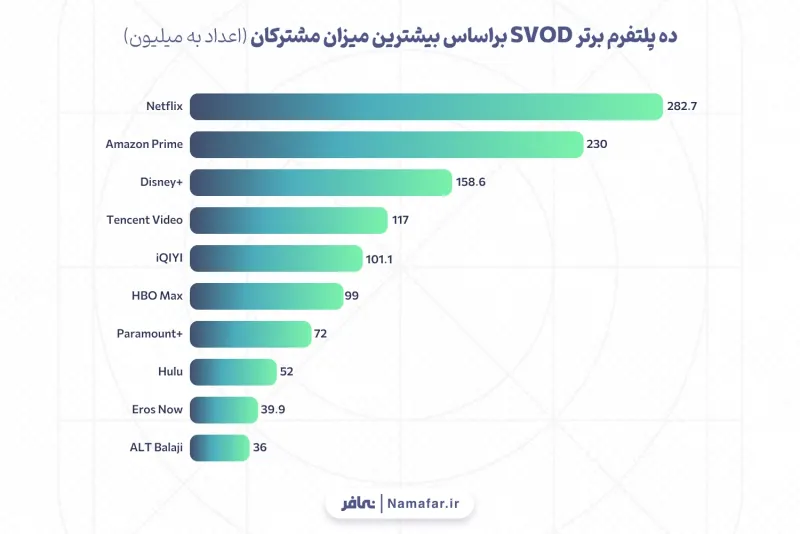
The Netflix platform, which is known as the pioneer and the first VOD service in the world, is still in the lead in its industry with the largest number of subscribers and currently has 282.7 million active subscribers. This company, by offering original content and diversity across various categories, has been able to maintain its position at the top of video streaming platforms. However, in recent years Netflix, with the entry of powerful rivals and new streaming services, has faced many challenges. One of its serious rivals is Amazon Prime, which with 230 million subscribers is in second place.
The Walt Disney Company owns the two platforms Disney+ and Hulu, which have respectively succeeded in obtaining third and eighth ranks in terms of number of subscribers at the global level. These two platforms in total have been able to reach 208.6 million subscribers. Disney+, by offering original and exclusive content from well-known brands such as Disney, Marvel, and Star Wars, has been able to quickly gain popularity among viewers. On the other hand, Hulu, with a focus on television content and up-to-date films, especially in the US market, has maintained its position among the major streaming rivals. This combination of content strategies and diversity in service provision has caused Walt Disney to still have an important place in the streaming and VOD industry.
Among the ten platforms with the largest number of subscribers, 7 platforms are American, 2 are Chinese, and 1 is Indian, a combination that indicates the United States of America's lead in the subscription video services industry and its dominance of the global streaming market.
By comparison, China, with popular platforms such as iQIYI and Tencent Video, each of which has more than 100 million active subscribers, has taken a notable position in the Asian market. On the other hand, India, with the Eros Now platform, which has nearly 40 million subscribers, has taken an important share of the growing digital content market in South Asia.
The United States, not only in terms of the number of successful platforms but also in content production and attracting global users, is at the top of the competition. However, the presence of China and India also indicates the rapid growth of Asian markets that, because of high population and widespread internet access, have considerable potential for the expansion of the streaming industry.
Video-on-demand services in Iran
In recent years, the video-on-demand (VOD) industry in Iran, by modeling global trends, is developing rapidly. With an increase in internet penetration, the expansion of smartphone use, and a change in users' digital content consumption pattern, demand for VOD services has also had striking growth. Although this industry in Iran faces challenges such as legal restrictions and weak content oversight, it has been able to take a considerable share of the digital entertainment market. Platforms such as Filimo and Namava, by offering diverse content including domestic and foreign films, exclusive series, and documentary programs, have succeeded in attracting a wide user base.
One clear example of this industry's growth is Filimo as one of the pioneers of the VOD field in Iran. This platform has been able, over four years, to increase film and series viewing 41-fold; such that the amount of content watched has gone from 700 million minutes in 1396 (2017/18) to 29 billion minutes in 1399 (2020/21). This upward trend indicates users' reception of video-on-demand services and a change in the digital content consumption pattern in the country. It is expected that with more investment in exclusive content production, improvement of internet infrastructure, the adoption of supportive policies, and effective content oversight, VOD services in Iran will have considerable growth in the coming years and become one of the main pillars of the digital entertainment industry.
Final word
In recent years, streaming (online broadcast), especially in the video domain, has faced unprecedented growth and has become one of the fundamental pillars of the media and entertainment industry. This progress is mainly the result of the expansion of access to high-speed internet, the development of new technologies, and a change in the digital content consumption pattern.
Statistics show that the number of users of streaming platforms has been continuously increasing, this industry's revenue has an upward trend, and related content productions have expanded strikingly. Meanwhile, video-on-demand (VOD) services, by offering the possibility of watching content at any time and place, have played an important role in accelerating these changes and have caused a broad transformation in how digital media are consumed.
Machine-translated from Persian by Namafar; the Persian original is authoritative. Read the original in Persian