Every year, after the budget bill is submitted to Parliament (Majlis), numerous reports on the status of various sections of the country's budget are published in expert and media circles. One of the important sections that needs attention is the country's cultural budget. Culture, as one of the essential and foundational pillars of the sacred system of the Islamic Republic of Iran, plays a vital role in social development and national identity. However, compiling and preparing a comprehensive statistical report on the budget allocated to the culture sector and other related sectors has always been a concern of considerable importance and necessity.
Study of the country's annual budget is important because a major part of the appropriations of the culture domain and related fields are budget-dependent, and funding is mainly provided by the government and annually through budget allocation. Therefore, analyzing and examining the Budget Laws and compiling the details of the budget allocated to various cultural sectors is an important step in assessing the quality and quantity of this sector's financing.
The distinguishing feature of the "Cultural Budget Brief: Institutional Review" compared with other reports on the country's cultural budget is that in this research, the budget of all institutions and organizations with a cultural nature and activity is counted under the budget of cultural institutions; even if that organization, from the standpoint of appropriation allocation, is under a non-cultural institution. Such as the Qorb-e Baqiyatallah Cultural Headquarters, which as a fully cultural organization operates under the Islamic Revolutionary Guard Corps and for this reason its budget in the official Budget Law has been placed under the defense affairs budget. Another difference of this research from similar studies is that the examination of the status of agencies' cultural budgets is conducted not in a single fixed year, but over time (1401–1403 (2022–2025)) so that the possibility of presenting a deeper analysis is provided.
The "Cultural Budget Brief: Institutional Review" consists of 298 pages and 3 sections (government institutions; sovereign institutions; non-governmental–sovereign institutions), and in each section the details of the status of agencies' cultural budgets over the years 1401 to 1403 (2022–2025) have been addressed, and it can meet the needs of researchers, policymakers, and cultural practitioners.
Overall status of the cultural budget allocated to institutions
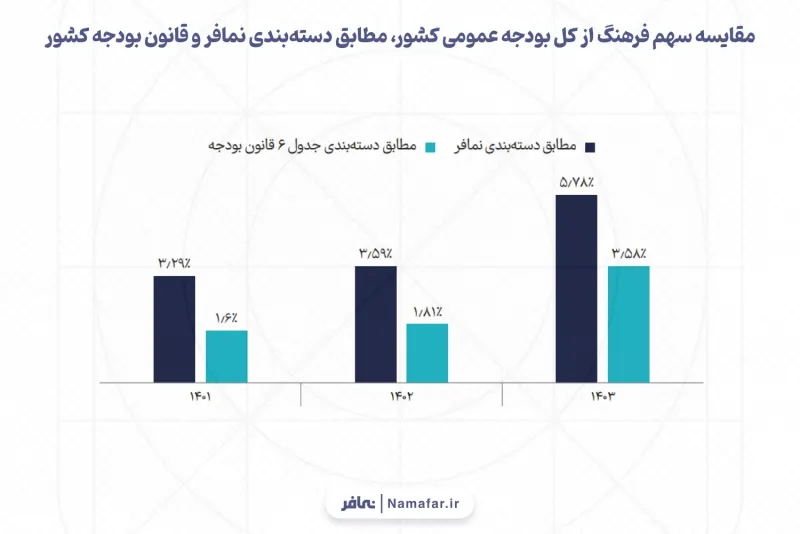
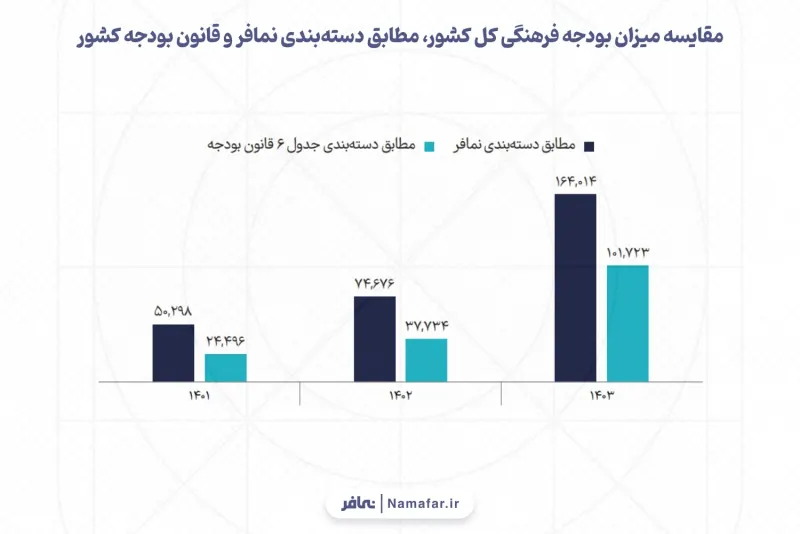
Namafar's policy research and data analysis group, in compiling this report, has examined all sections of the Budget Law of 1401 to 1403 (2022–2025); such that various cultural expenditures in unrelated chapters such as defense, higher education, and so on have also been reflected in this research. For this reason a significant discrepancy is observed between the cultural budget reported on the basis of the conventional categorization of "Culture, physical education and tourism affairs" according to Table 6 of the Budget Law, and the cultural budget according to Namafar's categorization.
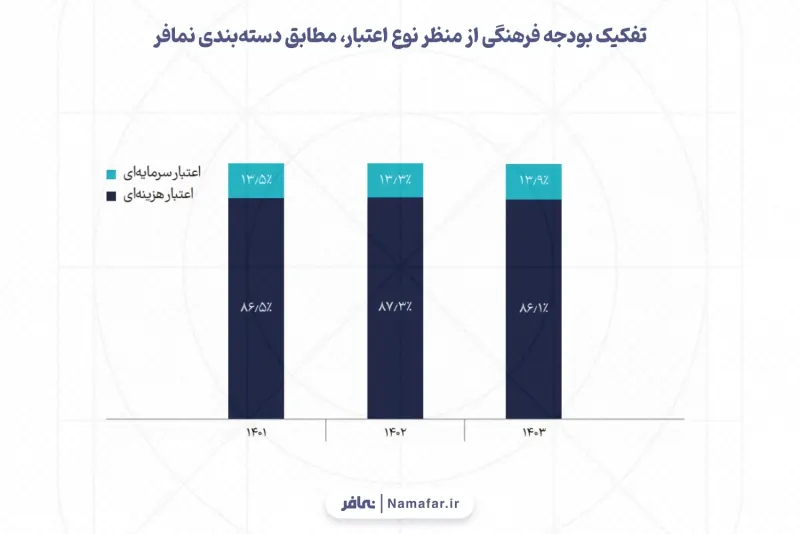
Budget uses, according to type of use, are divided into two categories of "current" and "acquisition of capital assets." Current uses include the current expenditures of the government and agencies, a large part of which is salaries and wages. Acquisition of capital assets generally includes the country's construction expenditures and infrastructure development. Given the explanations provided, the overall picture of the type of budget uses over the years 1401 to 1403 (2022–2025) is as follows:
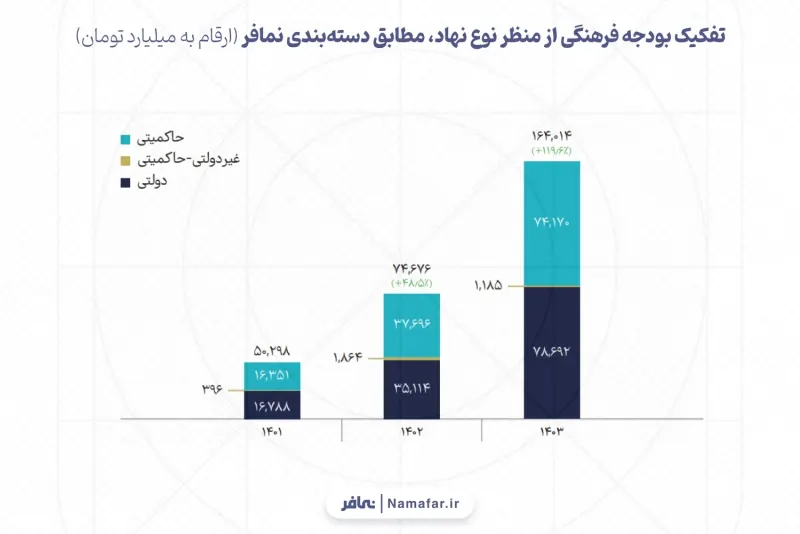
Based on the examination conducted of the Budget Law, in 1403 (2024/25) government agencies have accounted for the largest share of the country's total cultural budget. Among government agencies, the "Ministry of Culture and Islamic Guidance and institutions related to it" has the largest amount of cultural budget, with a figure of about 18 thousand billion tomans. After government institutions come sovereign institutions, and among these institutions, "IRIB (Islamic Republic of Iran Broadcasting) and related institutions," with a figure of about 29 thousand billion tomans, has the largest share among sovereign institutions. At the end are non-governmental–sovereign agencies, to which only about 7/0 percent of the country's total cultural budget has been allocated.
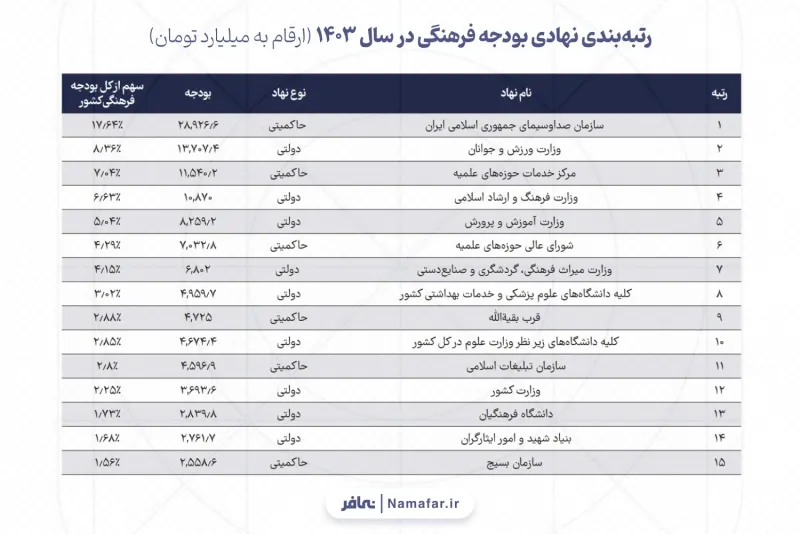
The analysis presented above has been of the agencies with the largest cultural budgets broken down by government, sovereign, and non-governmental–sovereign institutions. In Table 1, the country's first fifteen agencies with the largest allocated cultural budget in 1403 (2024/25) (without a breakdown by type of institution) are presented.
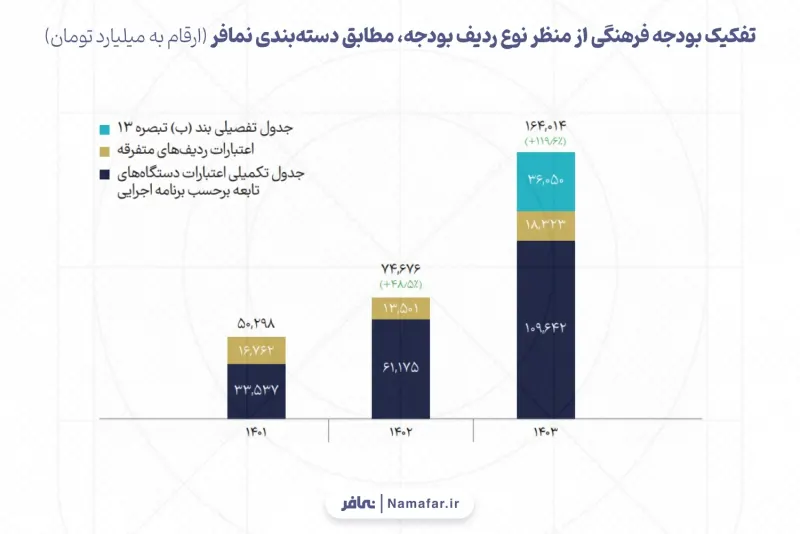
Another issue that has caused a difference between the amount of cultural budget calculated by Namafar and other conventional reports in this field is the examination and addition of "transferred miscellaneous appropriations" and also "facilities under clause (B) of Note 13 of the Budget Law," which although sometimes the receiving agency of the appropriation is not specified, because they are allocated in the arena of cultural programs, they have also been mentioned in the statistical calculations of this research.
Machine-translated from Persian by Namafar; the Persian original is authoritative. Read the original in Persian