For several years the subject of the country's budget has been one of the events that both receives media attention and is a matter of public discussion. The country's budget bill, from the moment it is submitted by the government to Parliament (Majlis) until the amendments and approval of the document, is prominent news among the public. For this reason it can be said: the subject of the country's budget is one of the items of news that is put up for discussion in the public sphere and among public opinion. But a precise and comprehensive examination of the budget document in various sections and affairs, including the culture section - which happens to be the most attended-to section of the budget among the public - is of high importance. Precise attention to this subject, in addition to transparency and answering questions and resolving ambiguities raised in public opinion, can create a comprehensive and sound understanding for policymakers, agents, officials and those in charge and practitioners in the field of culture. In this connection, Namafar's policy research and data analysis group, with a comprehensive approach going beyond the official categorization of the Budget Law, has dissected the culture section budget on the basis of the 1402 (2023/24) budget document, in a comprehensive and new categorization, the result of which is the "Thematic Culture Budget Brief report". In this report, in addition to a comprehensive and new categorization of the culture section, the share of each topic from the budget has been specified precisely.
How much is Iran's cultural budget?
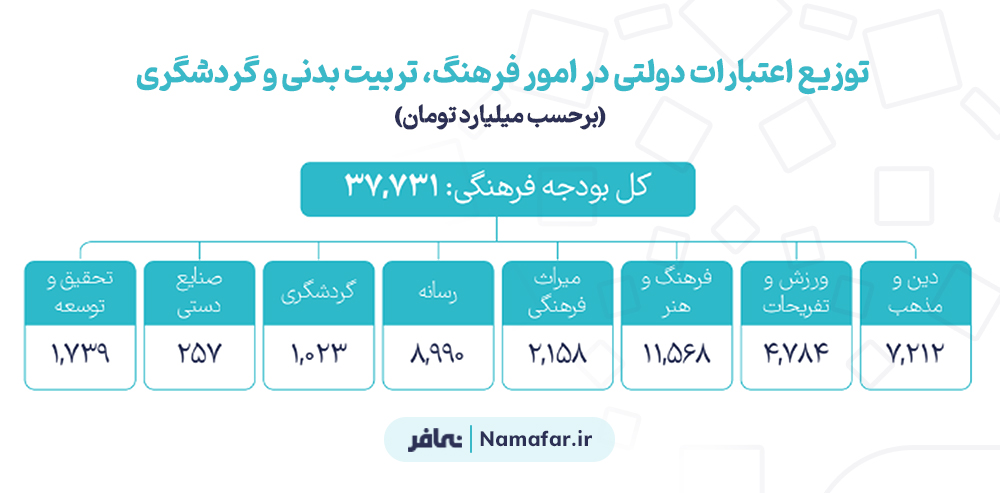
In the official categorization of budget laws, what is counted as the cultural budget appears under the title "Culture, physical education and tourism affairs". The thematic subcategories of the "Culture, physical education and tourism" section, which are designated as "chapters", include the chapters "Religion", "Sports and recreation", "Culture and art", "Cultural heritage", "Media", "Tourism", "Handicrafts" and "Research and development in culture affairs", "Physical education and tourism". The image below shows a view of the chapters defined under "Culture, physical education and tourism affairs" in the Budget Law of 1402 (2023/24).Among the most important indicators for describing and assessing government appropriations in the field of culture is the share of each of the topics from the appropriations. On the basis of this categorization, the country's total cultural budget is 37,731 billion tomans. Figure 1 shows the structure of this categorization and also the amount of government appropriations specified for each of its sections.
Why has Namafar presented a new categorization for the cultural budget?
Namafar has set aside the aforementioned official categorization, which is used every year in the country's budget laws, and a new thematic categorization has been defined. Among the reasons for designing a new categorization and replacing it in place of the official categorization, by Namafar, is the existence of some cultural line items in non-cultural affairs of the Budget Law. For example, in the country appropriations have been allocated for cultural issues related to family and women, which fall entirely under public culture, but in the Budget Law they have not been counted under the culture section. Also similar to the above case, a considerable part of cultural appropriations, solely because the receiving agency is military, has been defined under defense affairs and in the official definition is not counted as included in the cultural budget. Another factor in designing a new categorization for the thematic breakdown of Iran's cultural budget is the need to make transparent the appropriations of some particular and indeed important cultural fields such as family, the budget of culture-based industries and so on, for a more precise understanding of the structure of the cultural budget.
Namafar's classification includes 12 macro topics and 40 subcategories
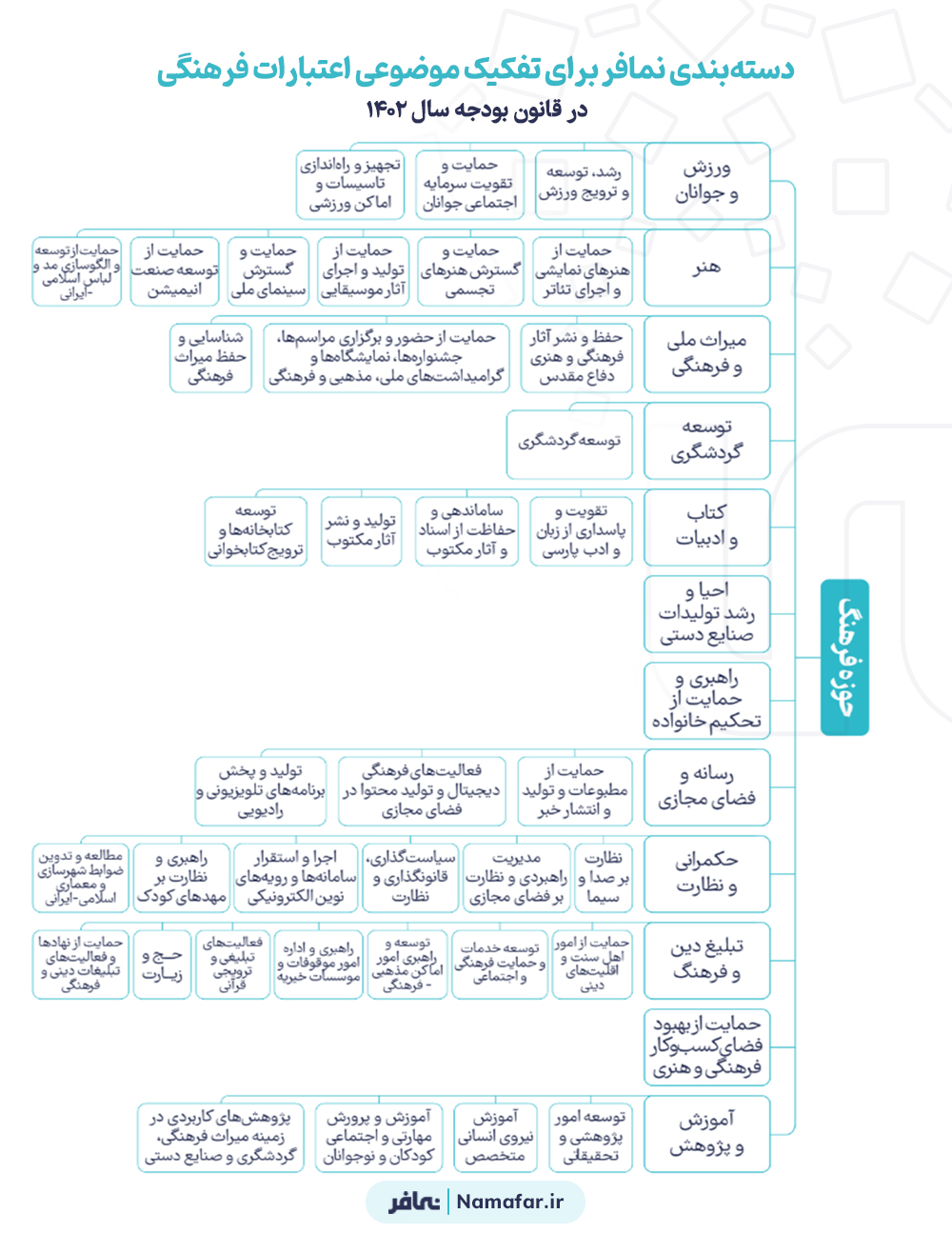
To discover culture's precise share of the country's budget, the most important step is precise and comprehensive identification of the domains that fall under culture. For this reason a new categorization has been defined which, in addition to enumerating some key cultural concepts, is not limited in scope solely to "Culture, physical education and tourism affairs" as one of the ten sections of the budget, and from every section of the Budget Law a part of it has been identified and displayed as cultural budget. In designing the new thematic categorization, key topics were identified and each was defined as a separate subtopic. After defining these subtopics, by examining the content of all outputs of the nationwide Budget Law, these outputs were defined in one of these topics. Finally, subtopics that had the greatest thematic affinity with one another were defined in one topic. In this way 40 subtopics and 12 macro topics were created. On this basis, topics such as "Stewardship and support for family consolidation" and "Governance and oversight in cultural affairs" are topics to which budget has been allocated but which are not seen in the official categorization of the Budget Law.
The country's cultural budget is 74,673 billion tomans
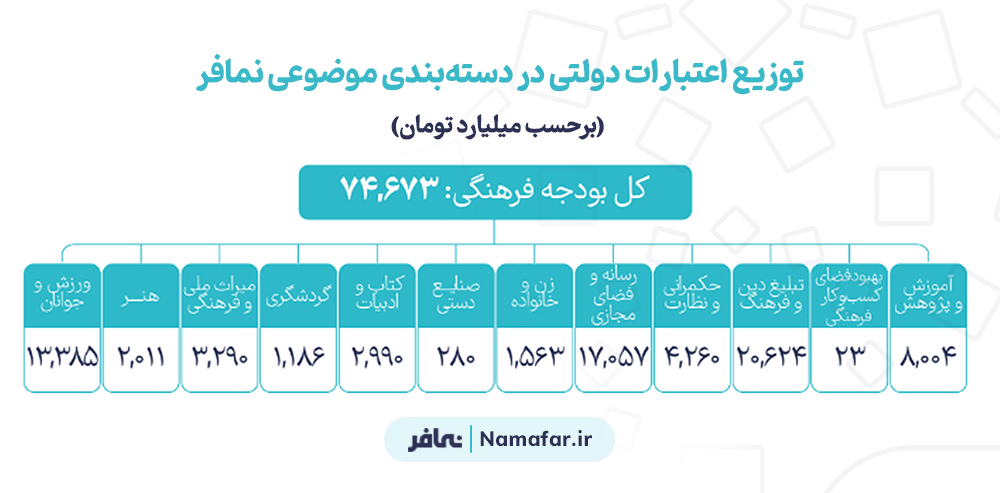
As mentioned, Namafar has categorized the culture section budget into 12 macro topics "Sports and youth", "Art", "National and cultural heritage", "Tourism development", "Books and literature", "Revival and growth of handicrafts production", "Stewardship and support for family consolidation", "Media and cyberspace", "Governance and oversight", "Promotion of religion and culture", "Support for improving the cultural-artistic business environment" and "Education and research", by topic. On the basis of this classification the country's total cultural budget is 74,673 billion tomans. Figure 3 shows the structure of this categorization and also the amount of government appropriations specified for each of its sections.
Which topic has the largest share of the cultural budget?
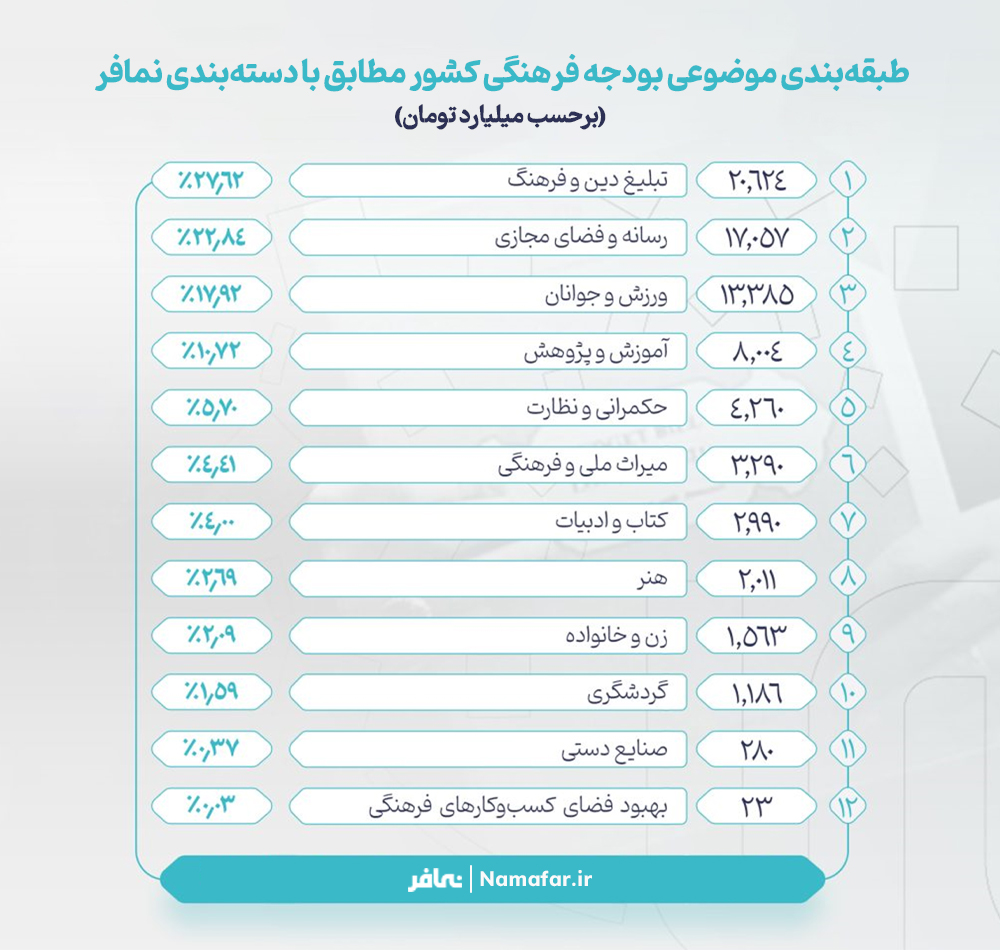
A look at the thematic classification of the country's cultural budget in 1402 (2023/24) based on Namafar's examinations indicates that among the 12 macro topics, the category "Promotion of religion and culture" with 20,624 billion tomans has accounted for 27.6 percent of the country's total cultural budget. After the "Promotion of religion and culture" section, the topic "Media and cyberspace" with 17,057 billion tomans comprises 22.8 percent of the culture budget. Also the category "Sports and youth" with 13,385 billion tomans holds 17.9 percent of the country's cultural budget.
Conclusion
The Thematic Culture Budget Brief report, in addition to identifying the state of the division of appropriations in each topic and subtopic of the nationwide budget, has also presented, on the basis of each of these topics, a map of institutions' activity in a precise and comprehensive form. In this connection, the institutions active in each section and subtopic have been explained in detail, and this work has resulted in presenting a comprehensive picture of the cultural activities of budget-receiving institutions. Also if we look at the country's cultural budget from a critical and industry-centered viewpoint, the formation, promotion and improvement of cultural businesses have a very small share in the country's cultural budget, and most government support for the country's cultural institutions is unconditional support.
Authors: Arsalan Veisi/Ali Rohandeh
Machine-translated from Persian by Namafar; the Persian original is authoritative. Read the original in Persian