One of the problems that many artists and practitioners in the cultural and creative industries face is attracting capital and financing their projects and activities. Common methods of covering costs include government budgets, private grants, and commercial investments. Dependence on government budgets and private grants in the cultural and creative industries stands opposite business-oriented models that are common in more commercial sectors. Business models, although they bring considerable revenue for intermediaries such as film studios, offer a limited financial outlook for most practitioners in the cultural and creative industries. Going beyond the two approaches mentioned above, this article seeks to introduce crowdfunding as an alternative and promising investment approach for the cultural and creative industries that makes a direct connection between artists and audiences possible.
Limitations of traditional financing of the cultural and creative industries
Traditional financing methods in the cultural and creative industries have weaknesses and limitations that make attention to alternative methods necessary. On the one hand, government budgets and government grants bring problems such as inefficiency and lack of productivity, limited access to audiences, and the control and restriction of elites; on the other hand, commercial investments are project-based, and for that reason individuals and companies that hold capital try to distribute and spread risk across their subsidiaries. The investor, by taking over the intellectual property rights and the profit of the project, also causes the creative individual or institution to have limited income.
Development of crowdfunding in the cultural and creative industries
Crowdfunding is a creative method of raising capital in which an individual or business, in exchange for offering shares and making the public partners in their activities and projects, collects money from them through a campaign. A brief historical review takes us to early examples of internet crowdfunding in the late 1990s and early 2000s that were pursued by artists and musicians, because the web environment created a more direct connection between creators and fans. This article, however, introduces the launch of public reward-based platforms such as Kickstarter and Indiegogo in the late 2000s, facilitated by the rise of social media and digital payments, as the starting point at which crowdfunding was elevated.
A review of types of crowdfunding platforms
A typology of different crowdfunding platforms focused on the cultural and creative industries shows that public reward platforms, patron sites for creative fields, dedicated regional platforms, and subscription platforms are the four main types of crowdfunding platforms in the cultural and creative industries. This classification shows the diversity of crowdfunding and at the same time points to merger and consolidation pressures that have led to the dominance of only one or two top players in each niche. This model-based division is useful for beginning an inquiry into the capability and impact of different approaches on financing various cultural and creative industries projects.

A look at the share of cultural and creative industries campaigns
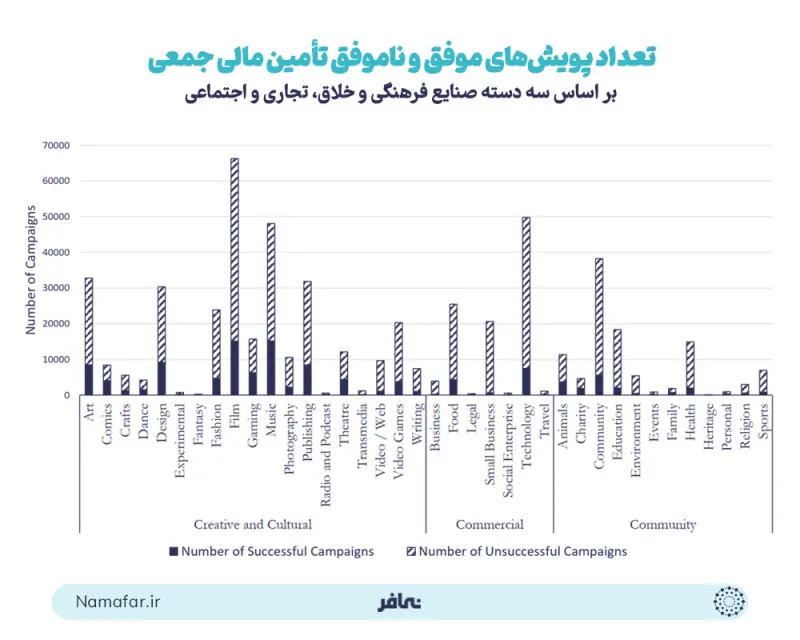
Using data from platforms such as Kickstarter, Indiegogo, FundRazr, Crowdfunder and RocketHub from January 2014 to November 2017, the trend of crowdfunding in the cultural and creative industries has been examined. According to the findings, the cultural and creative industries have accounted for a 61.3 percent share of more than 500 thousand campaigns formed, and the social and commercial clusters have accounted for 19.8 percent and 18.9 percent respectively.
Analysis of campaign data
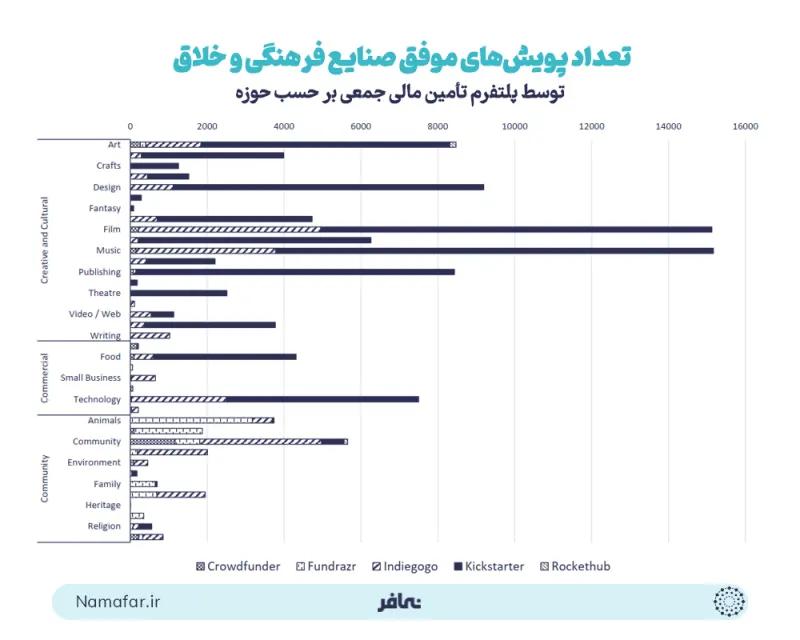
An examination of campaign success indicates differences in the success rate among different categories. Cultural and creative industries campaigns have achieved a notable success rate of 26.5 percent and have surpassed the commercial (12.8 percent) and social (17.2 percent) clusters. The Kickstarter platform, by hosting 67.5 percent of all successfully funded campaigns, leads among the various platforms, and after Kickstarter, Indiegogo with a 23 percent success rate stands in the next position. It is noteworthy that 81.1 percent of successful cultural and creative industries campaigns find their home on Kickstarter, which highlights this platform's superiority in the creative crowdfunding environment.
A close examination of funding goals shows that cultural and creative industries campaigns have typically set higher means (46,000 dollars) but lower medians (5,600 dollars), which indicates a considerable influence from a few exceptionally successful campaigns. Conversely, commercial clusters generally target higher medians. In terms of amounts raised and participants as well, cultural and creative industries campaigns consistently outperform other categories.
Success of crowdfunding campaigns
Crowdfunding, because it has reinforced commercial successes, has been transformed from a secondary option for financing the cultural and creative industries into a credible and attractive choice and has been recognized as such. For example, Oscar and Grammy nominees, top music albums, and even books that have won international prizes have used the crowdfunding method over the past decade. Among various platforms, Kickstarter, since 2017, has showcased various cultural and creative industries campaigns and in this period has raised considerable capital. The music industry, with 100 thousand dollars to 1 million dollars in capital raised, has also been the leader among various industries.

Closing remarks
In the cultural and creative industries, crowdfunding has firmly established its place as a leading financial strategy, and various creative activities and works have drawn on this method. This approach is used not only for financial support, but also for promotional purposes and for linking artists directly to their patrons. Despite the limitations, crowdfunding appears to be not merely a substitute for existing financing schemes, but a complement to them. As this phenomenon continues to evolve, conducting further studies designed specifically for the dynamics of the cultural and creative industries can clarify the existing ambiguities regarding its potentials and risks.
In this context, what can relate directly to Iran's cultural organizations is, first, using paths that have been tested in the world, while taking into account the principles and cultural ecosystem of Iranian society, and second, efforts to understand the possible advantages and problems of this approach, with a view to an active, creative scholarly presence at the global level.
Machine-translated from Persian by Namafar; the Persian original is authoritative. Read the original in Persian