If you had a hand in drafting the budget bill, under which of the budget affairs would you place "cultural diplomacy"? Is cultural diplomacy a matter solely related to the country's foreign-policy apparatus, specifically the Ministry of Foreign Affairs, and therefore a political and diplomatic subject? Or is it more a cultural matter than a political one and should be counted under the cultural affairs of the Budget Law? What about "education and research"? Does education and research belong to a country's institution of culture, or merely to one or two government ministries? Can education be separated from culture?
In Namafar's view, when we say culture, we imagine a coherent whole that encompasses all cultural dimensions of human life. In this definition, education cannot have no place, and cultural diplomacy, which is the use of culture to develop international relations and improve the country's public standing, is an entirely cultural category, and effort toward it is, in essence, effort for the country's culture. What we have said is a brief and simplified reason for the necessity of a different look at the Budget Law. A look in which the enumerated cultural subjects truly cover the entire cultural affairs of the country's budget and tell us precisely how large the country's cultural budget is and on which of the cultural affairs it is spent.
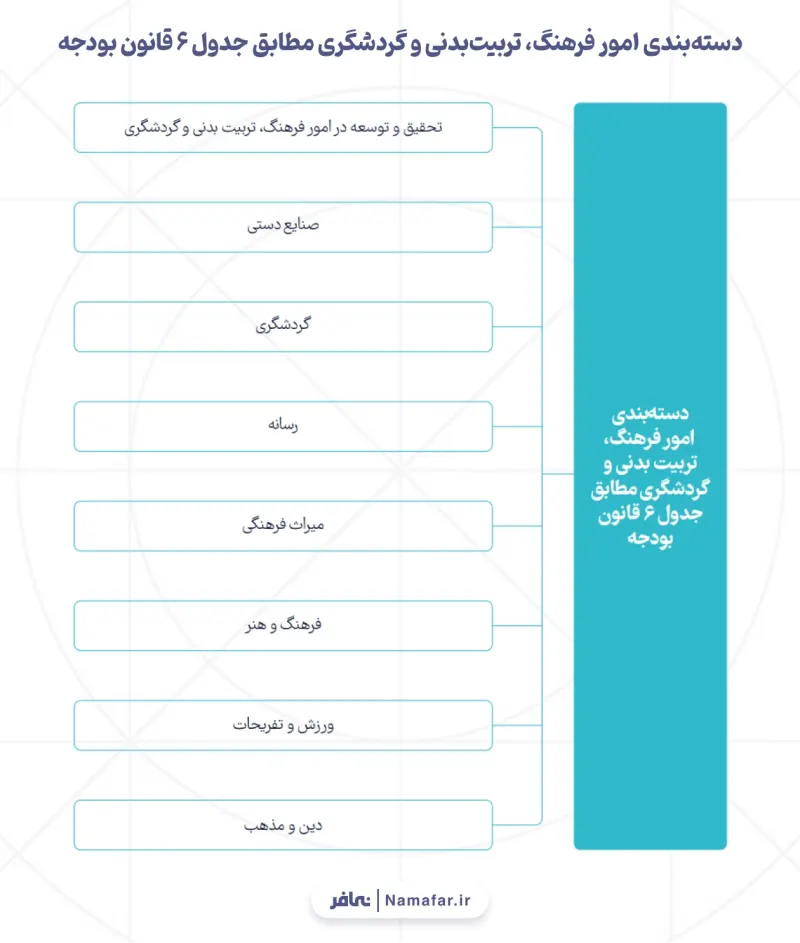
In this different view, the final figure of the cultural budget also comes out entirely different from the figure claimed by the Budget Law. The Budget Law divides cultural affairs into 8 categories. These affairs, according to Namafar's classification, fall into 12 categories.
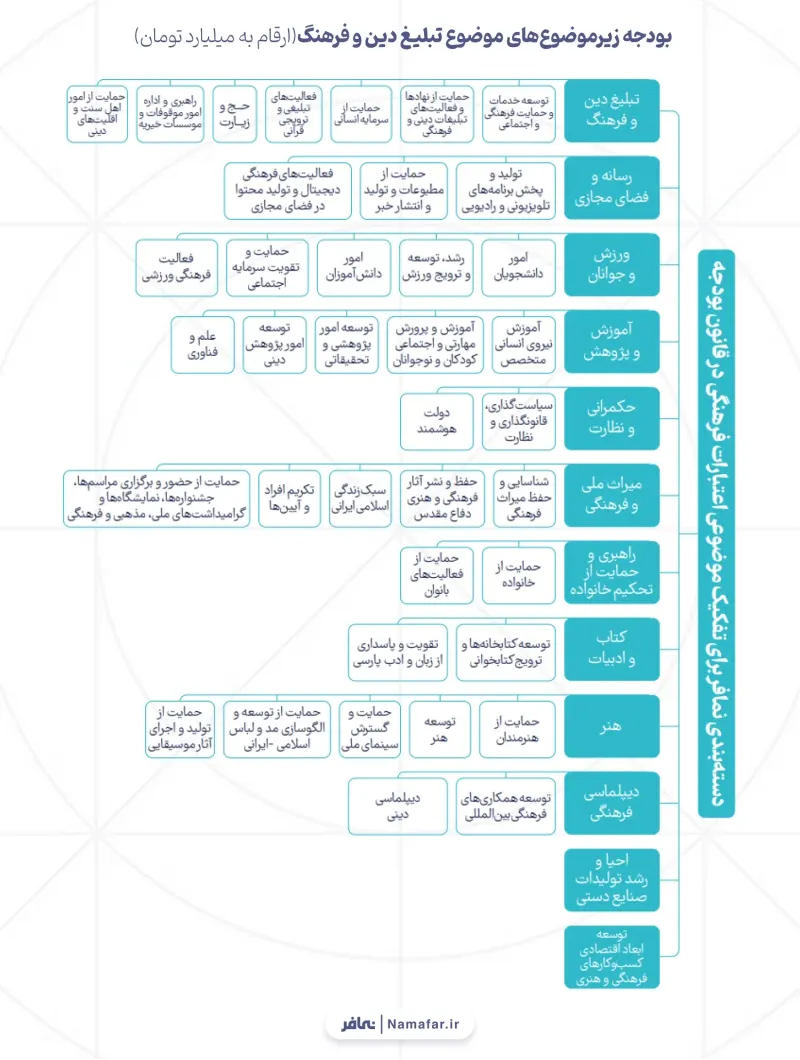
Which subject is allocated the largest budget?
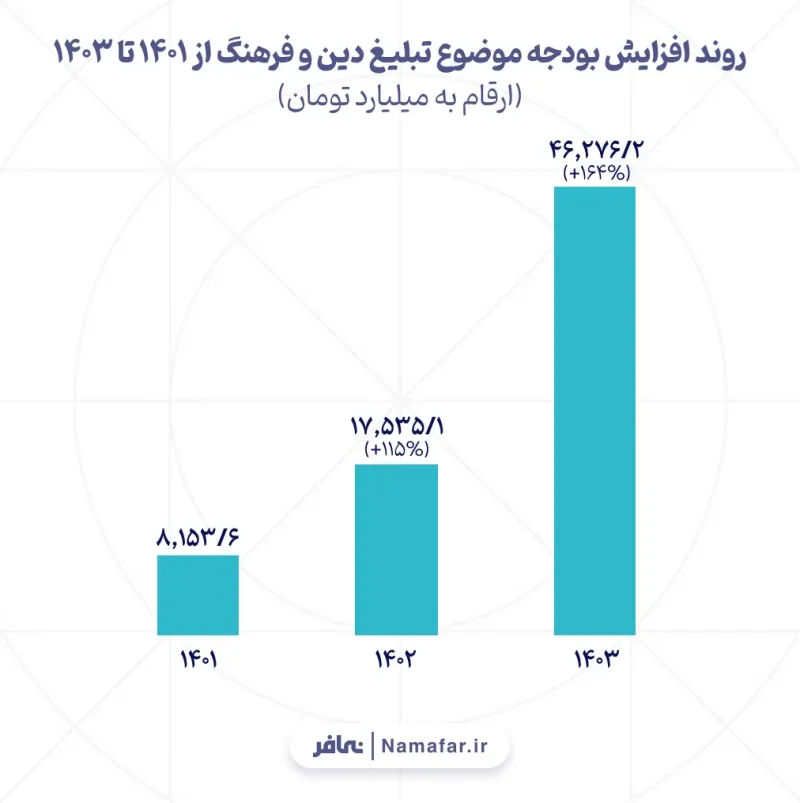
The cultural budget brief 1403 (2024/25), thematic review, has examined Iran's cultural budget from 1401 (2022/23) to 1403 (2024/25), and in all three years the subject of promoting religion and culture leads other subjects in the amount of budget allocated.
Also, over these three years this subject's share of the country's total cultural budget has been continually increasing. 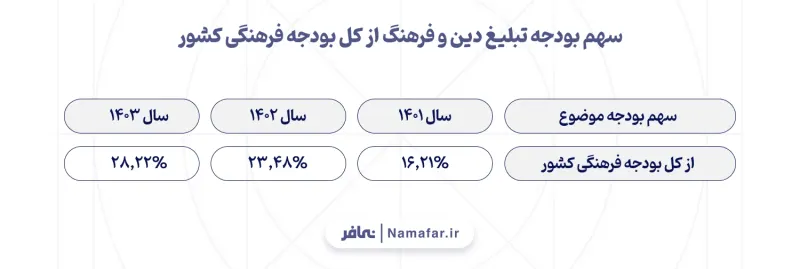
Promoting religion and culture, which given the nature of the Islamic system has always been of considerable importance, has in recent years, coinciding with an increase in the volume of media activity by hostile countries aimed at changing the value-based and perceptual orientation of the Iranian people, taken on added importance. For this reason this subject's share has been increasing exponentially in recent years and has gone from 16 percent in 1401 (2022/23) to 28 percent in 1403 (2024/25). Of this 46,276.2 hemt (trillion tomans), 19,033.5 hemt is allocated to developing services and sociocultural support, and 19,014.8 hemt to supporting institutions and activities of religious and cultural advertising. In the developing services and sociocultural support section, the largest budget is allocated to the Center for Seminary Services for "providing support services." This agency's budget has increased 77 percent compared with last year, and in 1402 (2023/24) it also enjoyed a 202 percent increase relative to 1401 (2022/23).
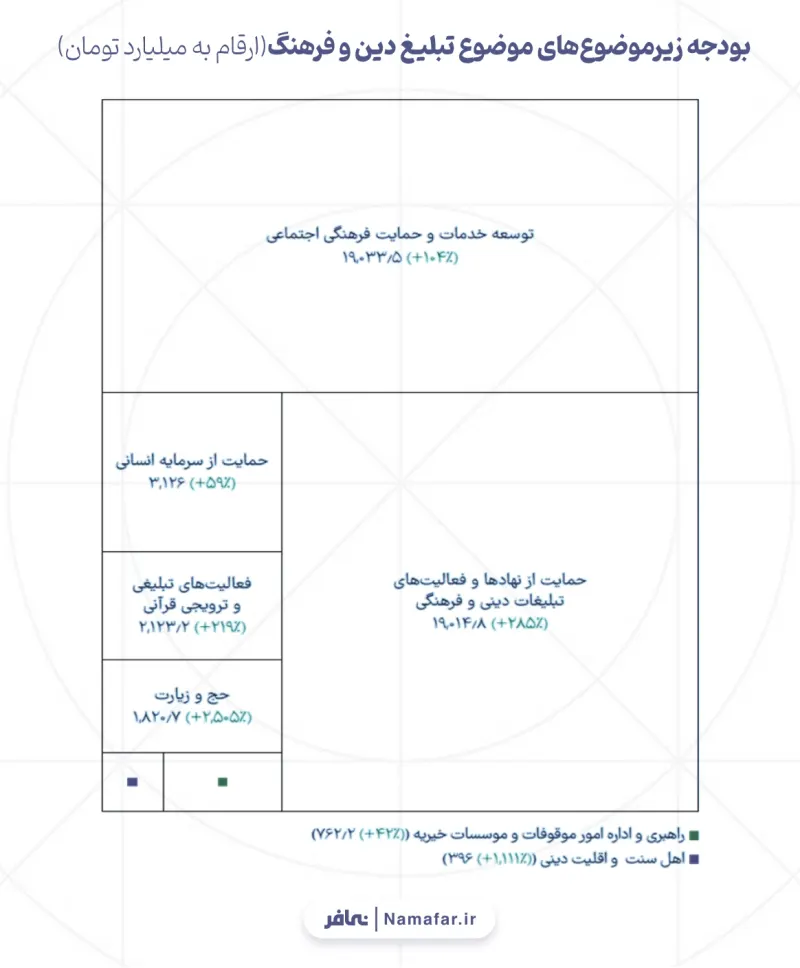
Promoting religion and culture, which given the nature of the Islamic system has always been of considerable importance, has in recent years, coinciding with an increase in the volume of media activity by hostile countries aimed at changing the value-based and perceptual orientation of the Iranian people, taken on added importance. For this reason this subject's share has been increasing exponentially in recent years and has gone from 16 percent in 1401 (2022/23) to 28 percent in 1403 (2024/25). Of this 46,276.2 hemt (trillion tomans), 19,033.5 hemt is allocated to developing services and sociocultural support, and 19,014.8 hemt to supporting institutions and activities of religious and cultural advertising. In the developing services and sociocultural support section, the largest budget is allocated to the Center for Seminary Services for "providing support services." This agency's budget has increased 77 percent compared with last year, and in 1402 (2023/24) it also enjoyed a 202 percent increase relative to 1401 (2022/23).
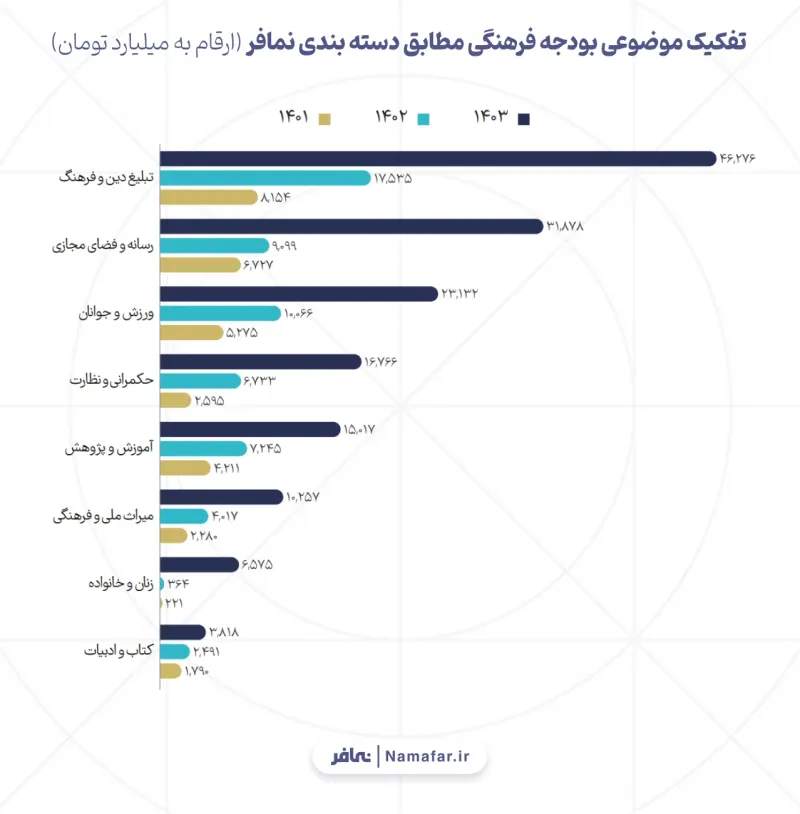
The cultural budget brief 1403 (2024/25), thematic review, in the same way examines each of the 12 cultural subjects together with their sub-subjects, broken down by each agency, from 1401 (2022/23) to 1403 (2024/25). This possibility of comparison across the past three years enables the reader to see the trend of change in decision-makers' priorities. For example, the subject of women and the family had a very negligible share in the 1401 (2022/23) and 1402 (2023/24) budgets and in 1403 (2024/25) experienced a jump. It can be inferred that the importance of this subject, given the social changes of recent years, has increased in the view of the government and the ruling system. Also, while the growth of the budget for subjects such as "promotion of religion and culture" and "media and cyberspace" has increased exponentially, a subject such as books and literature has had steady, undirected growth.
Machine-translated from Persian by Namafar; the Persian original is authoritative. Read the original in Persian