Taaghche is an Iranian platform for reading and buying text and audiobooks that, by focusing on technology, content, and user experience, has made digital reading easier. In a conversation with Mohammad Sadoughi, co-founder of this company, we talked about the behind-the-scenes of its launch, the path of growth in the small but challenging Persian publishing market, and its future outlook. He considers the impact on increasing per-capita reading time to be Taaghche's most important achievement.
To begin, please tell us about Taaghche's initial goals and the main dimensions of its activity.
Taaghche was established with the aim of offering books in various forms and formats. This happened in 1392 (2013/14), and from then until now this platform has been developing and advancing in three main areas. First is the technical development of the product, such that it constantly strives to offer users a better and more efficient product. The second area is content development; meaning that Taaghche's publisher-relations team always tries to provide audiences with more diverse and broader content. And the third area can be called advertising and marketing development. In this segment, Taaghche seeks to increase its audience and users and enter more markets so that more people use its services. These three goals have been defined at Taaghche from the beginning, are still being pursued, and will most likely continue in the future as well.
In what formats are books offered, and how do users gain access to them?
At present, Taaghche offers audiobooks and text books in two forms: first, outright purchase, in which the user becomes the permanent owner of the book, and second, subscription, under which users, by paying a subscription fee, will have access to a collection of books. People can obtain the books they want in text and audio formats, both as a subscription and as an outright purchase. They can also view the books inside the app and benefit from the reading process. Taaghche offers text books in two text formats, EPUB and PDF, and audiobooks are also available in MP3 format, which makes reading and listening possible.
At present, who or which entities hold the majority ownership of Taaghche?
Taaghche was initially launched by the "Hasin Group." This group was founded in 1383 (2004/05) by a group of students and graduates of Sharif University of Technology and is active in various software and information-technology fields. Hasin's shareholders are the same original individuals, and this company is also considered Taaghche's majority shareholder. In addition to Taaghche, Hasin also owns companies such as Myket, Tarabarnet, and GoshiShop.
Taaghche is an in-house product of the Hasin Group; that is, a few people independent of Hasin did not found it and then transfer it to this group. Rather, Taaghche took shape as a startup within Hasin; in such a way that the required human resources were recruited and the idea was developed inside the company. From the very beginning, Hasin has been its majority shareholder and owner, and it still is.

How did the initial idea of founding Taaghche take shape? What motivation was behind entering this field?
The idea and the motivation consisted of two parts. In terms of the idea, it must be said that this plan was not a novel and unique idea. Before that, companies such as Amazon in 2006, Kobo, and some other large global players had become active in this field. Therefore, in terms of conceptual innovation, Taaghche's idea was not considered new. But the Hasin Group had a serious competitive advantage for entering this market. First, it had considerable experience in developing platform software. And second, it had at its disposal an infrastructure called Myket, that is, an Android app store, that could be a suitable bed for Taaghche's distribution and growth.
Hasin had successful experience in writing platform applications, and many of its products are an intermediary connecting two groups of users. For example, Tarabarnet connects drivers to cargo owners, and Myket connects app developers to users. Taaghche too becomes the link between publishers and authors and book readers.
Compared with other platforms, what distinguishing feature or added value does Taaghche have for its users?
Three main players are present in this market: Taaghche, Fidibo, and Ketabrah. Given the amount of time that has passed since these companies began operating, it can be said that the market has in a sense become saturated. That is, many of the values these platforms offer have become similar to one another, and no very special distinction is seen among them.
Even so, at times Taaghche has had innovations that for a period were considered its unique feature. For example, when we added the "audiobook" service, Taaghche was the only platform that offered audiobooks and text books simultaneously in a single environment. Also, the subscription model that was introduced under the name "Taaghche Unlimited" was implemented for the first time by our company, and after that other platforms also went after this model.
At present, perhaps Taaghche's most important distinguishing feature relative to other competitors is the comprehensive support it provides both for publishers and for its users. In addition, it has a special focus on improving the user experience in order to provide software in which reading is simple and enjoyable for the audience. These approaches distinguish Taaghche from other players in this field.
How many people currently work at Taaghche, and what specialties does this team include?
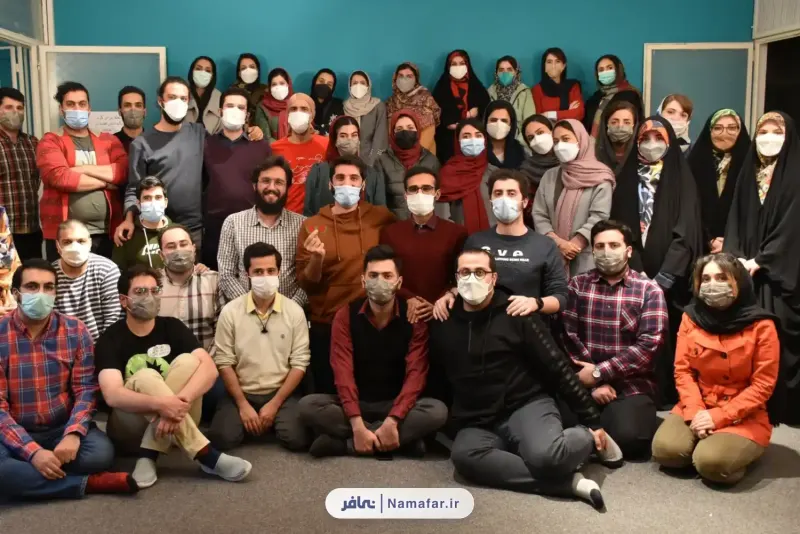
Taaghche currently has close to 50 staff who work in various departments. One of the key departments is the "technical and product" team, whose task is the continuous development and improvement of the platform. Members of this group try, by adding new features and capabilities, to raise the quality and efficiency of the product and keep it updated.
Another department that operates at Taaghche is "content preparation." In this section, books received from publishers are converted into standard formats and uploaded to the platform. Suitable descriptions are also written for each book.
The "support" department is also another important pillar of Taaghche, which itself is divided into two parts: "publisher support" and "user support." The first section is in contact with publishers, solves their problems, and receives new content from them. The second section also serves users, including handling problems with using the software, payments, and other similar matters.
Alongside these, there is also a "marketing" department whose task is running advertising campaigns, holding discount schemes, and taking part in events such as the book fair. Therefore it can be said that Taaghche is made up of teams with technical, content, support, and marketing specialties, all of which work to improve the user experience.
Has Taaghche so far had a distinctive and noteworthy achievement?
According to our colleagues' calculations, Taaghche has played a considerable role in raising the level of reading in the country. In the case of print books, purchases are often made in a discount or emotional setting and do not necessarily lead to reading. Sometimes people even buy books merely to have a beautiful library; but on Taaghche it is not like that.
On Taaghche, given that the concept of a physical library does not exist and books are always available 24 hours a day, users usually purchase works that they really intend to read. In other words, the likelihood that purchased digital books will actually be read is far higher than for print books. Therefore, even if we do not say that Taaghche is the direct cause of growth in per-capita reading time, it at least plays an important role in facilitating reading and encouraging it.
On the basis of last year's behavior of Taaghche users, per-capita reading time has increased by 9 minutes. In my view, the greatest achievement such software can have is precisely this impact on increasing people's reading. How many books have been sold, or how many books exist on Taaghche, is of secondary importance compared with this matter.
On Taaghche's development path, have you used private resources more, or have you also drawn on government facilities?
If by government facilities you mean a loan or a special form of support, I must say no, not at all. From the time Taaghche took shape until now, we have received no direct help from the government or the state. We neither received a subsidy, nor was any infrastructure or special path provided to make our work easier. Even for taking part in the book fair, it took years before we could have a suitable place.
In fact, we traveled this path through our own effort. Of course now that I am also active in other guilds, I can say that the mere fact that the government has not created an obstacle has itself been a great kindness! (laughing) That is, non-interference and granting permission to operate is a form of support. Because if it had been a matter of obtaining strict permits or going through complex processes, perhaps Taaghche would not have taken shape at all.
Given the striking growth of artificial intelligence, has this technology had an effect on Taaghche's work process?
It has certainly been influential; although we are still in the early stages of using it. Artificial intelligence can help us in the areas of support, technical product development, and other fields. For example, from the past we have developed an artificial-intelligence model for recommending books on the basis of the user's taste and behavior.
At this year's fair we also unveiled a new model called "Ketabjo." In this tool, the user can write whatever is going through their mind about a book, and Taaghche, on the basis of that person's mindset and request, introduces several books to them. For example, someone is looking for a book that has simplified complex economics concepts in a narrative form. They write just that, and Ketabjo recommends books to them. The user may write a longer and more complex description. Up to a ceiling of 300 characters, whatever the description is, it is received and recommendations are given on that basis.
We hope to develop this product further soon, add more features, take its conversational model from one message to several messages, and improve the accuracy of its recommendations.

What is Taaghche's main challenge on the path of development?
Taaghche's biggest challenge is the limitation of its market. Our target community is confined to the Persian language, which does not have much of an international audience. On the other hand, even inside Iran, despite a population of 80 to 90 million, a culture of reading has not yet been institutionalized and per-capita reading time is low. Therefore Taaghche operates in a small market with limited growth capacity, and this issue makes the path of development more difficult.
What social group are Taaghche's users mostly from? Do you plan for a particular group?
A considerable share of users fall in the 25-to-35 age range; but our audience is not limited to this age group. Given the diversity of content available on Taaghche, including children's books, younger users also use this platform. From an age perspective, Taaghche covers a wide spectrum of audiences.
The same diversity is also seen in other characteristics. Our users are very diverse in terms of education level, occupation, and lifestyle. School students, university students, housewives, and people employed in various fields, especially because of access to textbooks and study-aid books, are among Taaghche's active users.
Machine-translated from Persian by Namafar; the Persian original is authoritative. Read the original in Persian