The Tehran International Book Fair (TIBF) is one of the country's most important cultural events, which has been held since 1366 (1987/88) with the aim of promoting a culture of reading, supporting the publishing industry, and facilitating public access to books. In addition to creating an opportunity to introduce new domestic and foreign publications, this fair has provided a setting for support policies such as book vouchers.
The book voucher, which especially at the time the fair is held becomes one of the key instruments of support for reading, is allocated by the government to various groups including university students, seminary students, people of the pen, teachers, and faculty members, in order to reduce part of the cost of buying books and to create the ground for fairer access. Here a fundamental question is raised: over the past ten years, has the book voucher been able to preserve its supportive function?
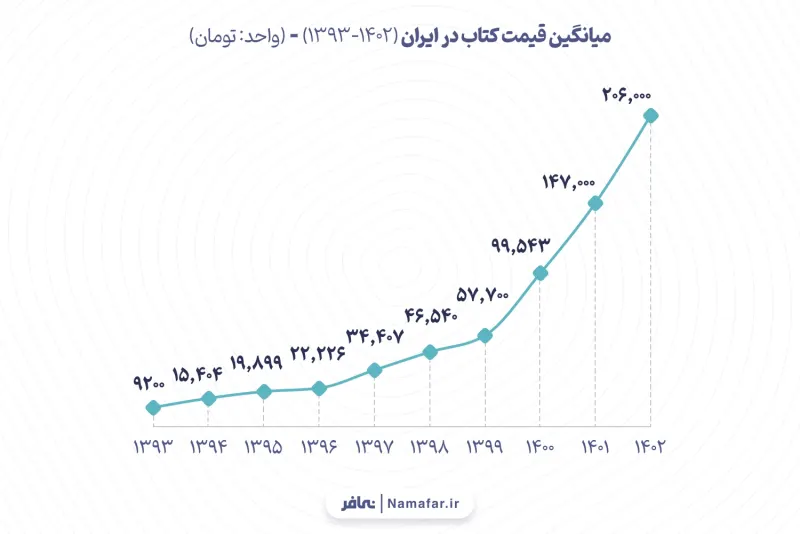
The rise in book prices in Iran; 14-fold growth over a decade
The statistics on book prices tell a story that is not particularly pleasant. Over the past decade the price of books in Iran has had an unprecedented jump and has increased more than 14-fold; an increase that from 1398 to 1402 (2019–2024) gained greater intensity and confronted the book market with a crisis. In the interval from Mehr (September–October) 1400 (2021/22) to Aban (October–November) 1403 (2024/25) alone, the average book price went from 62 thousand tomans to 206 thousand tomans; that is, 230 percent growth that has moved books out of reach for a large part of the public.
This upward trend has continued in 1404 (2025/26) as well, and the average book price has reached 221 thousand tomans; a figure that, relative to Farvardin (March–April) 1403 (2024/25) (181 thousand tomans) and Farvardin 1402 (2023/24) (81 thousand tomans), reports striking inflation. Also, an examination of prices in subject groups shows that children's and young-adult books have not been spared the wave of price rises and have faced a considerable increase. This matter has created concerns about restricted access to these works and its possible consequences for the cultural formation of the young generation.
The book voucher; a nominal increase or real support?
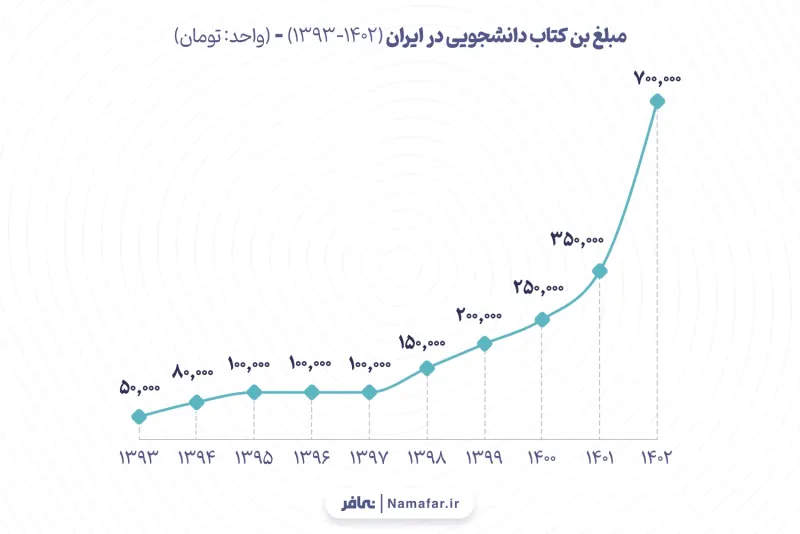
Alongside the growth in book prices, an examination of the amount of the student voucher shows that this financial support, although it has faced delay and at intervals stagnation, has overall had an increasing trend. It began in 1393 (2014/15) at 50 thousand tomans and in 1402 (2023/24) reached 700 thousand tomans.
Even so, it must be noted that this increase has not kept pace with the growth in book prices. For example, in the interval 1396–1399 (2017–2021), when the book price went from 22 thousand tomans to 57 thousand tomans, the voucher amount was in practice unchanged or experienced only minimal increases.
In recent years, the tendency to offer virtual vouchers has increased; a change aimed at improving access, especially for residents outside Tehran. Of course this policy, while increasing access, may lead to the unintended exclusion of some groups with limited digital skills or insufficient access to the internet.
The decline in the purchasing power of the student voucher; why do students buy fewer books every year?
One of the less-seen challenges in the support system in the book field is the gradual decline in the purchasing power of the student book voucher over past years; a matter that may at first glance be lost among the figures, but has considerable social and cultural consequences.
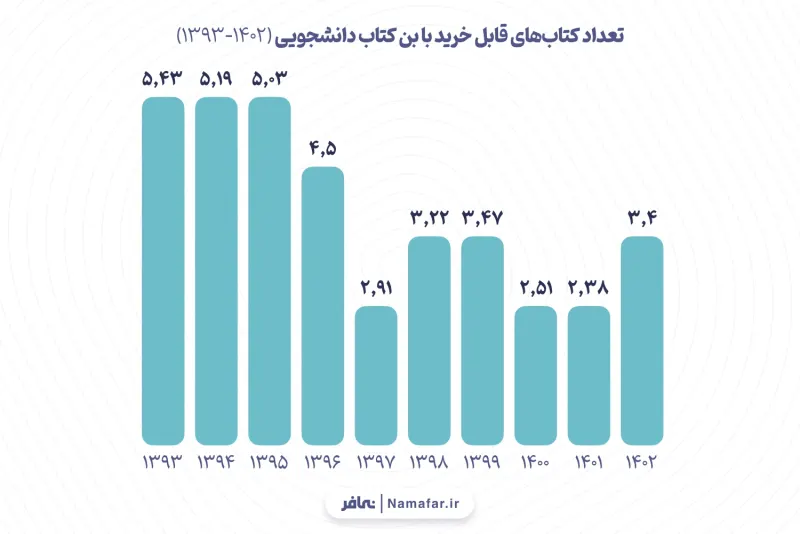
A look at official data shows that in 1393 (2014/15), a student with a 50-thousand-toman voucher could buy about 5 volumes of books at an average price of 9,200 tomans. This figure at that time perhaps met a student's basic reading needs. But it is enough to go a little forward; in 1398 (2019/20), despite an increase in the voucher to 150 thousand tomans, the average price of each book reached more than 46 thousand tomans and purchasing power was in practice cut in half.
The erosive trend of the voucher's purchasing power, in 1399 (2020/21) and 1400 (2021/22), reached a warning point. In 1400 (2021/22), despite the allocation of 250 thousand tomans in vouchers, a student could obtain only 2.5 volumes of books.
In 1402 (2023/24), although an important jump in the voucher amount occurred and its figure reached 700 thousand tomans, still, because of the sharp increase in book prices (with an average of 206 thousand tomans), real purchasing power reached only about 3.4 volumes of books; a figure that still has a large distance from the early years of the 90s, the 1390s (2010s).
This erosive trend shows that even with sometimes striking increases in the voucher, the speed of inflation in the book market has in practice neutralized any improvement in purchasing power. Put simply, students can buy fewer books every year, and this means the weakening of one of the simplest and cheapest paths for young people's access to knowledge.
The more important point is that this trend is not limited only to a numerical decline in books purchased. The drop in purchasing power has been followed by a change in reading behavior and has steered many students toward cheaper books or online sources (sometimes unreliable or lacking scholarly standards); a path that can have a negative effect on the quality of learning and the depth of study.
The Ahl-e Qalam voucher; the gap between policymaking and market reality
The Ahl-e Qalam book voucher is one of the support policies of the Ministry of Culture and Islamic Guidance for strengthening the standing of authors, translators, and other actors in the publishing field. In 1401 (2022/23), more than 9 thousand authors, translators, editors, and other cultural actors received vouchers with a total value of more than 5 billion tomans. A figure that, compared with the year before that, promised threefold growth. Over the two years after, the number of voucher recipients increased at a considerable speed and reached about 11 thousand people. Also in 1403 (2024/25) the voucher ceiling rose to one million tomans.
Even so, on the basis of statistics from the 1402 (2023/24) fair, only a limited portion of these vouchers was used, and in some groups the rate of use even fell below 30 percent. This low statistic indicates a gap between cultural policymaking and the real needs or conditions of the audience. Among the reasons for this, one can point to the vouchers being limited to use at the virtual fair, technical problems of the purchasing system, and the unwillingness of some people of the pen to buy online.
What does the world do?
In recent years, European countries such as France, Italy, Germany, and Spain have implemented programs to encourage young people toward cultural consumption. These programs include offering cultural cards with amounts of between 200 and 500 euros to 18-year-old young people, for buying books, theater tickets, music, and other cultural activities. The aim of these measures has been to increase young people's cultural participation and to support the cultural industries, especially after the negative effects of the coronavirus pandemic. For example, in France, more than 75 percent of purchases made with the cultural card have been allocated to books. A matter that shows the effect of these programs in raising cultural consumption.
In the end: a book subsidy for everyone?
Allocating a book-purchase voucher to all visitors to the Tehran International Book Fair in 1404 (2025/26) can be assessed as a positive step in the direction of developing cultural justice and facilitating public access to books. This measure has for the first time taken the possibility of benefiting from the subsidy out of the mold of particular groups and extended it to all visitor strata; a policy that at first glance can make the fair's atmosphere more dynamic and make buying books possible for a broader spectrum of people.
Even so, developments of the past decade in the domain of the Tehran International Book Fair book voucher indicate that although the government's support policies through the allocation of book vouchers have continued and at some junctures have been accompanied by a nominal increase, these instruments have in practice fallen behind inflation in the book market and have resulted in a decline in the purchasing power of target groups and a change in consumption behaviors. In these conditions, a look at global experiences shows that redesigning support policies with a smart, flexible approach proportionate to the needs of new generations can have greater effectiveness.
Machine-translated from Persian by Namafar; the Persian original is authoritative. Read the original in Persian