Throughout history, having musical instruments and the knowledge of using them has belonged to a particular stratum and class, and players and musicians have been members of well-off, art-loving families. Of course these days teaching this art is not as hard as in earlier times. Music schools in every locality are busy teaching the art, and playing is not the art of one group of people. In addition to public classes, many teachers are also busy with private instruction. The music conservatory, alongside independent music schools, also trains students.
We see that everything is within reach. We can drop by the nearest school and enroll in the field we like. If one could buy the instrument one intends to learn by walking around Hafez Street and around Baharestan, everything would be in place. This is where the high price of some instruments has made the work a little hard for the picky. Perhaps with free online instruction one can learn to play, but without an instrument it is laughable.
Music's need for a quality instrument
We have classified all the instruments on the Iranian market; Iranian instruments and Western instruments. Western instruments are usually produced outside the country and are imported into Iran, so with dollar and currency fluctuations their prices rise; the cost of shipping to the country, customs, and tax is also counted. Iranian instruments are the result of the art of Iranian craftspeople and are produced under particular conditions. For example, to make a santur one must use very high-quality, seasoned wood. The Iranian producer usually uses walnut wood; that is, they obtain walnut lumber that exists in the western parts of the country and keep it in water for a time so that it seasons and ages. The wood sap comes out and after that the raw material for making a santur is ready. A great deal of effort is needed just to obtain the wood for one type of instrument, and the price of an Iranian instrument, despite a shortage of capable makers and of raw materials, is not all that unfair!
With my salary, which instrument can I buy?
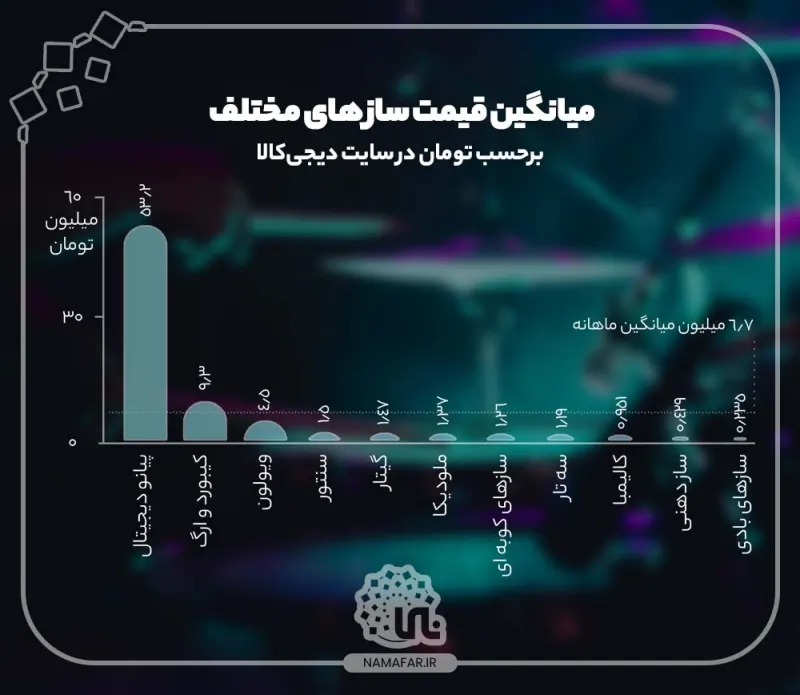
The minimum wage in Iran is 6 million and 700 thousand tomans. Wind instruments in Iran, compared with other instruments, are cheaper. The average price of 200 thousand tomans for these instruments is due to the very low price of handmade neys and harmonicas. Of course the very low price has not caused more students to turn to these instruments. The guitar is the best-selling instrument in Iran. Its average price is close to 1/5 million tomans, which many enthusiasts can probably obtain. Free guitar-instruction resources are plentiful and learning it seems easier; so it persuades more people to buy a guitar.
The price of a piano is close to 50 million tomans. With this level of income, to buy a piano one must work seven or eight months! In fact the work is hard for Iran's Mozarts and Beethovens; but the other instruments can to some extent be obtained.
Can the French buy instruments with their salaries?
In France the situation is different. The average income of the French is such that with a portion of their monthly salary they can buy the most expensive instrument on their country's market; of course there are also instruments of several hundred thousand euros whose purchase is very hard. The average price of the most expensive instrument compared with other instruments is not stark, and market conditions are not such that the price gap among them is large.
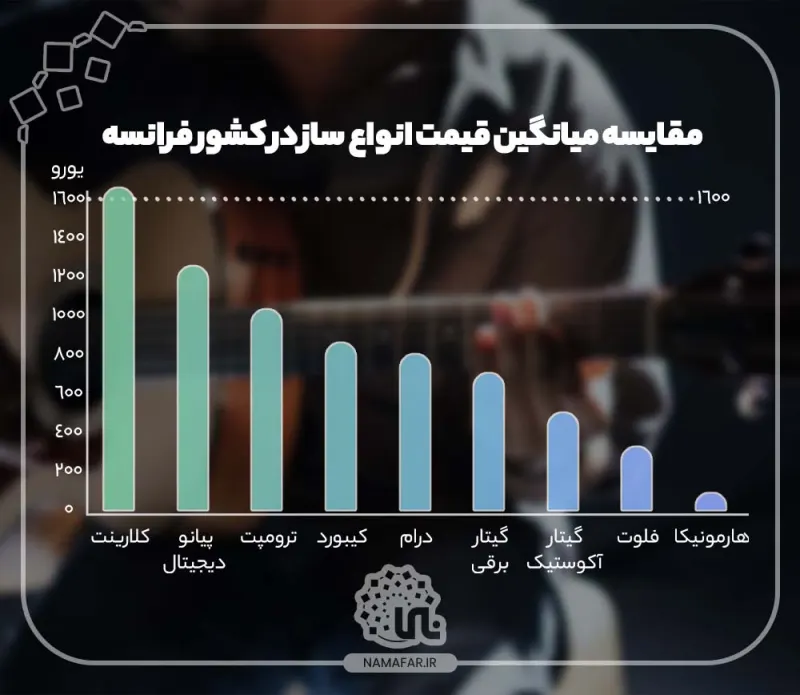
Unlike in Iran, in France the clarinet, which is considered a type of wind instrument, is the most expensive instrument and is about 1,600 euros. This instrument is used a great deal in classical music and jazz. The cheapest instrument in France also falls in the wind-instrument category. The 200-euro harmonica is the cheapest instrument in France. Of course the harmonica and the clarinet in Iran also fall in the cheap and expensive instrument categories, but reception of them differs from France.
The conditions the market has created for music lovers
Given the conditions of the musical-instrument market in Iran, instrument prices also affect people's choices; that is, a person, despite an interest in the piano, may decide on the basis of their income to play a cheaper instrument. For example, the price of a keyboard or organ in Iran is one-fourth the price of a piano, and these instruments have a great deal of similarity to one another. The price gap among instruments in France is not this intense. The imported nature of instruments in Iran is probably a factor in such a price difference.
Learning the art in the field of music, and in Iran, requires more effort. Unlike France, in Iran's ordinary schools there is no music lesson, and musical instruments are not made available to students free of charge so that they can be talent-spotted or find their interest in a particular instrument. Also, the instrument-buying market in Iran is not as thriving as France's market, and fewer people turn to learning the craft of instrument making; so a shortage of supply is probably another cause behind the high price of some instruments.
Machine-translated from Persian by Namafar; the Persian original is authoritative. Read the original in Persian