South Korea, in a short seventy-year period, in 1948 with an independence movement was able to become one of the world's developed countries. This country spent thirty-eight years under the colonization of the Japanese Empire and was even deprived of the opportunity to teach the Korean language to its own students. A hundred years ago, the leader of Korea's independence movement wrote in a letter: "I want our country to become the most beautiful country in the world, not the richest or the most powerful country. The only thing I want our country to have without limit is the noble power of culture. Culture brings happiness for us and for others." Today the Korean language is the world's fourteenth most-spoken language. In this connection, last year 26 Korean words were added to the Oxford dictionary.
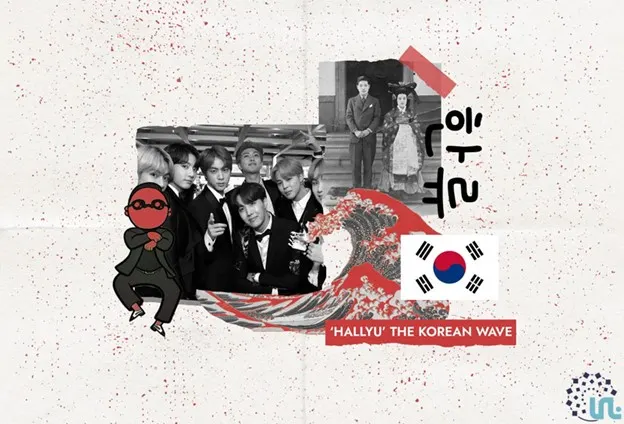
The Korean Wave | Hallyu
After Korea attained independence, the people of this country made extensive plans for the scientific and cultural progress of their country. The term Hallyu | Hallyu or the Korean Wave is drawn from Korea's success in cultural dissemination. Also, Hallyu stars are the same as Korea's music and cinema stars. The spread of this wave—such as fashionistas taking inspiration from hanbok clothing, or the popularity of kimchi pickle among fans of Eastern foods, the high viewership of Korean films and series, and also Korean pop music—has gone so far that the artists of the BTS group are invited to the White House and speak as representatives of Asia about anti-Asian crimes. With investment and the special attention of the South Korean government, the Hallyu Korean Wave expanded every day. The budget the government allocated to this work was one percent of the country's net income, which amounted to about one billion dollars. Therefore this matter is considered a threat to Westerners and has focused minds on one question: "Can Korea's soft power, embodied by K-pop, turn this country into a cultural powerhouse with global influence?"
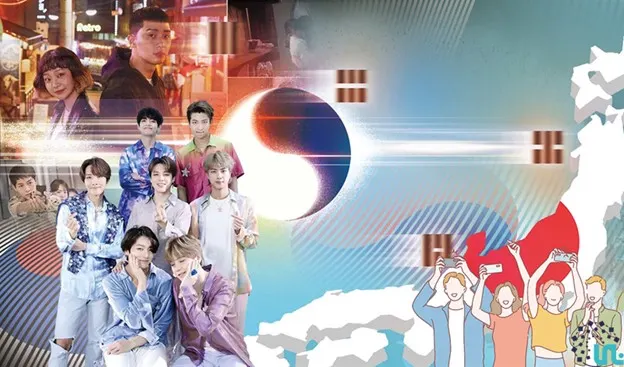
A wave that became a storm
In the first decade of the Korean Wave, before the emergence of internet televisions and new trade infrastructure, foreign fans of Korean series and films illegally downloaded the electronic products they wanted and watched them with English subtitles. The global success of Korean film and series and the activity of the first generation of K-pop took shape from the 1990s with the investment of large filmmaking and music-composition companies. In 2012, with the release of the Gangnam Style music video by the singer Psy, a turning point in the history of K-pop came about. This music video, in a short time, by gaining one billion views on YouTube, broke 3 Guinness World Records. In 2022 this figure reached more than 4.5 billion views, and it is still on the list of the top 10 most-viewed and popular music videos in YouTube history. The impact of the Korean song Gangnam Style went beyond the music industry and has the role of the main catalyst in Hallyu and the Korean Wave. The success of this Korean track paved the path of globalization for other K-pop groups and caused Korean pop culture to exit the gateway of East Asia.

What is K-pop?
K-pop is a general term for South Korea's popular music, which many, following past custom, also call Gayo. Korean pop music groups, or the K-pop music industry, together with coordinated stage movements and designed K-pop dance of various kinds such as techno, rock, hip-hop, and dance-pop, have faster growth relative to other fields. These features have caused these works to endure, especially in the minds and hearts of younger generations. Recently, pop, which originally referred to American and English pop music, is used for the popular music of other countries by adding the first letter of that country's name. For example, the prevalent music in Thailand and Japan is called T-pop and J-pop, respectively. On the same basis, South Korea's prevalent music also takes the name Korean K-pop. From the activity of Korean K-pop music groups to today, four generations have passed. Each, based on the time span in which they started their activity, has been placed in the ranking of these Korean groups. The first generation and the first K-pop groups are Seo Taiji and Boys, the group H.O.T, the group S.E.S, and the group Baby Vox, which are in the ranking of K-pop groups.

Why did Korean pop music, K-pop, become popular?
South Korea, because of the many commonalities it has with Western countries, has been able, in addition to Asian countries, to attract many enthusiasts in European and Western countries. For example, Koreans place great value on the free market, democracy, and freedom of the press. According to surveys conducted, 18 percent of respondents considered the rhythm of Korean pops the reason for its appeal. It appears that the use of entertaining bass lines together with English phrases has been able to draw audiences' attention to K-pop music.
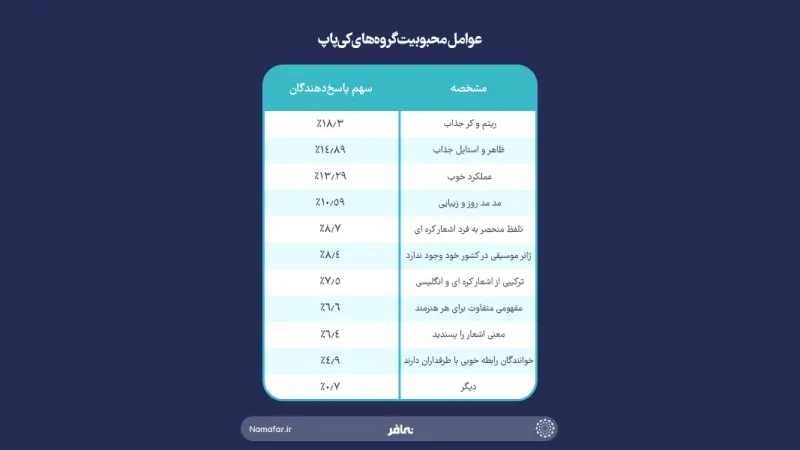
Wearing glittering clothes and creating a relatively timid and cute appearance has made K-poppers unique and conveys a sense of intimacy to their fans. K-pop kings usually address their fans as oppa or eonni, meaning older brother or older sister, in order to establish an emotional connection between themselves and the audience. The behavior and speech of Korean pop music groups is free of any violence, which is a matter that can increase their appeal in Islamic and Asian countries. Koreans have a long history in song, dance, and entertainment. These roots and historical experiences, alongside a great deal of practice and a strict diet, produce a precise, flawless, and fully coordinated show in the form of K-pop song and dance.
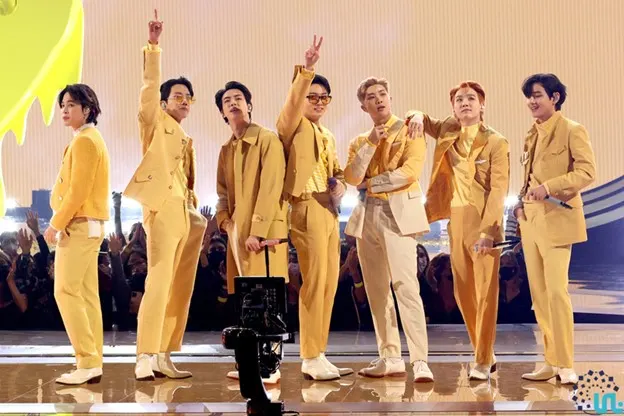
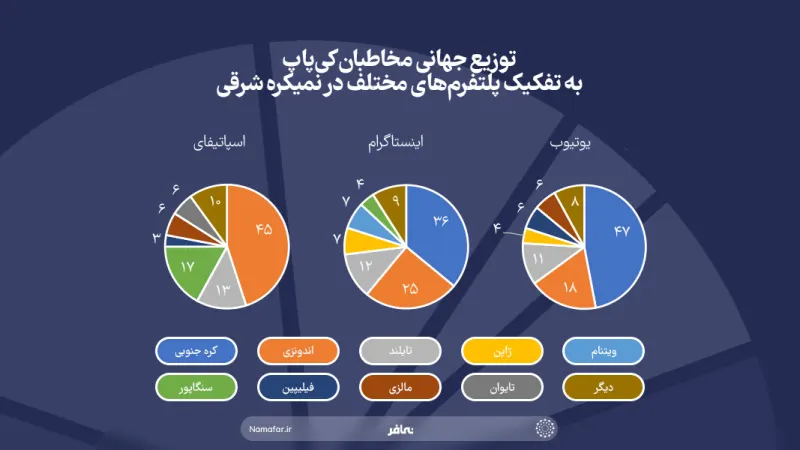
In a survey conducted in 2021 in 18 countries, about 39 percent of respondents stated that the K-pop genre is very popular in their country. This result showed that the popularity of Korean pop music extends far beyond the borders of South Korea. An examination of the world's top 200 K-pop acts confirms that the highest level of consumption can be found in East and Southeast Asia. This statistic is the same both among Instagram followers and in YouTube views.
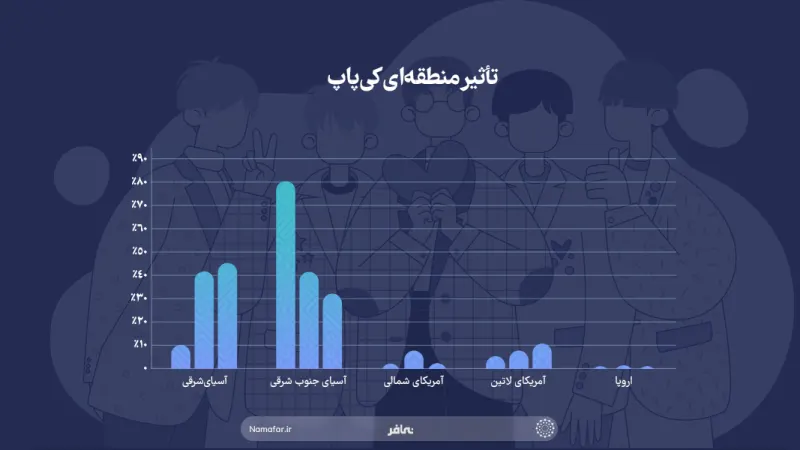
The discrepancy in Spotify's monthly listeners in these two regions is due to its muted presence in East Asia. For example, Spotify was not launched in Korea until February 2021, and it is also not available in China and competes with local streaming services in Japan. When we expand the scope of our examination to the global level, we see that Korean K-pop groups, in addition to the East, have also opened a place for themselves in North and South America.
The largest consumers of K-pop
To monitor the countries that have the highest level of consumption of Korean pop, various components are in our hands. Components such as the amount spent on this music in each country or the time allocated to it. Countries such as China with 26 percent of total exports, the United States with 15 percent and Hong Kong with 6 percent, Vietnam with 10 percent, Japan with 4 percent, and Taiwan with 3 percent are among the largest consumers of K-pop. South Korea's trading partners act as good representatives for K-pop. Based on estimates, the export value of the K-pop music industry is about 10 billion dollars annually, half of which is allocated only to the BTS group.
Based on a survey conducted in 18 countries in 2021, respondents in the United Kingdom spent the largest amount of money on K-pop groups, at 25 billion dollars. After that, the highest figure belongs to the United Arab Emirates with 24 billion dollars and the United States of America with 22 billion dollars. In this year, on average, 10.8 dollars a month was spent on K-pop worldwide. But based on time spent, Vietnam, with 38.5 hours per month, is considered the highest-consuming country. While the global average of this statistic is 26.8 hours per month.

The popularity of K-pop in the Western world
The growth of K-pop in Latin America is a strange phenomenon. Because geographic location, linguistic diversity, and cultural differences cause some to disregard this region as a consumer market for this type of Korean music genre. Whereas Korean K-pop has taken large steps to fill these gaps. For example, many K-pop artists have sung Spanish songs and collaborated with local artists.
It appears that K-pop's topics and themes have attracted the attention of Latin audiences. Optimism, humility, love, self-improvement, hard work, and self-restraint are all a complete departure from Western pop. In truth, K-pop dance and music are a new and cheerful start for the youth of South America.
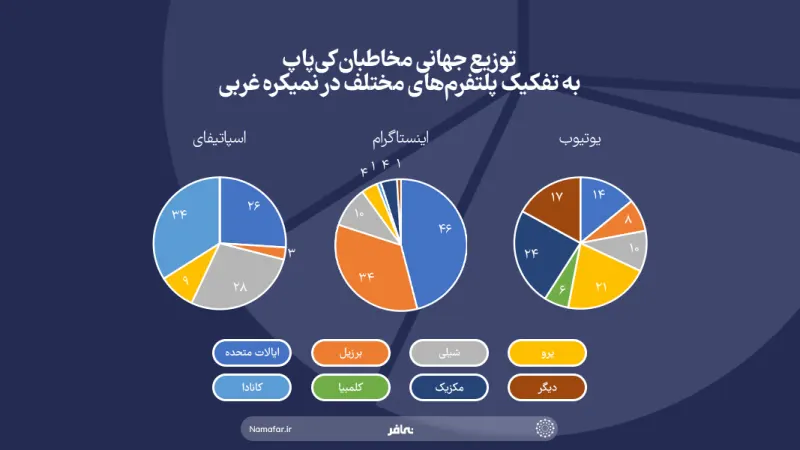
An examination of YouTube and Spotify statistics shows that in the Western Hemisphere of the world, Mexico has the largest number of listeners and viewers of K-pop music and concerts. Then the United States, Peru, and Chile are at the top. Although Instagram has a large deviation from this trend, overall the three countries of Mexico, Chile, and the United States account for 90 percent of K-pop followers.
The impact of the government's role on the success and popularity of K-pop groups
The popularity and success of Korean K-pop is to a very large extent the result of the correct policies of the South Korean government over the past two decades. It was 1998 when the government of Kim Dae-jung, out of fear of brain drain, created the Ministry of Culture alongside sport and tourism and allocated 148.5 million dollars to the promotion of cultural industries. In this ministry a special office was also created that was responsible for developing local pop music along with fashion, dance, film, and art. This important matter coincided with the end of government censorship and the lifting of the cultural ban on Japan, which led to an increase in Japanese consumption of Korean culture and created a large market for their productions.
After that, Korean music, alongside other domains of culture, as a way to accelerate economic recovery, received the support of the government, banks, and private companies. The amount of investment in the field of culture and art from 2009 to 2013 increased from 1 billion won to 319 billion won, or 280 million dollars. In 2022 this figure for the first time exceeded 7 trillion won (6.5 billion dollars). In addition, this ministry pledged to expand regional tours by national artistic groups and to invest in regions that are culturally weak. Now K-pop music has also been added to the national curriculum.
The popularity of K-pop in Asia
Among Asian countries, South Korea itself has the largest share of fans of this music style. Nevertheless, it has left a notable effect in Southeast Asia, such that this region covers at least one-third of consumption on these three platforms. Especially Indonesia and Thailand are the largest importers of the K-pop style. Other countries such as Malaysia, Singapore, and Vietnam also form a considerable part of the K-pop song consumption market in Asia. The widespread appeal of K-pop song and dance across Asia has various causes. In addition to geographic proximity providing the possibility of rapid and easy dissemination, this music style also has great appeal for this region in terms of content. Because the lyrics of K-pop songs mainly have positive themes, which attract the attention of Asia's family-centered culture.
The popularity of K-pop songs in Africa
Nigeria with a 267 percent increase in K-pop streams, Ghana with a 236 percent increase in streams, and Kenya a 140 percent increase are considered Africa's largest consumer markets, respectively. According to Spotify's head of music streaming, to complete surprise, the increase in streams of Korean K-pop groups in sub-Saharan Africa in 2022 had a 93 percent increase, which is more than 3 billion hours of playback.
The impact of the coronavirus pandemic on Korean pop music
The popularity of online K-pop concerts, which increased steadily in the coronavirus period. In 2022 more than 64.3 billion views were recorded on YouTube for K-pop songs, the largest share of which belonged to the BTS group. After that, the group BLACKPINK, TWICE, and Lisa were placed in this ranking, respectively. The income of the BTS group, by holding the largest online K-pop concert held in this period, increased so much that Rolling Stone magazine wrote: "BTS proved the fastest money circulation is here." The global wave and export of K-pop during the coronavirus pandemic, unlike other industries, not only was not harmed but found even greater prosperity.

Conclusion
Korean pop songs, with bouncy rhythms and beats, coordinated and appealing K-pop dances, the use of fashion, and the singing of positive lyrics by young and beautiful idols, have become a popular style and have linked culture with the economy. Determining whether Korean K-pop music can deepen its roots as a music style is somewhat difficult, but it is clear that this genre has been able, as an appealing and flexible art, to gain growing popularity around the world.
The range of influence of K-pop music has expanded not only at the regional level but throughout the world. Although geographic proximity has caused the largest number of K-pop fans to appear in Asia, over the past ten years this genre has been able to cross borders and find growing audiences in North America, South America, and even Africa. This development is in part due to South Korea's position as an export-based economy. In addition, the flexibility of the K-pop music style for combining with local cultures has turned it from a Korean art into a global phenomenon. Interest in kpop songs is still growing, but it remains to be seen whether this global interest is a fleeting current or a lasting one!
Do not miss reading the post The role of creative content agencies in advancing the Korean Wave.
Machine-translated from Persian by Namafar; the Persian original is authoritative. Read the original in Persian