Until just two decades ago, the only image of South Korea in the world's mind was the ruins left from the war with North Korea that were seen at the Seoul Olympics. Now, however, even in the most remote parts of the world K-pop songs are heard, Korean filmmakers capture the most prestigious cinema awards, anime is recognized as one of the most popular genres, and every day the number of Korean-language learners increases. A country that at most was known for its cars has so firmly planted its heel in the ground of culture that it is considered a cultural hub with hundreds of millions of fans worldwide.
South Korea's content industry; global influence
The global influence of South Korea's cultural industries, which is known by the term Hallyu, has been able to turn Korea into one of the most successful non-Western countries that produces and exports a wide range of cultural genres and forms.South Korea's content industry includes various cultural sectors including publishing, music, games, broadcasting, film, and animation. The table below shows the export trend of some of these sectors from 2013 to 2020, in which the growth of all of them is evident.
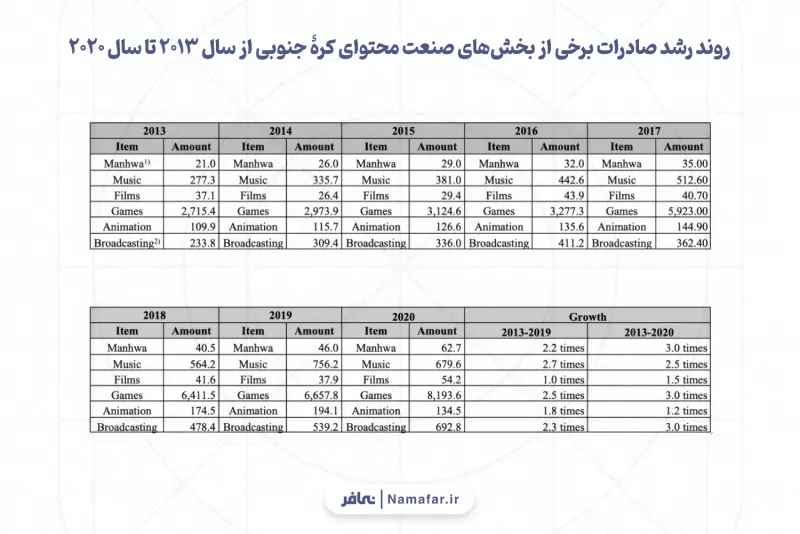
Manhwa is the Korean term for printed comics and cartoons, which here also includes webtoons (digital comics). Exports of this sector from 2013 to 2020 grew 3 times and went from 21 million dollars to 62.7 million dollars. This growth was 2.5 times for the music sector, 1.5 times for film, 3 times for games, 1.2 times for animation, and 3 times for broadcasting (including drama series and other television programs).
The total export value of South Korea's content industry in 2022 was estimated at 13.24 billion dollars. We grasp the magnitude of this figure when we look at some of Korea's leading export items. For example, in 2022 the export value of secondary batteries was 9.9 billion dollars, electric vehicles 9.83 billion dollars, and home appliances 8.06 billion dollars. Of course we should bear in mind that Korea's exports of cultural goods are still negligible compared with the exports of industries such as semiconductors, automobiles, and ships. In 2020 the total export value of cultural goods was equivalent to only one percent of the export value of semiconductor goods. Nevertheless, the striking growth of South Korea's cultural industries market proves the immense capacity of content as a good that, alongside other industries, can be a driver of economic growth, job creation, and, more importantly, cultural influence.
The trend of Hallyu's growth in the world
The chart below shows the trend of the increase in Hallyu fans on the basis of the number of people and the number of countries.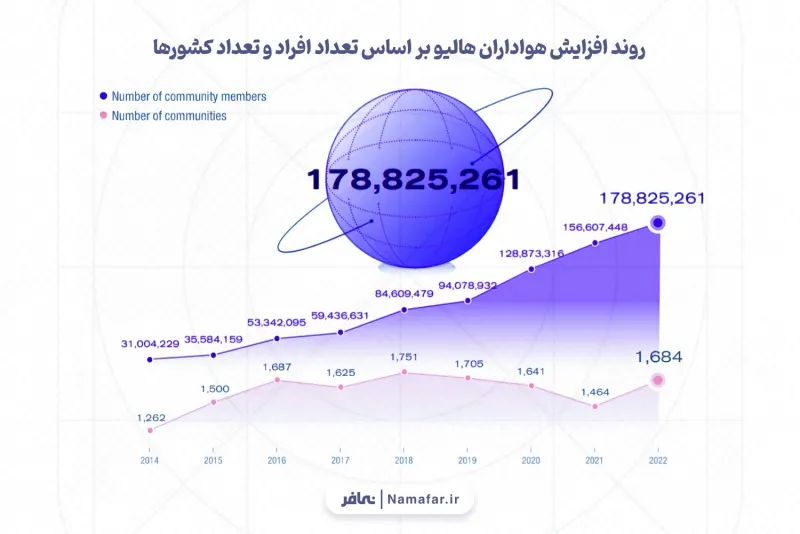
The number of Hallyu fans in terms of people, with an upward trajectory, went from 31 million people in 2014 to more than 178 million people in 2022. Also in terms of the number of countries, from 1,262 countries in 2014, after passing through two declines in 2017 and 2021, it reached 1,684 countries in 2022.
The figure below shows the trend of Hallyu's growth on the basis of geographic distribution.
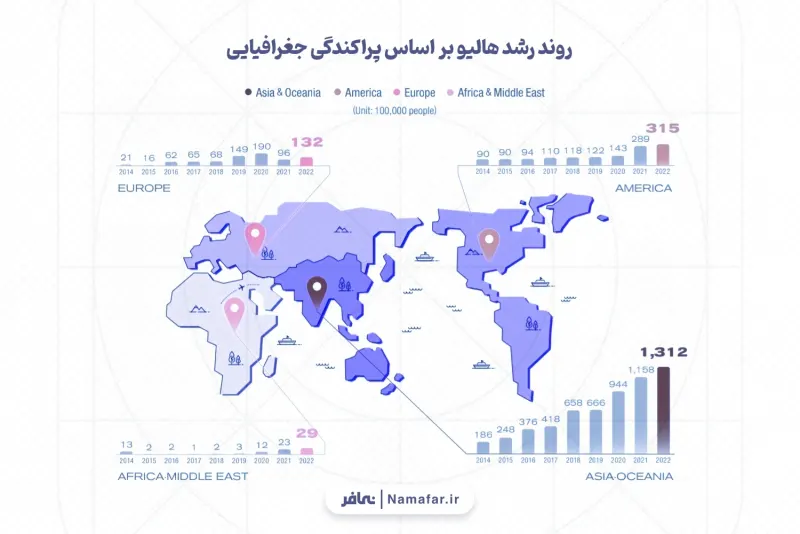
In this figure the world is divided into four parts—Asia and the Pacific, the Americas, Europe, and Africa and the Middle East—and the greatest growth of Hallyu fans has been in the two parts Asia and the Pacific and the Americas. In Asia and the Pacific the number of Hallyu fans went from 186 units (each unit equals 100 thousand people) in 2014 to 1,312 units in 2022. Also in the Americas it went from 90 units in 2014 to 315 units in 2022. Although this amount is smaller in Europe and in Africa and the Middle East, in these two parts as well we have witnessed an upward trend over the years 2014 to 2022.
Where did Hallyu begin?
The crystallization point of Hallyu should be sought in the 1990s; right in the midst of the Asian economic crisis that pushed Korea toward technology and the digital economy. On the other hand, recognition of the export capacity of cultural content in this period changed Korean policymakers' understanding of the cultural industries from "something that must be controlled" to something that "can be one of the export axes." Following that, industrial policymaking too, alongside leadership in fields such as electronics and automobiles, shifted toward the creative sectors, and various programs were defined for the growth of the cultural industries.The Ministry of Culture's role in developing the creative industries
Meanwhile, Korea's Ministry of Culture has played an important role in directing the government's approach toward the cultural industries. This ministry, in addition to its usual role of supervising the cultural sectors, has also devoted itself to developing the cultural industries, and this very dual role shaped Korea's cultural-economy policy in the 1990s. Over time, as the cultural industries became a notable sector in the economy, the Ministry of Culture's role in expanding the cultural sectors also became more prominent. In other words, with the placement of the cultural industries at the center of the new economic development framework, the Ministry of Culture took on the task of being the hub of coordination and support for government cultural organizations. One of the Ministry of Culture's initiatives in this period was the establishment of the Creative Content Agency, which has had a great impact in advancing Hallyu.Establishment of the Creative Content Agency; the Korean government's most important initiative
The Korean government in 2009, to streamline support for the creative industries under a single body, merged the Creative Content Agency with several preexisting organizations, namely the Korea Broadcasting Institute (KBA), the Korea Game Agency (KOGA), and the digital content business group from the Korea IT Industry Promotion Agency (KIPA). In fact, the formation of the Korea Creative Content Agency (KOCCA) in its present form is considered a turning point in the growth trajectory of South Korea's creative industries, which brought support for media content production, talent development, and technological innovations under one umbrella. The Korea Creative Content Agency is responsible for providing funding, resources, and training programs for the global development of Korea's cultural industries. It also facilitates the exchange of ideas and collaboration between content creators and global partners in order thereby to expand South Korea's cultural influence.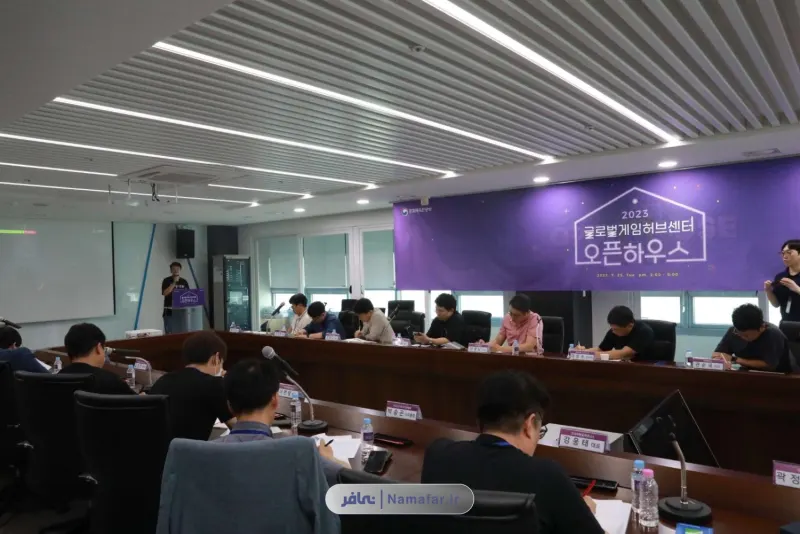
Duties of the Creative Content Agency
Innovation in content production
Creative content agencies, through managing production teams, participate in making music, television shows, and films. But their activity is not limited merely to these traditional media sectors; they also play a significant role in the development of new media and digital content. Financing virtual reality (VR) and augmented reality (AR) projects and supporting online games have been among this agency's actions. In fact these efforts are carried out in pursuit of South Korea's macro policy of leading technological innovations in the creative industries. Therefore it should be noted that the Hallyu phenomenon has been the result of a convergence between culture and technology, not merely a one-dimensional effort toward content production. In 2022, there were 381 virtual reality and augmented reality companies in the city of Seoul and a total of 711 companies across South Korea. That year the size of South Korea's virtual reality and augmented reality industry market was 4.14 billion dollars, which is forecast to increase by 2027 at a compound annual growth rate of 30.1 percent.Discovering and developing talent
Creative content agencies play an important role in discovering and developing talent, especially in the music and entertainment industries. Large entertainment agencies such as SM Entertainment, YG Entertainment, and JYP Entertainment have created training systems that help strengthen artists' skills. These trainings include dance, singing, and acting and even foreign languages, which often start from a young age. By 2023 more than 200 entertainment agencies have been registered in South Korea, which are mainly focused on the music industry, especially K-pop. For example, SM Entertainment has a rigorous training system known as the SM Rookies program that prepares trainees for future careers as K-pop idols. This structured talent development has created high successes for artists at the domestic and global levels. More than 70 percent of K-pop idols who have been trained by the large agencies achieve notable success in their first year of activity.
Marketing and branding
Creative content agencies not only help artists grow but also engage in the production, marketing, and distribution of content at the global level. Agencies strive to create a favorable image of Korean cultural products in the world, which is done through social media platforms such as YouTube, Instagram, and TikTok and international partnerships across the world. For example, the group BTS, which is managed by the company HYBE, owes its fame and popularity to a large extent to this company's media strategies. So much so that it has been able to form an international fan base called ARMY for itself on social media. This group's YouTube channel now has 78.6 million subscribers.Hallyu's achievements with the Creative Content Agency as driver
Now that we have become aware of the breadth of Hallyu's influence with the Creative Content Agency as driver, it is worth examining further its results for South Korea.Tourism
One of the indirect effects of Hallyu for South Korea has been the growth of the tourism industry, which has turned this country into a major tourist destination in the world. In 2019—one year before the COVID-19 pandemic—South Korea attracted more than 17.5 million tourists and its revenue reached 20.7 billion dollars. Some of these tourists travel to Korea specifically for Hallyu-related activities such as attending K-pop concerts or visiting the filming locations of popular dramas. In a survey conducted in 2023 in South Korea, 16 percent stated that they had chosen this country as a travel destination to attend a K-pop concert or other Hallyu-related activities.Music
Today K-pop has many devoted fans not only inside South Korea but across the globe. This country's music industry exports went from 22 million dollars in 2005 to 927 million dollars in 2022. In a survey conducted in 2022 in 26 countries, about 46 percent of respondents stated that K-pop is very popular in their country.Film
The film industry too, like music, has had notable growth inside and outside Korea. In 2020 the Korean film "Parasite," as the first non-English film that was able to win the Oscar, made history and had a tremendous impact on the global standing of Korean cinema. The value of Korea's film exports in 2022 reached 71.5 million dollars, which was the highest figure after 2005.Games
Games are considered one of South Korea's most successful cultural industries. This country has consolidated its position as a major international player in the electronic sports industry. South Korea is the base of some of the world's largest game companies such as NCSoft, Nexon, and Netmarble. In 2022 South Korea exported the equivalent of 8.98 billion dollars of games to the world.Summary
In recent years South Korea's cultural industries have experienced astonishing growth in the world and have become a notable sector of this country's economy. At the heart of this wave, which is known as Hallyu, are Korea's creative content agencies, which have taken on the task of developing Korea's creative industries. In this note we have first looked at the status of Korea's cultural industries, then, while examining the background of the Creative Content Agency, we have shown its duties and achievements relying on statistics.Short link: nmfr.ir/2yl
Machine-translated from Persian by Namafar; the Persian original is authoritative. Read the original in Persian