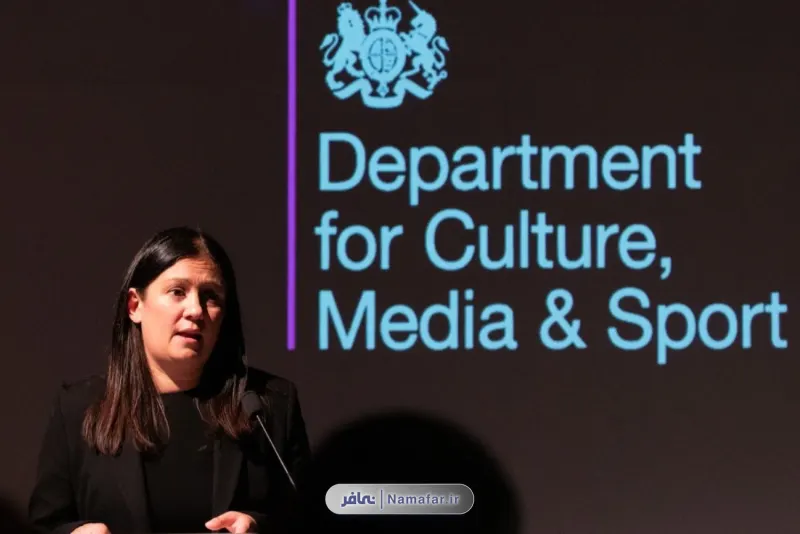
The UK is the world's third-leading creative economy, in whose related policy oversight and development Britain's Department for Culture, Media and Sport (DCMS) plays a central role. This department, which was established in 1992 as the Department of National Heritage, now leads a wide range of vital sectors for Britain's cultural and economic landscape. In other words, one of the UK's most important strategies in developing the creative industries has been to entrust various cultural, media, and sports sectors to this department as a responsible body. In this note, while reviewing the history of DCMS, we examine its actions and the results of its activities.
From the Department of National Heritage to the Department for Culture, Media and Sport
This department was first established in 1992 by the then prime minister under the name Department of National Heritage, whose aim was to increase government involvement in sectors such as the arts, sports, broadcasting, tourism, and national heritage. At that time, Britain was seeking to strengthen its cultural sectors with a focus on promoting British identity and heritage.
But in 1997 this department was renamed the "Department for Culture, Media and Sport," which indicated an expansion of its powers. Radio, television, and media were placed more centrally under this ministry, and its importance in Britain's modern culture and economy became more prominent. The department then began supporting the creative industries and considered their capacity not only culturally but also economically.
The digital transition and legal reforms (2010)
During the 2010s, DCMS saw an increasing focus on digital infrastructure. During David Cameron's premiership, this department began overseeing broadband expansion, internet regulation, and establishing digital culture, which indicates the impact of the digital revolution on media and the creative industries. Some legal reforms, such as protection of intellectual property rights to strengthen the creative economy, were also carried out.
Recent changes and current focus (2020)
In 2023 this department's responsibilities were reorganized, and as a result a dedicated post was created for a government minister for media, tourism, and the creative industries. This reorganization reveals the importance of the aforementioned sectors in terms of economic contribution, job creation, and global influence in Britain's landscape. DCMS now focuses on developing media policy, strengthening the tourism sector, and supporting the creative industries, which include film, music, and games.
DCMS's functions
DCMS has broad powers that cover a wide range of sectors—from traditional cultural industries to modern digital media. The main functions of this department are:
Promoting arts and culture
DCMS is responsible for promoting arts and culture across Britain. This department works with organizations such as Arts Council England to fund and support cultural institutions such as museums, galleries, theaters, and festivals. It also includes the protection of historic sites and buildings. In recent years DCMS has also invested in cultural education to ensure that art and cultural heritage are accessible to all citizens.
Media and broadcasting policy
As part of its media oversight, DCMS formulates and implements broadcasting policies, which include regulating the BBC and commercial broadcasters. This department is involved in issues such as media plurality, digital broadcasting, and the transition to digital services. In response to the rise of streaming services, DCMS also oversees policies for adapting to the changing media landscape. Its aim is to support British broadcasters, so as to ensure they remain at the level of global competition. Through such measures the department seeks to elevate Britain's standing as a cultural powerhouse while also creating significant economic benefits.
Tourism development
Tourism is another vital area under DCMS. This department works with VisitBritain and VisitEngland to present Britain as a leading travel destination in the world. This country implements strategies aimed at increasing international and domestic tourism. In addition, DCMS plays a role in developing sustainable tourism practices to reduce environmental impacts and so that local areas benefit from tourism growth. Support for cultural heritage and historic buildings that attract millions of visitors annually and contribute to the local economy is among these measures.
Support for the creative industries
DCMS provides significant support for Britain's creative industries—which include sectors such as film, television, music, games, and fashion. For example, it tries, through tax relief and similar initiatives in the film and video game fields, to strengthen the growth of creative companies. DCMS also encourages international collaborations and helps the growth of British talent at the global level.
Digital and online safety initiatives
DCMS is involved in digital and internet policies—especially regarding broadband access, online safety, and cybersecurity. This department works on expanding high-speed internet across Britain and addresses reducing the digital divide between urban and rural areas. It has also introduced regulations to protect users, and especially minors, from harmful online content. This department's recent initiatives include developing frameworks for controlling digital platforms from a security standpoint.
Creative industries: an economic engine for Britain
To know how effective Britain's strategy for developing the cultural and creative industries has been, it is necessary to look at the statistics and review the status of this field. Reports show that Britain's creative industries sector has seen 6 percent growth since 2019 and now accounts for 5.7 percent of this country's gross value added.
The chart below shows the trend of annual revenue of creative, artistic, and entertainment activities in Britain from 2008 to 2022.
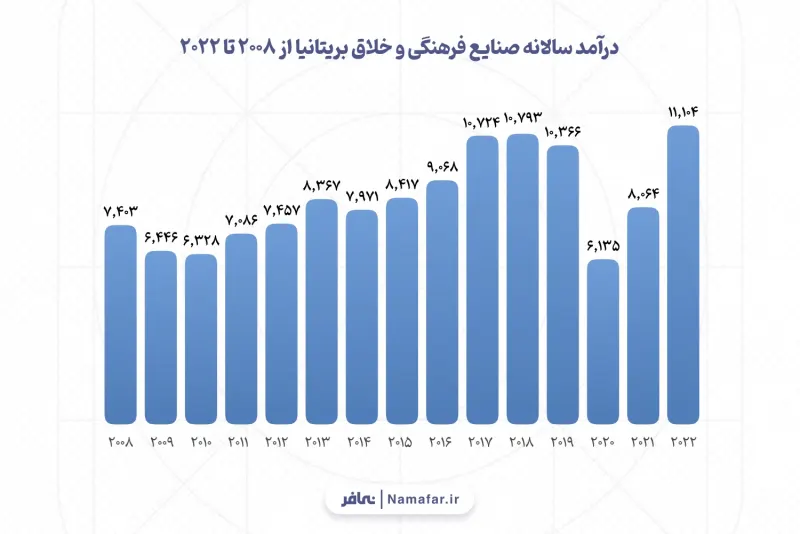
Based on the chart above, revenue of these sectors in Britain in 2022, relative to the previous two years when it had fallen sharply under the impact of the coronavirus pandemic, has seen striking growth and has reached more than 11.1 billion pounds.
The cultural and creative industries in Britain have expanded so much that they have been able to create jobs for 2.4 million people. Creative industries are now among this country's government's top five priorities for England's economic growth, with a plan to reach £50 billion in growth and an effort to create one million more jobs by 2030. The intended budget has also been announced as £77 million.
The most prominent sectors of England's creative industries
The chart below shows the share of Britain's creative industries' gross value added, broken down by each industry.
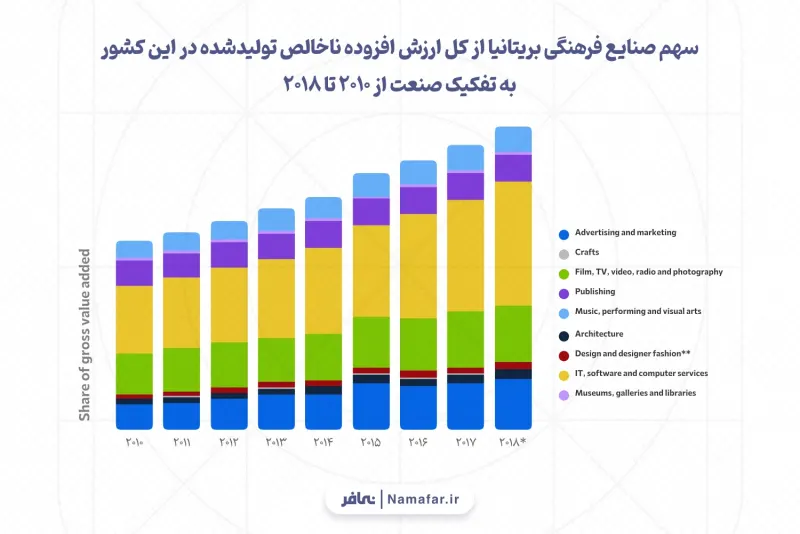
Accordingly, IT, software and computer services with 31 percent, film, television, video, radio and photography with 16 percent, advertising and marketing with 13 percent, publishing with 10 percent, music, performing and visual arts with 9 percent, architecture with 3 percent, and museums, galleries and libraries with 0.8 percent are the most prominent sectors of the creative industries in Britain, some of which we examine specifically below.
Music:
Britain's music industry is the world's third-largest music market after the United States of America and Japan, contributing about £6.7 billion annually to the British economy. This industry tripled its market share from 2010 to 2019 and has been able to employ 210 thousand people, accounting for 0.6 percent of all jobs in Britain.
Video games:
The Department for Culture, Media and Sport has reported that in 2022, IT, software and computer services, which also include video games, generated £53.4 billion in gross value added for the British economy. In fact, Britain's video games sector is considered the largest in Europe.
Publishing:
Britain's publishing industry has also had a notable performance. In 2023 this industry reached £7 billion in revenue for the first time, a 3 percent increase from the previous year. The digital and export segments are considered the strongest parts of Britain's publishing industry. Export market revenue that year was £4.4 billion, a 4 percent increase. Digital revenue was also £3.2 billion, a 5 percent increase.
Film and television:
Britain is the largest location for film and television production outside the United States, attracting about £3 billion in domestic investment in this sector in 2023. Britain's major studios have achieved some of the biggest box-office successes, including Warner Bros., which has signed long-term contracts with Amazon and Netflix. Britain's box office in 2022 had £945 million in revenue, a 57 percent increase from the previous year. Britain's international television program exports in 2022 and 2023 were also £1.85 billion, a significant figure. Overall, the film industry has become a major contributor to Britain's economy and is expected to reach 50 percent growth by 2026.
Closing remarks
Britain's creative industries have seen 6 percent growth since 2019 and now account for 5.7 percent of this country's gross value added. This sector has expanded so much in Britain that it has been able to create jobs for 2.4 million people. England is now considered the world's third-best creative economy. One of Britain's most important strategies in developing the creative industries has been assigning this sector to the Department for Culture, Media and Sport, which was previously titled the Department of National Heritage. Its goal is to increase focus on the aforementioned sectors as part of Britain's cultural and economic vision. In this note we have reviewed the history and evolution of the Department for Culture, Media and Sport as well as its functions. We then examined the state of England's creative industries, drawing on statistics.
Machine-translated from Persian by Namafar; the Persian original is authoritative. Read the original in Persian