In 2034 Saudi Arabia will host the world's most popular sporting event, the World Cup. This work is part of Saudi Arabia's Vision 2030 to diversify this country's economy by promoting the tourism, sports, and infrastructure sectors. Saudi Arabia's slogan in the 2034 World Cup competitions, "Growing Together," wants to show the world this country's transformative spirit in various fields; a slogan that has three main pillars: "Together for developing human capabilities," "Together for developing football," and "Together for developing bridges of connection." Hamid Al-Balawi, head of the Saudi Arabian Football Federation's bid unit, announced in a statement: "This campaign is powered and moves forward by the hopes and dreams of 32 million people in Saudi Arabia."
Saudi Arabia's stadiums for hosting the 2034 FIFA World Cup
Saudi Arabia intends, to host the 2034 FIFA World Cup competitions and meet FIFA standards, to build 11 new stadiums and renovate four existing stadiums. Saudi Arabia's program has special plans for these 15 stadiums in five host cities: Riyadh (8 projects), Jeddah (4 projects), Al-Khobar (1 project), Abha (1 project), and NEOM (1 project). Each stadium is designed so that it not only meets international standards, but also gives construction specialists the opportunity to work on pioneering and innovative projects.
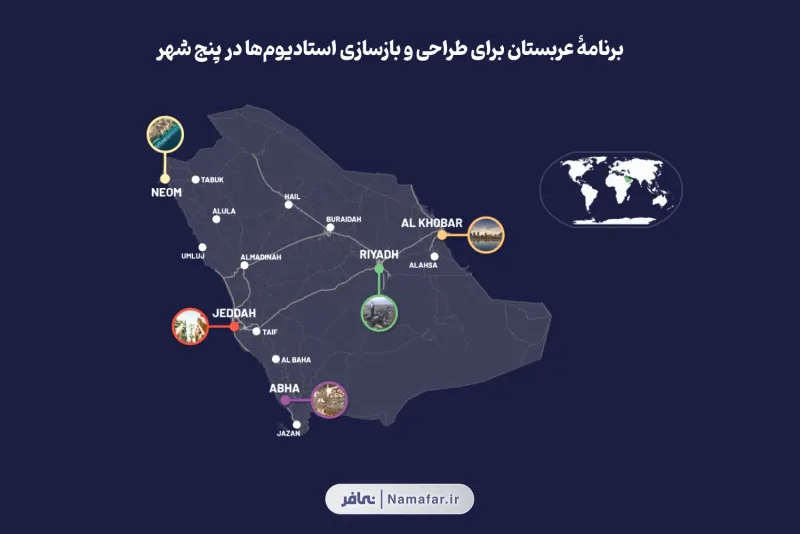
The four stadiums that are to be renovated for holding World Cup matches are as follows: King Saud University Stadium in Riyadh, King Abdullah Sports City Stadium in Jeddah, King Khalid University Stadium in Abha, and King Fahd Sports City Stadium in Riyadh. On the other hand, 11 other new stadiums, each with special designs, have been placed on the agenda of Saudi Arabian officials. For example, King Salman International Stadium in Riyadh, one of Saudi Arabia's largest stadiums with a capacity of 92 thousand people, is being designed and prepared by the Populous team to host the opening and final matches of the 2034 World Cup. The proposed design of this stadium is inspired by a mountain landscape and is being built near King Salman Highway and the large King Abdulaziz Park and will not be far from important centers of Saudi Arabia's capital such as King Khalid International Airport. This stadium has 150 special seats for princes, 120 seats for guests, 300 VIP boxes, and 2 thousand and 200 seats for high-ranking individuals. Also, next to this stadium, other sports facilities such as a hall, an Olympic-sized swimming pool, a track and field course, and outdoor volleyball and basketball courts have been provided. Prince Faisal bin Fahd Stadium is also part of the Prince Sports Park master plan, which is connected to Riyadh adjacent to metro lines and the bus network. This stadium, inspired by Salmani architecture of "modernism with a cultural context," uses local materials and efficient energy systems for construction and is to welcome more than 46 thousand spectators by 2027.
The other new stadium is the 46 thousand-person NEOM Stadium, which is to be built as another part of the 2034 World Cup programs in the 500-billion-dollar city of NEOM. Saudi Arabia has described this stadium as follows: "NEOM Stadium will be the world's most unique stadium. This stadium's pitch is more than 350 meters above ground level and will be accessible only through high-speed elevators and driverless vehicles. NEOM Stadium will use the most advanced technologies for players, spectators, and broadcasters. Meanwhile, this stadium is equipped with renewable energies such as wind and solar sources."
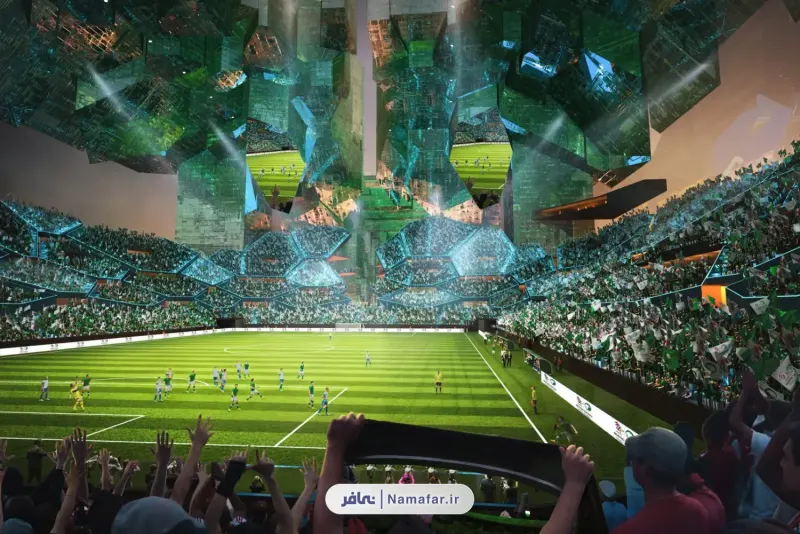
The eight other new stadiums that are to be made ready for the World Cup competitions are as follows: Prince Mohammed bin Salman Stadium in Riyadh, New Murabba Stadium in Riyadh, ROSHN Stadium in Riyadh, South Riyadh Stadium in Riyadh, Qiddiya Coastal Stadium in Jeddah, Jeddah Central Development Stadium in Jeddah, King Abdullah Economic City Stadium in Jeddah, and Aramco Stadium in Al-Khobar.
Festivals for fans
Among Saudi Arabia's special programs for the 2034 World Cup is holding festivals for football fans from all guest countries. Saudi Arabia's program for this work is selecting two symbolic locations in each of the five cities holding the matches that are close to accommodation or public transportation.
In Riyadh the large Qiddiya Festival complex is held, an exceptional place in an open-air space that faces Qiddiya's impressive ancient cliffs; with facilities usually found in indoor spaces. King Salman Park, one of the largest urban parks in the world, is another of this city's attractions prepared for holding festivals.
Khuzam Park in Jeddah combines modern facilities with the historic spaces of the Al-Balad area. Meanwhile Jeddah Waterfront – the famous linear park – provides people with beaches, green spaces, quality accommodations, and a rich cultural and historical environment.
The other city, Al-Khobar, will host King Abdullah Park; a beautiful coastal area close to many hotels, adjacent to Dammam Heritage Village and the stunning views of Al-Marjan Island. King Fahd Park, one of Saudi Arabia's largest parks, is another of the city of Jeddah's attractions that, with lakes, wetlands, and vast green spaces, provides unmatched facilities for holding various festivals.
Al-Bihar Square in the city of Abha, a place with a history of hosting large events, combines traditional Arab architecture with contemporary design; with extensive green landscapes and quality transportation. This city's other symbolic place is Al-Dhahab Park, which with its panoramic views of the Asir Mountains, while providing advanced connections, will continue its hosting tradition as in the past.
In the city of NEOM, Line Marina, as an attractive entrance beside the ocean, provides fans of various teams an extraordinary environment to enjoy football matches. The Marina Steps, surrounded by rapid transportation and access to NEOM's hotels and airports, offer a spectacular view of NEOM's most beautiful and historic landscape, namely Chandelier.
Accommodations: another facility for the comfort and ease of guests
Saudi Arabia has announced that, in accordance with FIFA requirements, it currently has more than 45 thousand hotel rooms across the host cities, and by 2034 more than 185 thousand additional rooms will also open. The table below depicts a view of Saudi Arabia's hotel market over the next ten years.
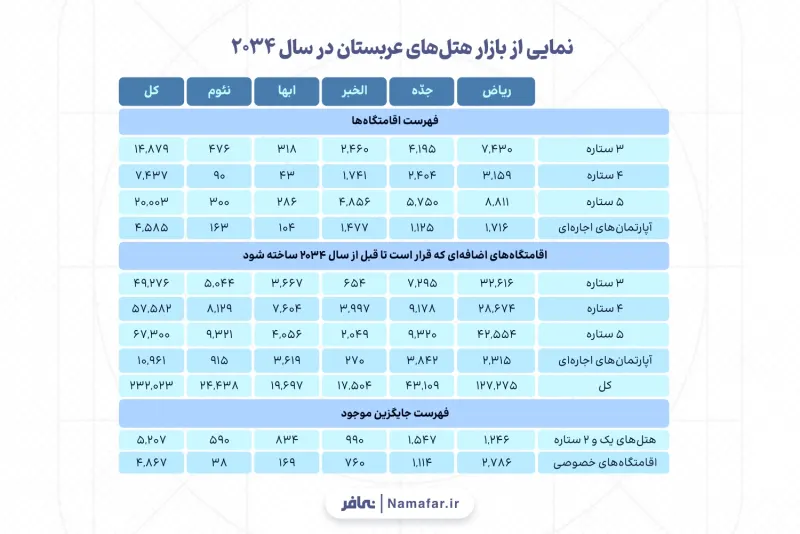
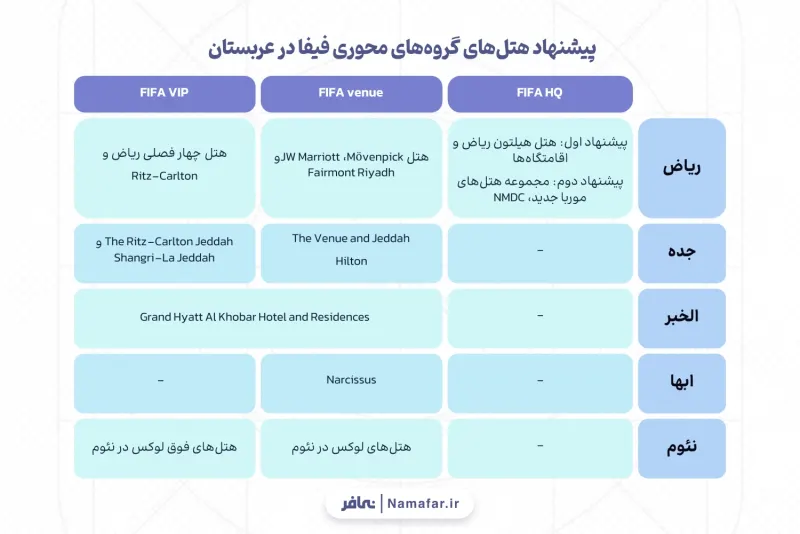
Saudi Arabia considers its fundamental goal by 2030 to be an increase of 150 million international and domestic tourists compared with 109 tourists in 2023. This requires increasing room capacity and building new hotels, which was also mentioned above. In a very interesting plan, the country's officials have proposed "FIFA core group hotels" in each of the five host cities. FIFA HQ hotels provide extensive business facilities for officials and the highest-ranking staff. FIFA venue hotels in each host city will be for the FIFA delegation, referees, member associations, and other FIFA guests and representatives, and finally FIFA VIP hotels are also the exclusive location of FIFA Council members and their guests. A list of the types of hotels in these three groups can be seen in the table below:
Proposal of FIFA core group hotels in Saudi Arabia
Challenges facing Saudi Arabia in the next 10 years
But what challenges may Saudi Arabia face in the next ten years for holding the World Cup? Thinkers have considered three main challenges facing the officials and planners of the World Cup games:
-
Human rights
Saudi Arabia's biggest challenge in the next ten years is the ability to answer this important question: in a country where individuals' rights are routinely violated, how can you guarantee respect for the rights of all members of society of all nationalities? Since 2016, with Gianni Infantino's presidency, FIFA has committed to observing the United Nations principles of respecting and protecting recognized human rights. This is while this country in the international Freedom report in 2024 scored 8 out of 100. Hence the priority of Lina Al-Hathloul of the organization ALQST, which is responsible for promoting human rights in Saudi Arabia, is empowering human rights organizations to ensure action in accordance with FIFA's commitments.
-
Labor rights
The second challenge concerns preserving and respecting labor rights. Qatar's shame at the death of more than 6,500 migrant workers during the 2022 World Cup brings greater attention to observing these rights before our eyes. However, Mustafa Qadri of Human Rights and Equidem, a labor organization, believes the picture of labor rights in Saudi Arabia is ambiguous and complex. That is, on the one hand employees' rights in this country are observed more than in many Persian Gulf countries, and on the other hand it has the worst working conditions among these countries. Qadri points to some of this country's positive changes, including: "workers joining independent unions being legal, workers being allowed to have complaints without legal prosecution, elimination of the law of dismissal from work, and efforts for equal protection of women and men workers." Although he speaks with uncertainty about the progress achieved, "FIFA may be persuaded that everything has improved, like what happened in Qatar."
-
Infrastructure
Saudi Arabia, thanks to building stadiums and the advanced communications and transportation it has, can be optimistic about holding the World Cup. In late January, the first match was held at Kingdom Arena, Al-Hilal's new home, which was built in 180 days. Populous architects published the first maps of Prince Mohammed bin Salman Stadium in Qiddiya, which had been named after the ruling crown prince. This 45 thousand-person hall is to be covered with a large LED screen and installed on the edge of a cliff. Other projects and stadiums are also under construction, which were briefly mentioned in this note. Of course, Ed James of the MEED business intelligence consultancy has considered the ability to deliver all these projects in a short time a worrying matter and believes there is a lack of sufficient resources and the imposition of great pressures in Saudi Arabia. He says: "Many invitations are sent to engineers, construction companies, and related consultants, this while many of them migrate to Dubai and the UAE, and Saudi Arabia also faces two competing markets for attracting talent."
Closing remarks
Saudi Arabia, as part of its Vision 2030 to diversify its oil economy, intends to host the FIFA World Cup games in 2034. Games that, by bringing together people of different nationalities and showcasing its local culture, can give more vigor to the country's economy. Accordingly this country has begun its steps to renovate existing stadiums and build new types with various designs matching the world's current technologies so that it can be a good host from all corners of the world. But various challenges lie ahead of it; challenges such as how to respect the rights of each and every human being and respect for workers' rights which, if it cannot successfully cross them, it will face many problems in successfully holding the World Cup.
Machine-translated from Persian by Namafar; the Persian original is authoritative. Read the original in Persian