Content revenue sharing; from stakeholders' demand to the need for regulation
In the age of the spread of cyberspace / online, the content circulating in this space has become an economic and industrial issue. In fact, human society in this newly emerged age has encountered the appearance of a new market of supply and demand whose essential commodity is "content." The issue of "content industry revenue sharing" is among this industry's economic issues, which has been addressed in various ways in different parts of the world. This serious issue, because it has diverse economic stakeholders, can also become a site of serious dispute. Therefore conflict and disagreement among state actors, private actors, and even general users and digital citizens over this subject is inevitable. But the important issue is some governments' effort for content producers in general to benefit fairly from this industry's revenue. An important part of these producers includes human-media and micro-media that, alongside large and mass content producers, may receive less attention and whose share of this industry's revenue may be treated unjustly. In fact, governments are expected to support observance of justice and the rights of these small and numerous producers so that in this way, in addition to practicing justice, they strengthen the market for micro-media and human-media content production.
Iran's experience; the Supreme Council of Cyberspace's content revenue-sharing resolution
In Tir (June–July) 1403 (2024/25), the Supreme Council of Cyberspace adopted a resolution titled "Policies and requirements for network traffic tariff-setting and content revenue sharing". The background to the formation of this resolution goes back to the early years of the 1390s (2010s), when, with the growth of multimedia content consumption in the country and the expansion of platforms such as Aparat, the issue of revenue sharing and domestic traffic tariff-setting was raised as a policy gap. This resolution pursues goals such as realizing economic justice in the digital content value chain, supporting domestic content production, strengthening investment in infrastructure, and creating competitive platforms. Within the framework of this document, traffic related to domestic content must be subject to a preferential tariff, and operators have been required to allocate part of the revenue arising from users' consumed traffic to platforms and content producers. Also, from an implementation standpoint, this resolution obliges the responsible agencies to design a transparent mechanism for accurate traffic measurement, recording and publishing data, and overseeing the sharing process. Also, the creation of a national system for recording, monitoring, and auditing information related to traffic and revenue has been emphasized.
Why do media reactions to the content revenue-sharing resolution matter?
Media reflection of such documents can play a key role in explaining, interpreting, and also amending and improving them. The media are the communication bridge between the policymaker and public opinion, and analyzing their content makes it possible to recognize hidden or under-expressed layers of concerns, worries, and intellectual support. Meanwhile, the existing disagreements among state and private actors, diversity in media leanings, and at times contradictory representations in media with different political tendencies, all indicate an open and discussable space in the policymaking process. Therefore, statistical and content analysis of these reactions not only helps better understand the country's media space, but is also counted as a tool for participatory review on the path of implementing the document. In this same vein, the Namafar Center for Policy Research and Data Analysis has undertaken a data-driven examination of news published about the content industry revenue-sharing document by the country's news agencies and news sites.
The lineup and confrontation of supporters and opponents of content revenue sharing in the mirror of the news
Based on data mining by the Namafar Center for Policy Research and Data Analysis, from 21 Tir (June–July) to 6 Mordad (July–August) 1404 (2025/26), 239 news items about the content revenue-sharing document were published in news agencies and news sites. Analysis of the approach and sentiment of the published news toward the content revenue-sharing resolution shows that 40 percent of the published news items had a negative approach and treatment toward it. This is while 28 percent of the published news items had a positive and supportive approach toward the content revenue-sharing document. Also, 32 percent of the news items were also neutral and without a particular orientation. This statistical distribution indicates a kind of discursive confrontation with the predominance and heavier weight of opponents; a matter that is usually observed in encountering sensitive national policies, such as regulation of cyberspace / online. One of the most important reasons for opponents being more numerous is concern about rent, corruption, and monopoly in implementing the document. So that 45 percent of the pieces written among opponents arise from corruption-generation and rent-generation in the event of implementing the document.
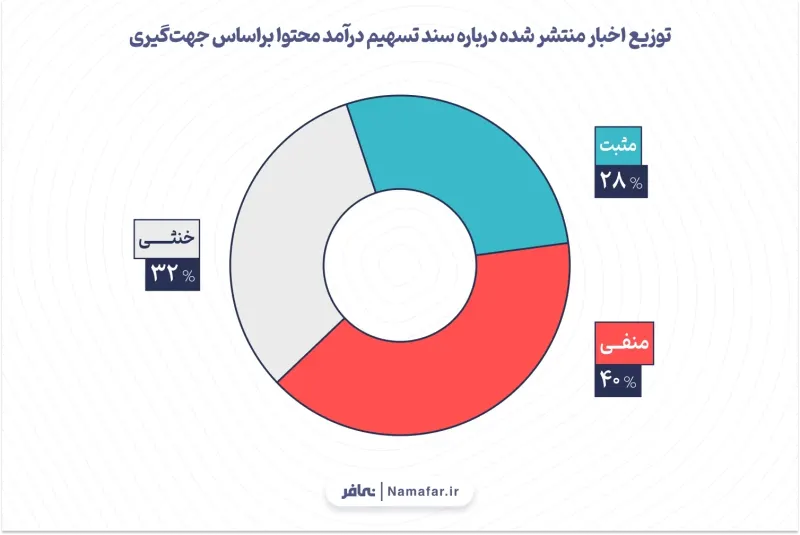
The main disagreement between the two views is between the public sector (organizations and institutions affiliated with the government, SATRA (audiovisual media regulator) (the supervisor), the National Cyberspace Center (the policymaker), the Communications Regulatory Authority (the regulator), and the Ministry of Communications (the implementer), which consider the document a step toward development and justice, and the private sector (private companies and content platforms such as Aparat, Filmnet, Namava, and so on) which have called it a cause of monopoly, rent, and restriction.
Supporters of the plan emphasize "the necessity of content development, network sustainability, and reducing dependence on international traffic and the fair distribution of revenue among domestic digital actors," and the support of digital publishing associations and related institutions for this document has been highlighted. Opponents also emphasize companies' protests, the risk of rent and monopoly, the absence of a limitation on free internet, the increase in internet prices and the negative impact on the private sector, the destruction of independent platforms, the reduction of content diversity, and the government's taste-based steering of content production. These statistics indicate the document's discussability and, on the other hand, indicate the absence of a final consensus in the expert and media body; because even different media with specified factional alignments published different and at times contradictory news about this document.
Which news agencies have published the most news about the content revenue-sharing document?
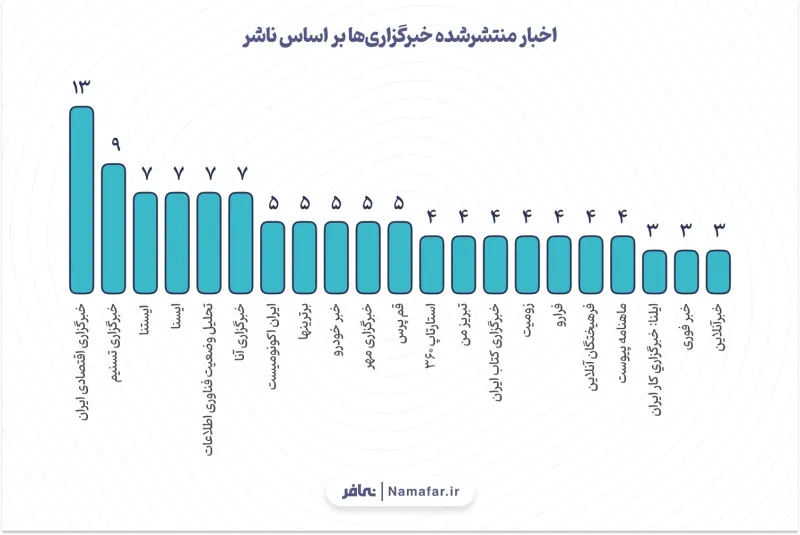
Examining and analyzing the content of leading news agencies and news sites in terms of the number of news items produced and published shows that the "Iran Economic News Agency," with 13 news items, has published the largest number of news items about the content industry revenue-sharing document. Tasnim News Agency, too, which, despite covering the private sector's concerns, has overall emphasized the existence and necessity of the document, with 9 news items, is in second place. Also, news sites such as "ICTNA," "ITNA," and others, which are specialized media in the field of information and communications technology, with an analytical and technical approach, have analyzed this document with a neutral stance. The table below states the status of the most important news agencies in publishing news related to the document and their orientation.
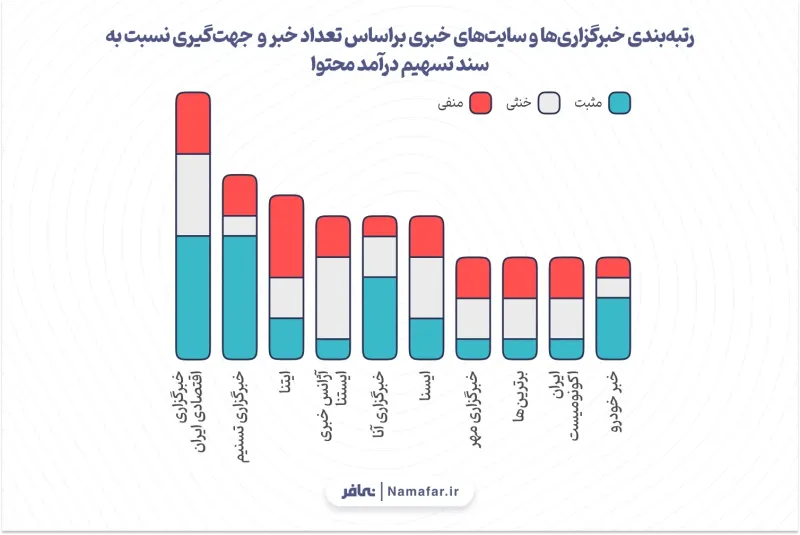
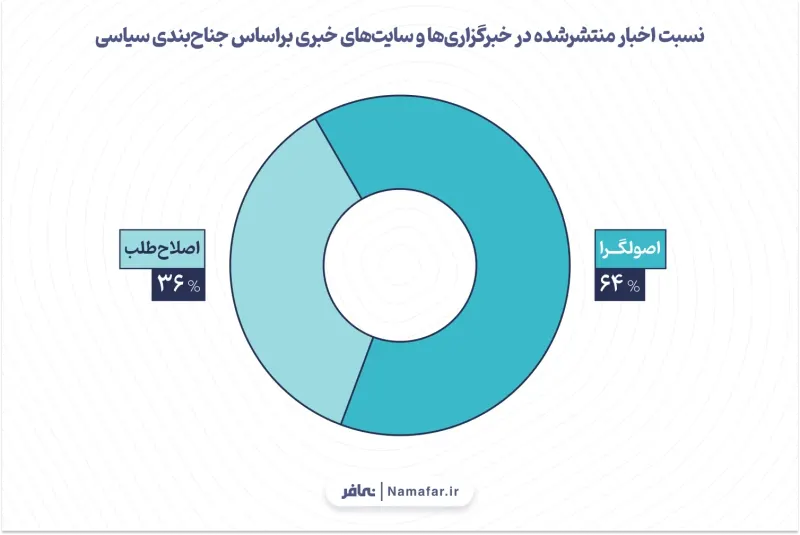
Principlist news agencies' special attention to the content revenue-sharing document
Most of the news related to the content revenue-sharing document was covered by Principlist media. So that 64 percent of the news belongs to this faction's media and the remaining 36 percent was also covered by Reformist media. This subject shows that Principlist media attach greater importance to the document.
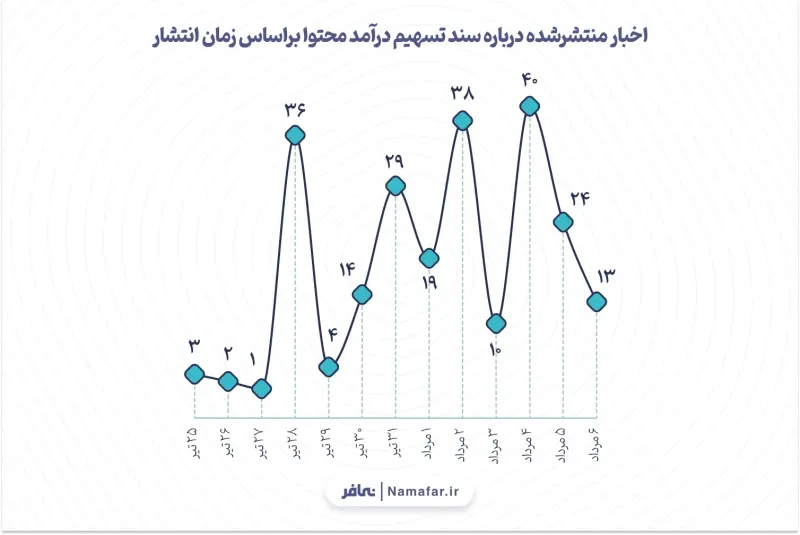
The protest of home video network (VOD) platforms at the center of news agencies' attention
On the other hand, the largest number of news items produced about the document also relates to 28 Tir (June–July) and 2 and 4 Mordad (July–August). 28 Tir is the time of publication of the protest letter of 30 platforms and actors in the home video network (VOD) such as Namava, Filmnet, Tamashakhoneh, and others. An important part of the news included a negative orientation about this letter and republication of it. On 2 Mordad, too, the media's focus was again drawn to discussion about the content document and different views were given about it.
Specialized information and technology news agencies' special attention to the content revenue-sharing document
According to the findings, the intensity and weakness of different news agencies' coverage of the content revenue-sharing document does not have a particular dependence on their factional classification. Also, one of the most important aspects in the number of news items produced by news sites is the prominent presence of specialized news agencies in the field of information and technology.
Based on content analysis of the news, the most important and most frequently repeated headlines published in news agencies have been focused on the subjects of explaining the document of policies and requirements for content tariff-setting, the government's effort to increase the share of domestic content production, the role of the Supreme Council of Cyberspace, the protest of some technology companies and the private sector against implementation of the document, emphasis on the necessity of free internet for realizing the National Internet, and the support of some state institutions for the new policy. In analysis of the linguistic form of the news, too, most news headlines have been written neutrally, but some contain words such as "protest," "without free internet," or "called into question" that have a worrying or critical tone. Also, the structure of most headlines is formal and report-like, and in some cases interviews with managers are used for citation and credibility of the news.
Perceptual and discursive contradictions regarding the content revenue-sharing document
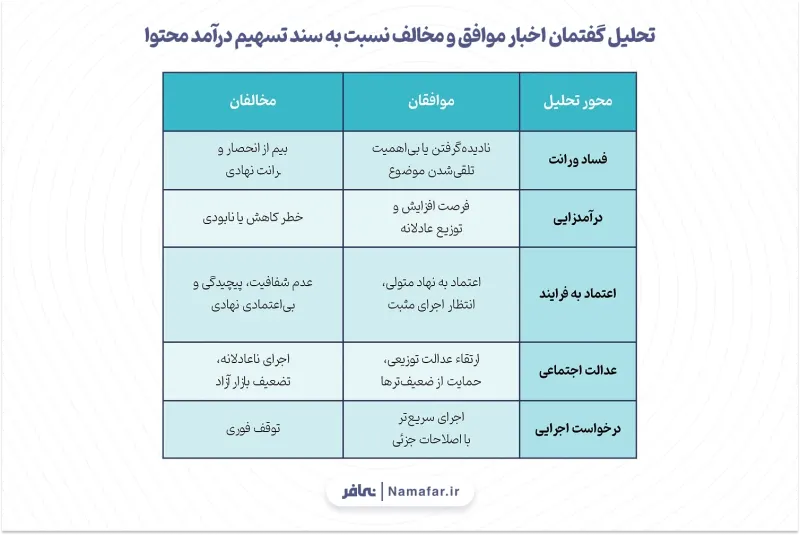
Discourse analysis of news for and against the content revenue-sharing document indicates perceptual and discursive contradictions about its key concepts.
Final word
Although the content revenue-sharing document is the start of an important path in digital governance, without structural reform it also has the potential to become a new source of rent-seeking and distrust. To avoid this danger, the policymaker, instead of hasty implementation, must take the path of social persuasion, dialogue with the private sector, and drafting transparent and binding bylaws. Otherwise, the document will not only fail to reach its goal of supporting content creators, but will itself become a factor in intensifying the state–digital society gap. For this reason it is proposed that the policymaker, by focusing on institutional trust-building, forming an independent oversight body, designing stepwise revenue models, and modeling successful global examples, turn implementation of the document into a platform for redefining justice in the platform economy. The success of this document will be a strategic test of the country's governance system's capability in transparent, participatory, and forward-looking regulation in the field of digital content and, beyond that, in the arena of cyberspace / online.
Machine-translated from Persian by Namafar; the Persian original is authoritative. Read the original in Persian