The narrative of data and statistics: a new language for understanding and analyzing Arbaeen
Arbaeen is not only a religious rite; it is a vast social event, a global collective movement, and one of the largest contemporary human gatherings. This event in recent years has gone beyond a pilgrimage ritual within Iraq's geographic borders and has become a transnational, multilayered, and multidimensional phenomenon; a phenomenon that has within it a combination of popular religiosity, volunteer participation, a unique pattern of popular hospitality (mawkibs), and a kind of civilizational solidarity. But to understand more precisely the grandeur and various dimensions of this phenomenon, one can no longer make do only with emotional images or personal narratives; the narrative of data and statistics is a new language for understanding and analyzing Arbaeen. This note, with a statistical and data-driven approach, tries to take a fresh look at this phenomenon and analyze its social and demographic dimensions in a comparative and trend-based setting.
Global participation in Arbaeen: analysis of the nine-year trend in the number of pilgrims
The Arbaeen ceremony, over the past decade, has gradually turned from an intra-regional religious rite into a large event with global participation. Official data published by the Al-Abbas Shrine show that the growth trend of Arbaeen pilgrims has not only not stopped, but by passing through crises such as COVID-19 has also taken on greater acceleration. Statistics on Arbaeen pilgrims in recent years indicate that the number of participants from about 11.2 million people in 2016 has reached more than 22 million people in 2023. This is while in recent years, not only Iraqi and Iranian pilgrims, but also millions of pilgrims from other countries have joined the Arbaeen walk. Many analysts consider this transnational presence a sign of the internationalization of Arbaeen; a process that, with the help of the media, popular networks, and the expansion of the discourse of unity, is being strengthened.
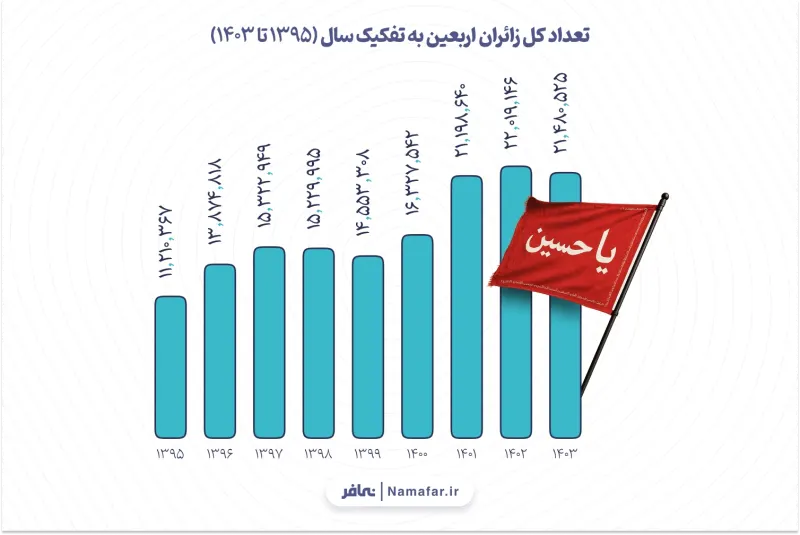
Interestingly, even in the years of restrictions caused by the COVID-19 pandemic (2020 and 2021), Arbaeen's global solidarity did not suffer a pause; rather it continued in more limited forms and with observance of the restrictions. This persistence caused a statistical jump in later years; such that in 2022 alone more than 21 million people participated in this ceremony and in 2023 an unprecedented record of 22 million people was registered. In analyzing the reasons for this upward trend, one must point to the role of the expansion of service infrastructure, the increase in global recognition of Arbaeen, and the active presence of regional and international media. The reasons for the growth of foreign Arbaeen pilgrims can be sought in the increase in the security of the routes, the strengthening of cultural relations among nations, and also the expansion of face-to-face publicity in various Islamic countries. These statistics are not only an indicator of quantitative growth, they are also a reflection of a deep transformation in Arbaeen's position as one of the symbols of the unity of the Islamic ummah; a rite that day by day more fully crosses national borders and becomes a manifestation of global solidarity.
Iran in the text of Arbaeen: a statistical narrative of the presence of Iranian pilgrims at Arbaeen
One of the key components in the quantitative analysis of the Arbaeen ceremony is examining the share and presence of Iranian pilgrims in this immense gathering. A look at the statistics of Iranian Arbaeen pilgrims in the time interval 1389–1403 (2010–2025) shows that the trend of Iranians' participation in this religious-social rite has in recent years been continuously upward and in some periods has passed the threshold of three million people. The peak of this trend occurred in 1402 (2023/24); a year in which for the first time the number of Iranian pilgrims went beyond 4 million people.
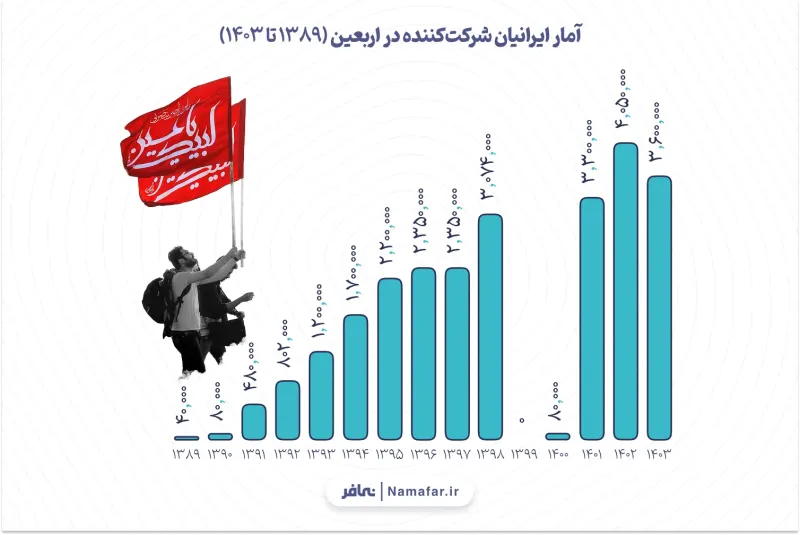
On the basis of official data published by the Holy Al-Abbas Shrine and the Central Headquarters of the Arbaeen of Imam Husayn (AS), in 1389 (2010/11) about 40 thousand Iranians participated in the Arbaeen walk. This number over several years increased with a gentle slope and in 1394 (2015/16) reached one million and 700 thousand people. The turning point occurred in 1398 (2019/20); where for the first time more than 3 million Iranian pilgrims (3,074,000 people) were present at Arbaeen. Although 1399 (2020/21), because of the outbreak of the coronavirus and the borders being closed, saw the recording of a figure of zero, the gradual return in the years 1400 to 1402 (2021–2024) indicates the rapid revival of this participation. In 1402 (2023/24), the highest amount recorded in the entire period occurred and the number of Iranian pilgrims reached 4,050,000 people. Although the figure announced for 1403 (2024/25) (on the basis of data of the Central Arbaeen Headquarters) indicates a relative decrease and reaching about 3,600,000 people, Iranians' participation has still remained at a very high and determining level. This increasing trend indicates a kind of national solidarity in the setting of Arbaeen's global solidarity. The increase in the population of Iranian pilgrims can be seen not only as a sign of religious fervor, but as a reflection of the institutionalization of global participation in the Arbaeen ceremony; a current in which Iran is considered one of the largest centers of participation and dispatch of pilgrims.
Arbaeen in second place among the world's largest peaceful gatherings
Every year millions of people in corners of the world gather in rites; from religious festivals to funeral ceremonies and cultural gatherings. But which of these gatherings are among the largest peaceful gatherings in history? And what is the place of the Arbaeen ceremony among them? To answer this question, an examination of statistical data from international sources shows that some ceremonies, by virtue of age, geographic scope, and cultural dimensions, have reached rarely matched numbers of participation. Citing these same data, the ranking below presents a precise picture of Arbaeen's place among the world's largest gatherings. In this ranking, Kumbh Mela in India, by a very large margin, is at the top; a ceremony with a participation capacity of hundreds of millions that is held once every 12 years. But the Arbaeen walk in Iraq, with more than 22 million participants in 2023, is the second-largest peaceful gathering in contemporary history and, more importantly, it is the largest annual ceremony that is held continuously. This place becomes more prominent when we consider Arbaeen's popular and volunteer structure.
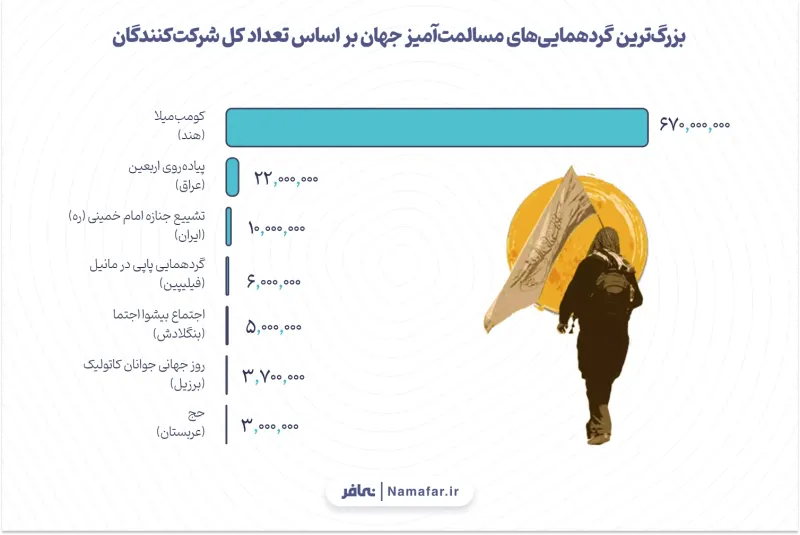
Unlike many other gatherings whose organization is the responsibility of centralized government or religious institutions, Arbaeen relies on a spontaneous network of pilgrims, mawkib holders, benefactors, and ordinary people who, without central concentration, produce unmatched order. From this perspective, the internationalization of Arbaeen is not merely a publicity process, but a reflection of a structural transformation in religious and cultural participation in the Islamic world. The presence of millions of pilgrims from various countries, including several million Iranians, has turned the Arbaeen ceremony into a symbol of global participation, religious solidarity, and popular soft power. Alongside the large numbers, what matters is the quality of the bonds, the depth of the beliefs, and the social energy flowing in this ceremony. Arbaeen is not only a gathering; it is a field of identity-making, transnational empathy, and the representation of a faithful way of life on a global scale.
The increase in the capacity of popular service provision at Arbaeen: a statistical narrative of the number of Iranian mawkibs
Among the various dimensions of Iranians' participation in the Arbaeen ceremony, the role of mawkibs holds a key place. Mawkibs are recognized not only as popular service-providing institutions, they are also a symbol of solidarity, hospitality, and organized social capital in a religious setting. The phenomenon of mawkib-holding is not merely a service activity; rather it is a cultural, ethical, and even epistemic structure that in its inner layers represents a kind of lived embodiment of faith, dignity, and unrequited hospitality. Mawkibs in the Arbaeen ceremony form one of the rarest instances of religious coexistence, giving without expectation of return, and non-profit-oriented social participation in the contemporary world.
In the tradition of mawkib-holding, service is not a duty arising from compulsion, but a matter arising from love and faith. Mawkib servants, from various social, financial, and educational classes, without receiving any wage, give up their sleep and comfort in order to serve pilgrims. Here, the dignity of the servant finds meaning in humility in service, and the pilgrim is not a customer, but a guest of Imam Husayn (AS). Mawkib culture, in an unmediated way, carries the transmission of values such as self-sacrifice, empathy, cooperation, and popular dignity. Many mawkib servants are young people and adolescents who, by entering this space, experience not only service skills but also the manners of ethical living and religious upbringing. Mawkib-holding is in fact a hidden school for training faithful, active, and responsible citizens. A statistical examination of Iranian mawkibs that have succeeded in receiving an official permit to operate at Arbaeen lays before the eye a clear view of the trend of growth, fluctuation, and consolidation of this field institution.
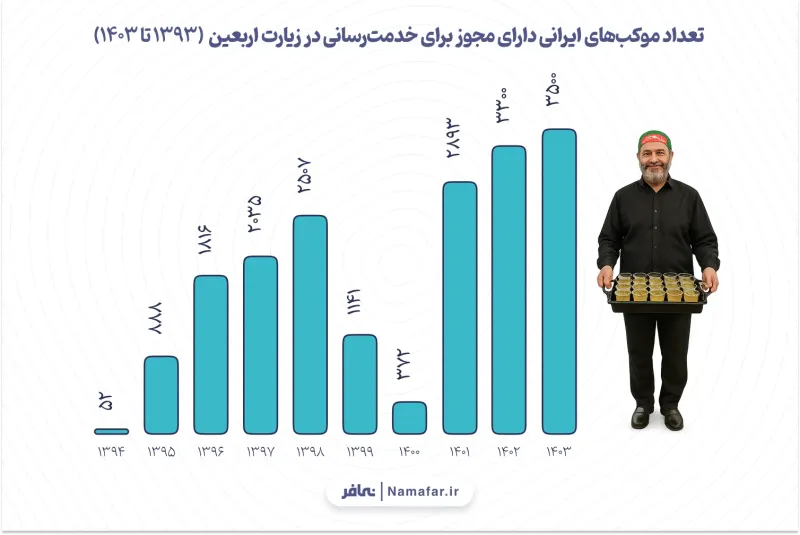
On the basis of officially published data, in 1394 (2015/16) only 52 Iranian mawkibs had an official permit to provide services at Arbaeen. This number, however, in less than a decade has experienced dazzling growth; such that in 1401 (2022/23) the number of licensed mawkibs reached 2,893 and in 1402 (2023/24) passed the threshold of 3,300. Estimates also show that at Arbaeen 1403 (2024/25), about 3,500 Iranian mawkibs with an official permit have been, or will be, stationed on the routes, at the borders, and in Iraqi territory. However, this continuous growth, in the middle of the path, has experienced two years of interruption and a striking decrease;
In 1399 (2020/21), because of the COVID-19 pandemic and Iraq's borders being closed, many mawkibs did not have the possibility of dispatch and a program titled "alternative plan in Iran" was implemented. As a result the number of mawkibs with permits fell to 1,141. In 1400 (2021/22) too, despite a limited reopening, the entry of Iranian pilgrims was conducted in a quota-based form and only 80 thousand pilgrims were dispatched to Iraq. This restriction directly affected the amount of issuance of mawkib permits and the statistic of active mawkibs fell to 372.
In addition to the quantitative dimension, a transformation in the quality of mawkib services has also been placed on the agenda. According to a report by the Headquarters for the Development and Reconstruction of the Atabat Aliyat, from 1401 (2022/23) the process of "drafting standards for mawkib services" has begun. In this framework, indicators such as enjoyment of cooling equipment, public hygiene, a suitable pattern of cooking and distributing food, simple and Iranian architecture, and hospitality manners are taken into account as qualitative criteria for evaluation and issuance of permits. In this way, the trend of issuing permits for Iranian mawkibs at Arbaeen is not only a reflection of extensive popular participation, it is also a sign of the gradual organization of a large volunteer institution as well; an institution that today, not only in quantity but in quality, is experiencing an infrastructural transformation and has the capacity to become a regional "model of cultural-religious services."
Closing remarks
Arbaeen, regardless of what takes place at the surface level, is a mirror of nations' overlooked capacities for coexistence, participation, and collective meaning-making. The statistical data of the present note showed that this rite, not only in terms of number, but in terms of structure, popular organization, and cultural depth, is one of the most unmatched events of the contemporary world. The striking growth of global participation, the extensive presence of Iranians, the unprecedented expansion of volunteer mawkibs, and the consolidation of Arbaeen's place among the largest human gatherings all confirm that this phenomenon, more than before, needs the attention of scientific, cultural, and strategic institutions.
In a world in which individualism and social alienation expand day by day, Arbaeen is a symbol of the revival of human and religious bonds on a comprehensive scale; a model that can be inspiring for new educational, civic, and communicative systems. In order for this capacity to be properly recognized, recorded, and strengthened, Arbaeen must be seen not merely as a religious ritual, but as an interdisciplinary field of study and a civilizational event.
Machine-translated from Persian by Namafar; the Persian original is authoritative. Read the original in Persian