Music is the refuge of contemporary human beings; in most of the moments they pass they are companions of music. It makes no difference whether we are prancing through a land of joy or have rolled into ourselves in grief and sorrow; music accompanies us even in standing on the borders and in not-knowing. For this reason one can claim that music is individuals' most tangible experience of the cultural and creative industries, with a wide circle of audiences and companions. On this basis it is expected that the music industry would have a large market, but in reality the situation is different. Statista's report on the music industry in 2023 has presented key and interesting statistics on revenue, leading companies and publishers, popular artists, awards and so on. This report, by studying trends, has a macro and data-driven look at the music industry, which is reviewed below and its prominent points examined.
The slow growth of music industry revenue
Music industry revenue compared with other creative industries is not a large figure; for example, the advertising and video game industries' revenue is respectively more than 10 times and 7 times that of the music industry. Also, the music industry in the past decade has had little growth and, unlike other industries, has not had revenue leaps. A look at music industry revenue shows that music industry revenue in 2023 reached 65.17 billion dollars. This is while this figure compared with 2012 has increased by only 20 billion dollars, and contrary to expectations the music industry has not been able to have a considerable increase in revenue.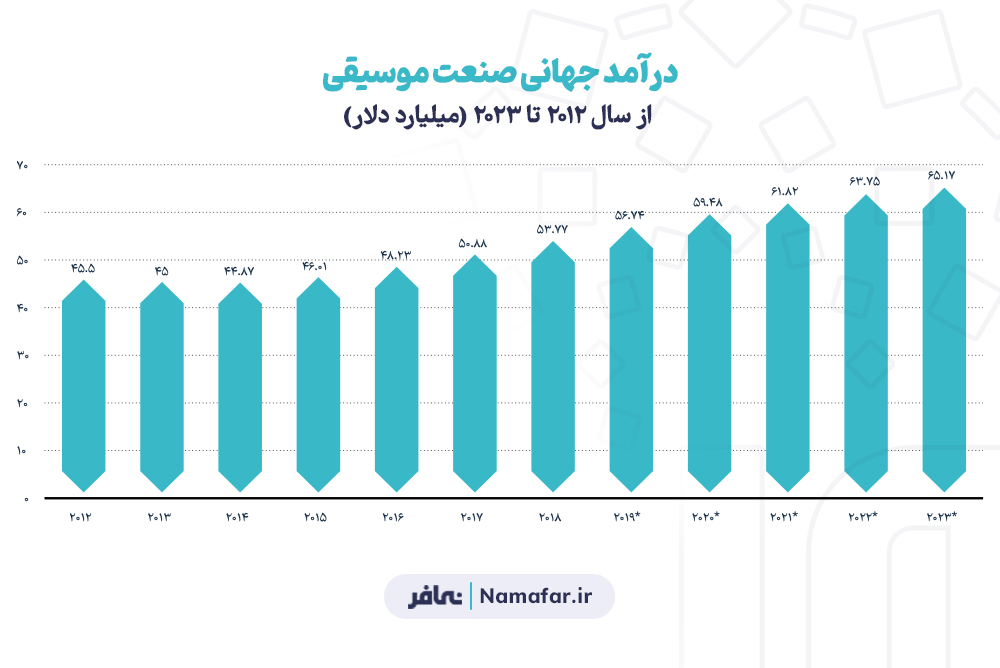
Growth of recorded-music revenue by prevailing over digital music and streaming
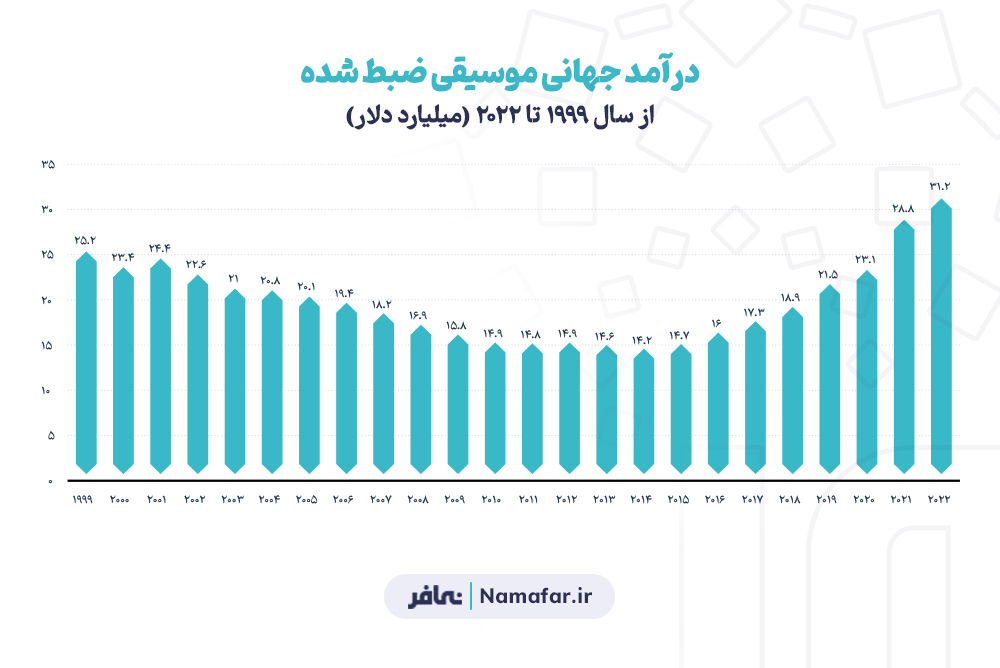
Although the growth rate of recorded-music revenue in 2022 declined compared with previous years, recorded music, with the 31.2 billion dollars of revenue it has, is still the highest-earning segment of the music industry in the world. Streaming-music revenue in 2022 reached 17.5 billion dollars. Digital-music revenue in 2021 also managed to bring 1.1 billion dollars to itself.
The best and largest music publishers
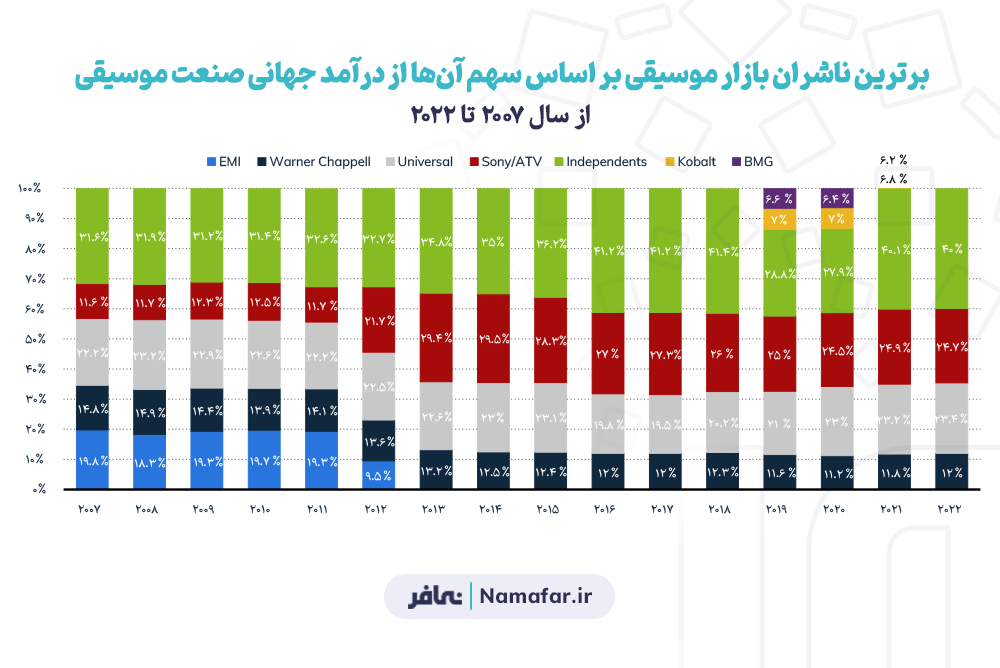
A look at the top publishers in the world music market based on their share of global music revenue shows that independent publishers ( Independents ) still, with 40 percent, have the largest share of music-industry revenue. Independent music refers to music that is produced independently of commercial recording companies and the centers affiliated with them.The company Sony/ATV, which since 2012 has been the largest publisher in the music market, in 2022 also managed, with the 24.7 percent share it had, to repeat this title.
The Universal music company with a 23.4 percent share and Warner Chappell with a 12 percent share of global music-market revenue stand in the subsequent places. Also, no name is seen of music companies such as EMI and Kobalt that in past years held a share of the market.
Online music playback on Spotify
In the second quarter of 2022, about one-third (30.5 percent) of online song-playback subscribers were Spotify subscribers. The number of Spotify subscribers leads relative to the rest of the streaming services. After Spotify, Apple Music with 13.7 percent is in second place and Tencent Music with 13.4 percent is in third place among the most popular music-streaming services. Amazon, YouTube Music, Yandex and so on are a number of other online music-playback services that have found favor and use among music listeners.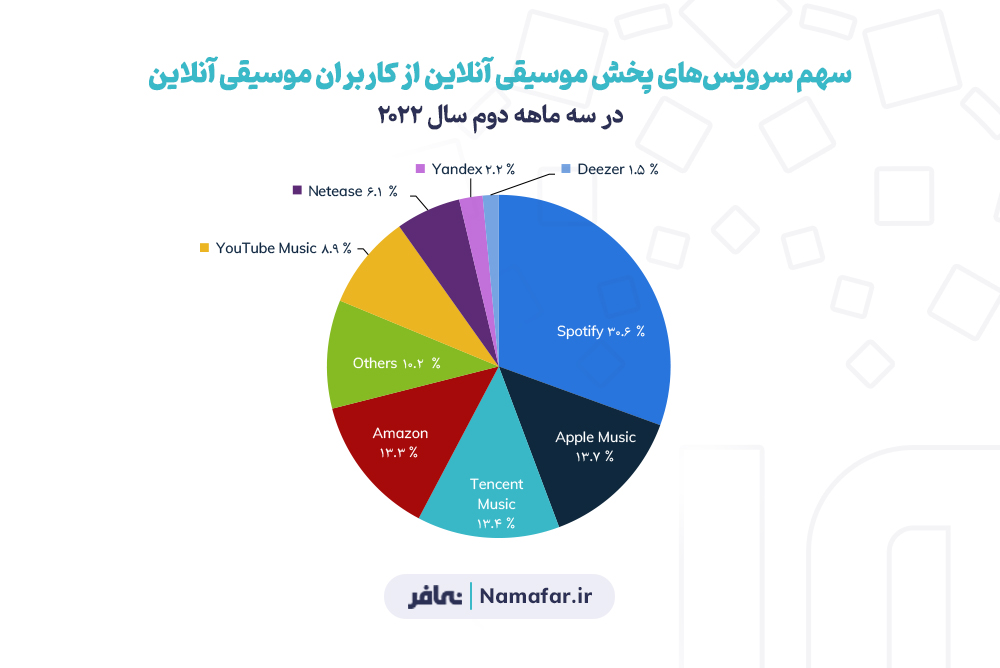
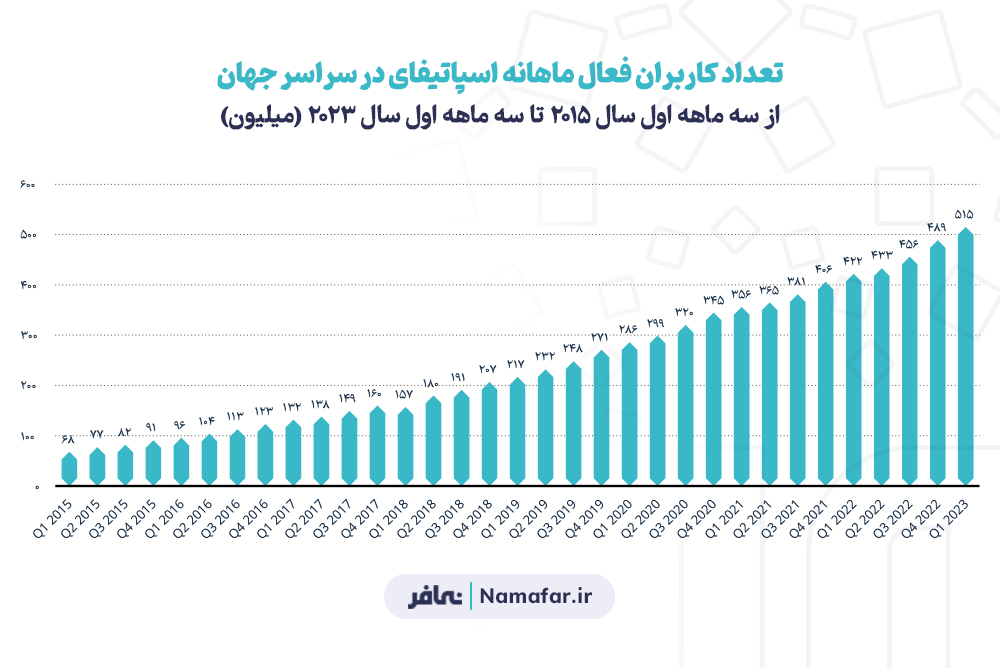
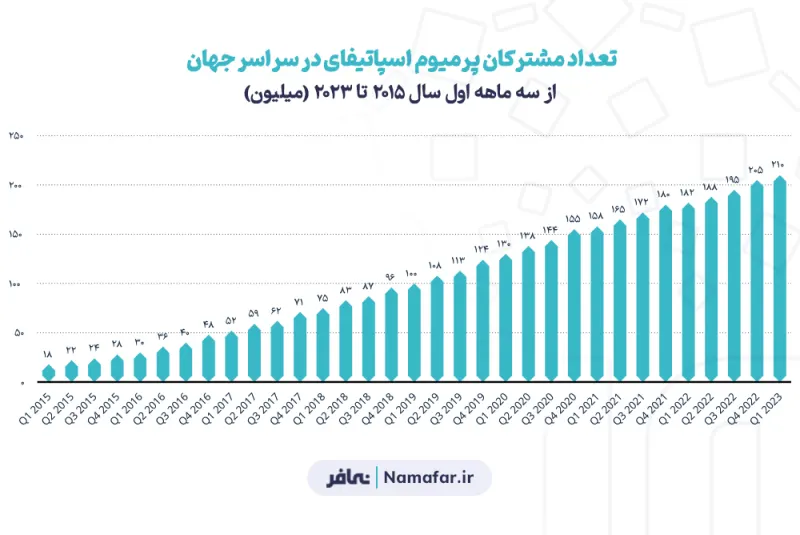
A closer look at the number of Spotify accounts indicates that in the first quarter of 2023, Spotify has 515 million active users worldwide. The Spotify service over the past year has had an increase of more than 26 million users. Also, the number of Spotify premium subscribers over the past year has increased by more than 28 million users and has gone from 182 million subscribers to 210 million subscribers.
The live music market's effort to escape the disruption of COVID-19
In line with expectations, live-music-event revenue during the COVID-19 pandemic declined by more than 75 percent, such that global live-music revenue in 2020 reached 7.32 billion dollars. Even so, live music from 2021 itself set out on the path of recovery and in 2023, with 28.86 billion dollars, reached the pre-COVID pandemic (2019) revenue level. This is while, according to forecasts, until 2025 live-music-segment revenue in the music industry will not be accompanied by a large increase and leap in revenue.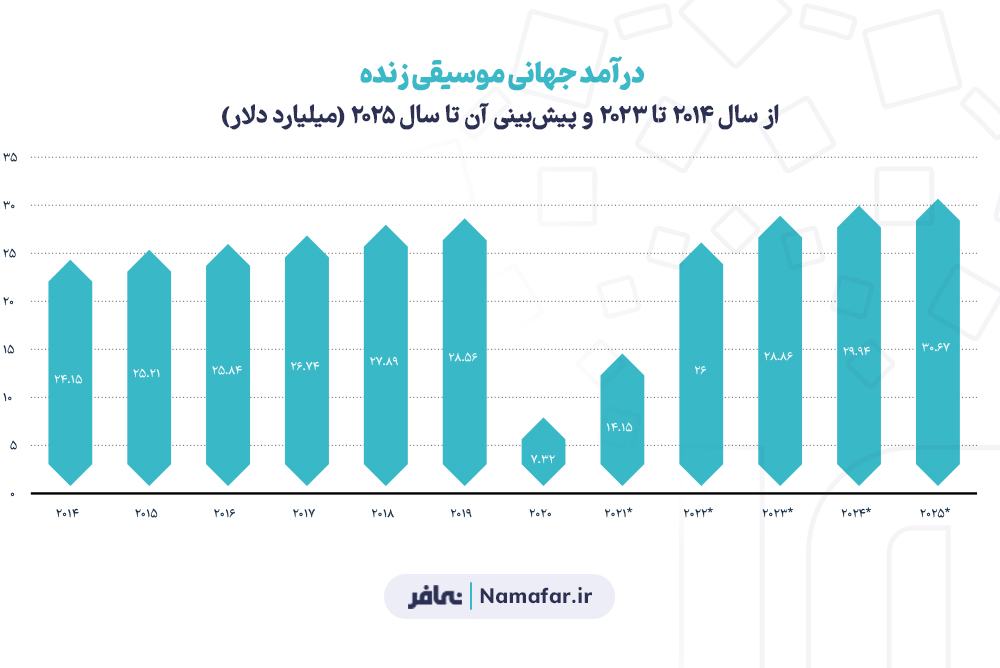
Internet users' considerable use of music
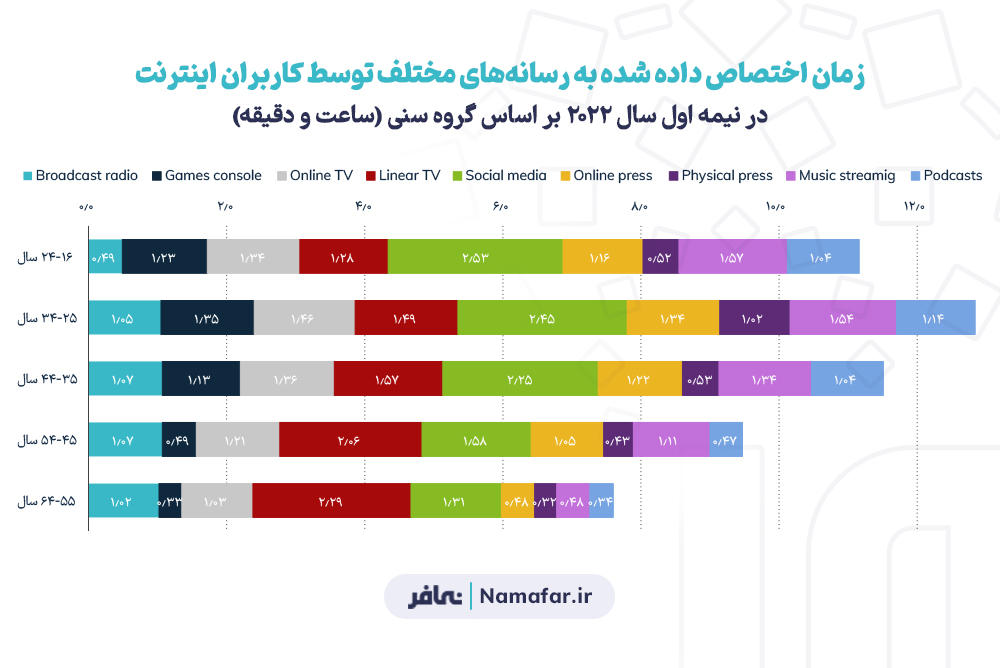
The use of social media is the dominant choice of 16-to-44-year-olds, and linear television is the popular and most-consumed medium of 45-to-64 users. Even so, online music consumption by these two groups is noteworthy, and music has a special place in their media consumption basket.For example, 16-to-24-year-old internet users who spend 2 hours and 54 minutes a day with social networks listen to music for 1 hour and 57 minutes, and it is their second most-consumed medium. Similarly, 16-to-24-year-olds also listen to music for 1 hour and 54 minutes a day, and it is their second favorite medium.
Where do music listeners hear new songs?
A study of how individuals use music and songs shows that younger generations tend to use social media and music apps to find new songs. Whereas older people (older generations) use radio to listen to new audio content. For example, 18-to-24-year-olds use music apps on the phone and social networks more to hear new music, and the choice of people 55 and older, by a large margin, is radio.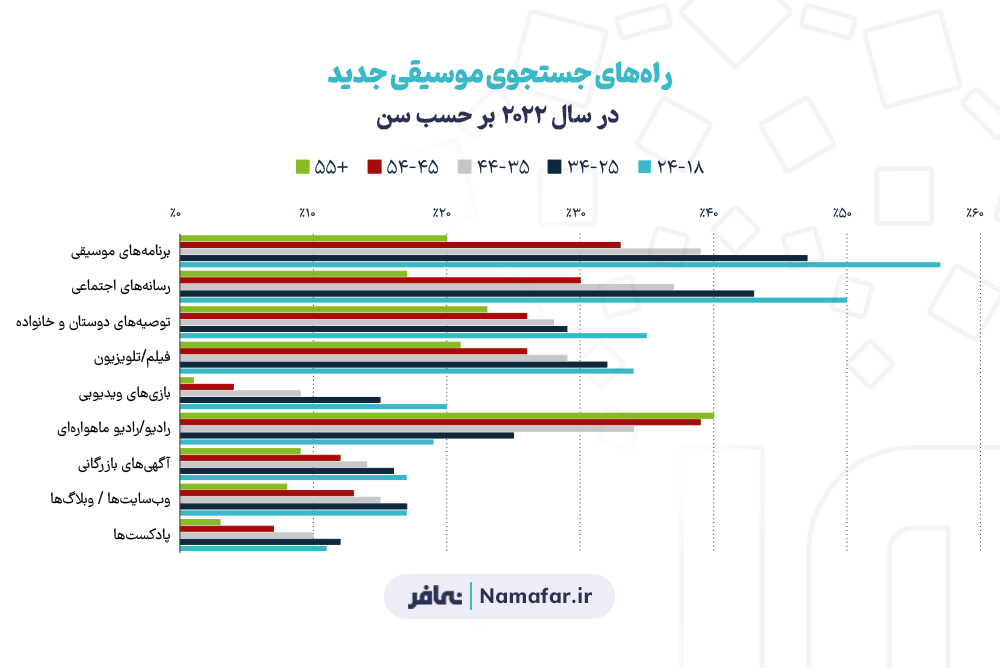
Sony; the best music company
Sony is one of the large companies in the world's music industry that in 2023 was able to earn in total 10.17 billion dollars in 2023 from the music market. Sony had 6.6 billion dollars of revenue from recorded music, 2.07 billion dollars from music publishing and 1.5 billion dollars from platform and visual media.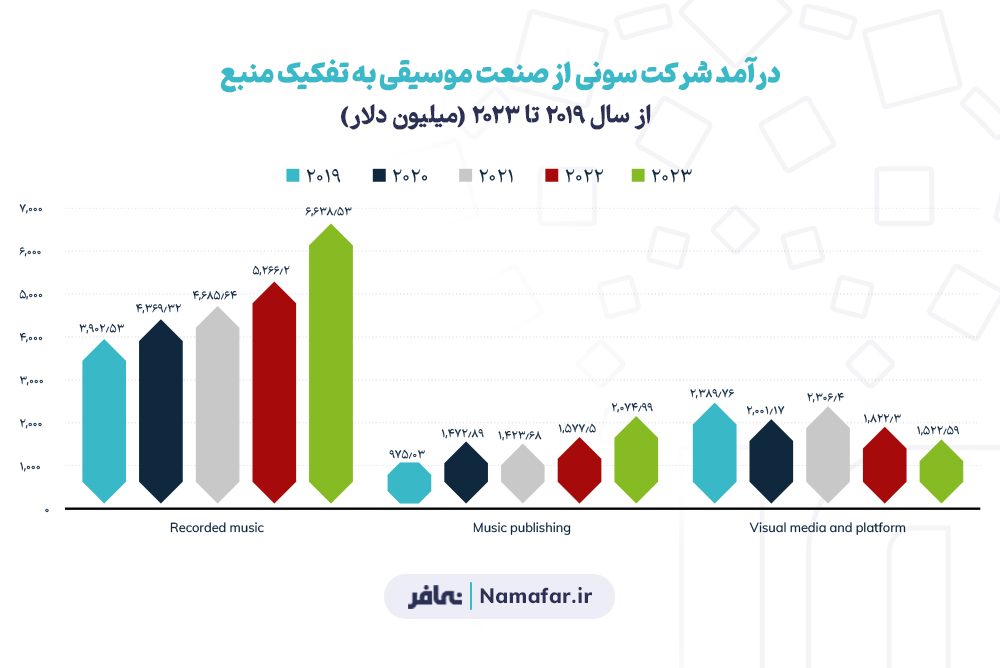
Grammy Award record-holder
Until 2022, Jay-Z and Beyoncé jointly, with 88 Grammy Award nominations, are the record-holders in this respect. Paul McCartney with 81 nominations and Quincy Jones with 80 Grammy Award nominations at the music festival stand in the subsequent ranks.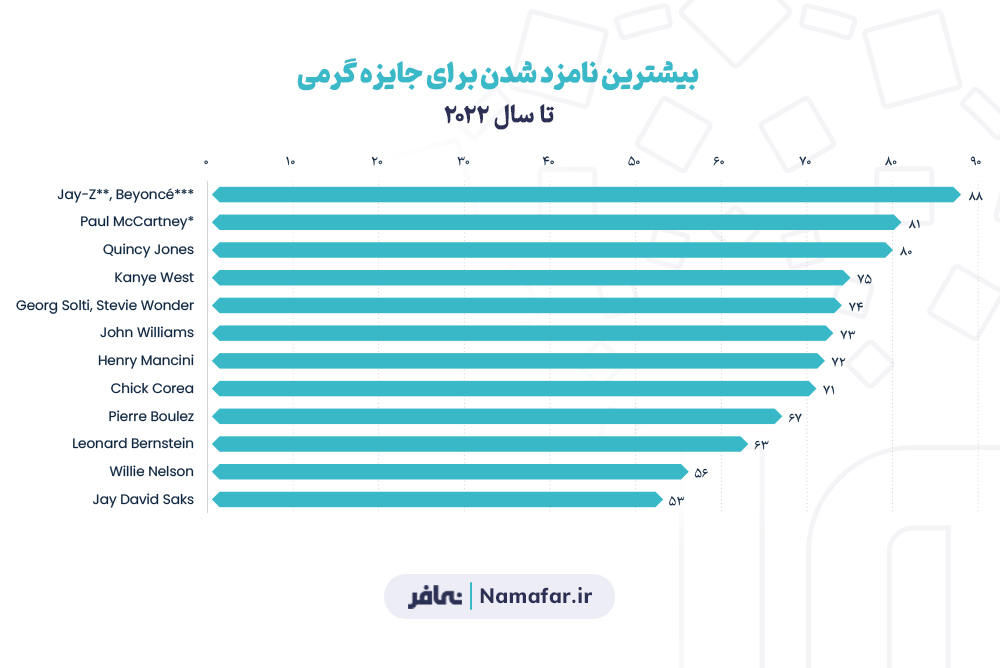
Conclusion
The music industry, although it has wide coverage and many people listen to music most of the time, in terms of revenue does not have a large market compared with other creative industries. In 2023 music revenue reached 65.17 billion dollars. Recorded-music revenue, still with the 31.2 billion dollars it has, is the highest-earning segment of the music industry. The best music company, Sony/ATV, which since 2012 has been the largest publisher in the music market, in 2022 also managed, with the 24.7 percent share it had, to repeat this title.About one-third (30.5 percent) of online music-playback subscribers are Spotify subscribers. Spotify has 515 million active users worldwide, of whom 210 million are premium subscribers. Live music in 2023, with 28.86 billion dollars, reached the pre-COVID pandemic (2019) revenue level. Also, younger generations tend to use social media and music apps for mobile to find new songs. Whereas older people (older generations) use radio to listen to new audio content. These developments indicate that the world music industry has adapted itself to current changes and developments and is moving on a specified path without — or with little — fluctuation.
Author: Ali Rouhandeh
Machine-translated from Persian by Namafar; the Persian original is authoritative. Read the original in Persian