Iran's toy industry has an annual turnover of between 300 and 350 million dollars (approximately equivalent to 50 thousand billion tomans). But of this amount, only between 30 and 35 percent is accounted for by Iranian toys produced domestically. It may be said that toy use in Iran is lower than in other countries. Most families view this good as an expensive product and a gift. The reason is that the structure and processes of toy distribution and promotion in Iran have not been coordinated and have limited the prosperity of Iranian toy production. Although technology in the toy manufacturing industry is advancing, product distribution is still carried out in a traditional manner, without examining the state of distribution and customer performance.
Turnover of the toy industry worldwide
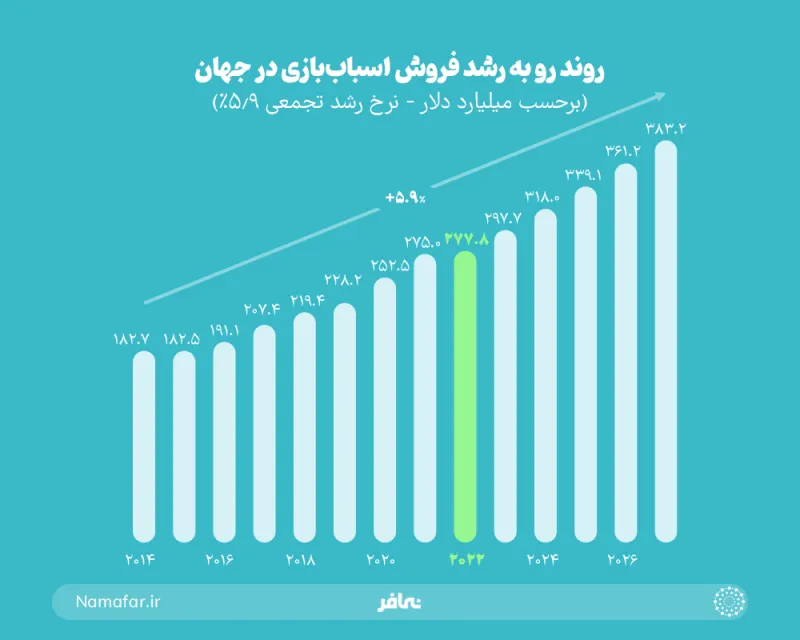
In global trade, the toy industry is considered a profitable industry that generated about 107.4 billion dollars in revenue in 2021. It should be noted here that the definition of toys differs across studies. According to some definitions, video game consoles are also included as toys. But video games themselves, as well as board games, are not a subset of this industry. In this regard, the definition of toy industry product sales, which includes various toys for children and adults, card games and consoles, was about 277 billion dollars in 2022.
If we consider game consoles a subset of toys, the figures for this industry change dramatically. Because the game console market is very large. But the toy industry in Iran is mainly identified with children's toys. Regardless of any definition offered for the toy industry, we are dealing with a strongly growing industry. In the chart below, which examines this industry's growth trend, the game console is also considered a type of toy.
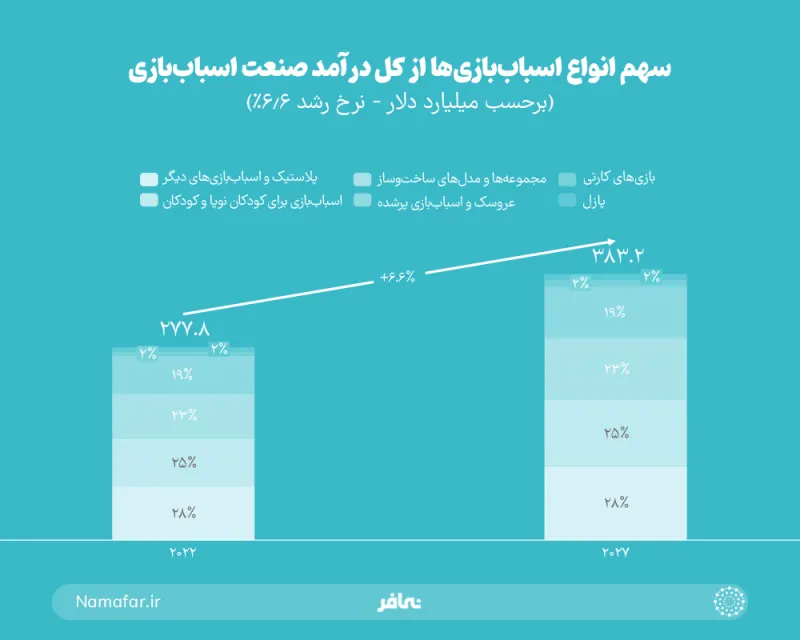
Among all types of toys, the lowest revenue belongs to puzzles and card games. The rank of the world's best-selling toys also belongs to children's and adult toys. Collectible and construction-related toys also generate substantial revenue.
LEGO toys
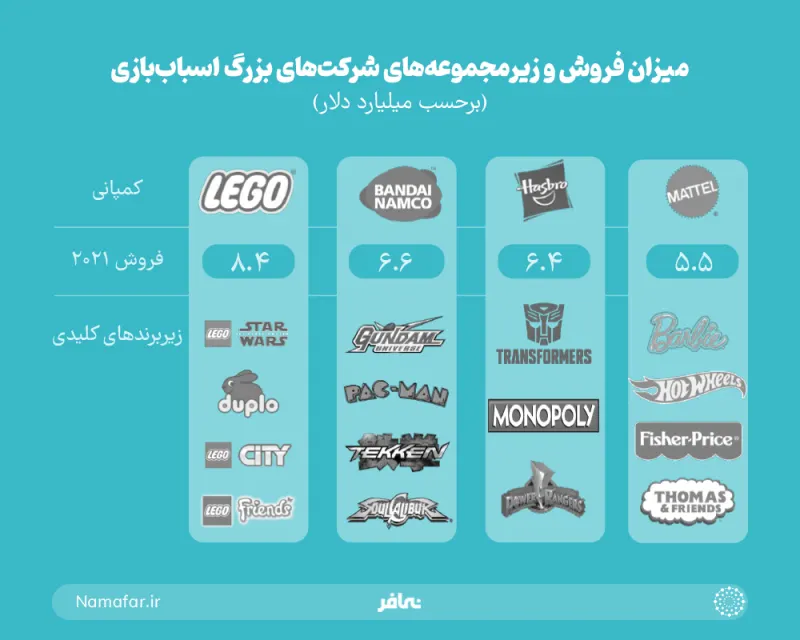
The LEGO company is the world's most successful and largest toy retailer. In 2021 this company had more than 8 billion dollars in sales. Denmark's LEGO company operates in more than 130 countries worldwide. LEGO products are typically known for plastic brick-like pieces that can be stacked to create various structures. In addition to play and recreation, these toys are also considered an exercise for developing creativity.
LEGO toys are also an unparalleled example in advertising. It is said that this company has made more than 80 video game titles and produced a large number of feature films, some of which, such as The Lego Batman Movie, have also gained considerable popularity. Among the striking statistics about this LEGO manufacturing company is that lego is said to manufacture 10000 pieces per second and 360 billion pieces per year.
The toy industry in Iran
Since the beginning of the twentieth century, the toy manufacturing industry worldwide has been growing continuously and has become one of the world's most profitable industries. In principle, developed and developing countries pay attention to the value of the toy manufacturing industry and its development in solving each country's problems, especially domestic issues and socio-economic events. But Iran, despite the potential to expand production and grow in the toy industry, has not yet been able to exploit this capacity.
In Azar (November–December) 1392 (2013/14), the Leader of the Islamic Revolution criticized the policies governing this industry. These remarks ultimately led the Supreme Council of Culture to introduce the National Innovation Document on Cultural Industries, Products and Soft Technologies. This document refers to increasing Iranian toy production with the aim of capturing at least 25 percent of the domestic market. Nevertheless, precise planning, standard statistical data and comprehensive information on the capacity and weaknesses of Iran's toy industry are still not available.
Production and manufacture of Iranian toys
With the rise in the exchange rate, a suitable opportunity arises for domestic toy production in Iran. But to make better use of this opportunity, we need to upgrade human-resource capabilities and increase knowledge in the toy manufacturing process. Also, creating toy industrial clusters by establishing mutual connections in various fields such as toy design, parts manufacturing, packaging and distribution, accessories and related industries can help develop the toy industry in Iran.
Finally, to develop the toy industry and attend to the upbringing of children and adolescents, cultural and educational efforts are needed to raise public awareness of the importance of play and its role in raising children. Achieving this requires holding promotional and educational programs tailored to different age groups for parents and educators. Developing the toy manufacturing industry in Iran requires a combination of smart distribution mechanisms, enhanced promotional activities, strengthening of governing institutions and improved quality of domestic products.
Challenges of the toy manufacturing industry in Iran
Strengths |
|
| 1. The Association of Toy Manufacturers of Iran, the industry's most important trade body, with more than 100 manufacturer members 2. Recognition of toys as one of the branches of the creative industries in the Vice-Presidency for Science and Technology 3. Recognition of the technological segment of toys as one of the knowledge-based technologies in the Knowledge-Based Companies Support Act 4. Holding the National Toy Festival regularly and annually | 5. Existence of traditional experience in the field of indigenous and local toys 6. Holding toy ideation courses 7. The long record of the Institute for the Intellectual Development of Children and Young Adults in producing and selling toys 8. Successful experience in exporting toy products |
Weaknesses |
|
| 1. Absence of a statistical information system in various segments of the toy industry value chain 2. Absence of structure in the industry innovation system to guide innovation and commercialization 3. Shortage of research related to toy production, limited use of designers and artists, absence of a toy design major in universities, and inadequate cooperation with universities and research institutes 4. Absence of organizations and NGOs in the field of doll and toy designers 5. Ineffectiveness of the evaluation system for imported toys 6. Absence of enforcement guarantees to protect toy intellectual property in order to prevent copying of domestic products 7. Absence of a mechanism for the practical promotion of toys, especially among target groups 8. Lack of attention to a mechanism for agenda-setting and awareness-raising regarding the effectiveness of toys | 9. Absence of practical and content standards (a native age-rating system) 10.Absence of a laboratory network for quality control of domestically produced toys 11. Absence of a union structure for toy sector actors that could steer the chain from production to market. 12. Competition by the Institute for the Intellectual Development of Children with manufacturers in producing toy products 13. Weak design capability among toy manufacturers 14. Absence of communications and interactions among manufacturers 15. Ineffectiveness of the hologram and production permit system and the need to replace it with an innovative system 16. Weak technology development in toy production |
Conclusion
The toy industry worldwide is known as a profitable industry with 107.4 billion dollars in revenue in 2021. The toy market in Iran also has a turnover of more than 300 million dollars, but it is said that only 30 percent of this figure is accounted for by domestic production. In the entertainment domain, the subject of games and toys does not have an appropriate place in the country's governance structure. The Council for Supervision of Toy Design and Manufacture, Import and Distribution of Toys exists as an important decision-making body in this field. But its organizational position within the Institute for the Intellectual Development of Children and Young Adults, which is a state-owned company, is weak. Therefore this council's role in policymaking and decision-making in the toy industry and market is limited. To strengthen governance of the toy industry in Iran, this council's legal standing and coordination among its members must be improved.
Sources
- ISNA news agency interview with the Director General of the Creative and Sports Industries Office of the Ministry of Industry, Mine and Trade, 19/04/1402 (2023/24), news code 1402041912077
- Namafar Policy Research and Data Analysis Group, "Policy Brief on Development of the Toy Industry", Center for the Development of Culture-Based Activities, spring 1400 (2021/22)
Statista: Toys & Hobby Report
Machine-translated from Persian by Namafar; the Persian original is authoritative. Read the original in Persian