In a comprehensive and exclusive definition, the cultural and creative industries are those sectors of organized activities whose main aim is the production or reproduction, promotion, distribution or commercialization of goods, services and content activities that have been taken from cultural, artistic or heritage roots (UNESCO, 2018). These industries, because of possessing a soft and cultural nature and economic empowerment, are recognized as one of the driving models in cultural policymaking and the economy of culture in the world. Possessing these two features grants the cultural and creative industries a special position, such that they are considered one of the important arenas of the realization and dynamism of sustainable development. Data over the past two decades prove that the creative economy as one of the fast-growing sectors in the global economy has a key role in creating income, jobs and exports. Therefore, the cultural and creative industries have been an important source for jobs and income and consequently create important spillovers for the broader economy. In many sectors such as the tourism industry, in addition to their own economic effects, they leave considerable social effects from supporting health and well-being to promoting social inclusion and local social capital (OECD, 2021).
The place of the creative industries in the world economy
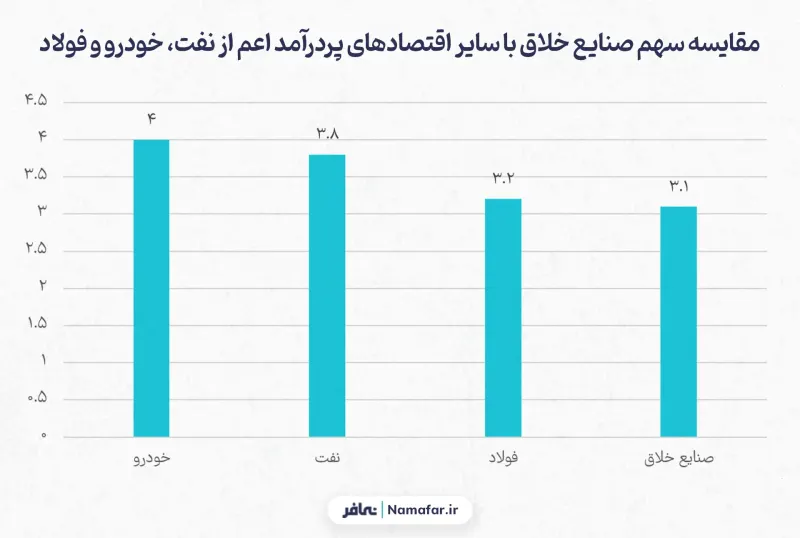
Based on the latest statistics from UNESCO, the market volume of the creative industries of global GDP is 3,100 billion dollars and equivalent to 3.1 percent, which constitutes 6.2 percent of total employment and creates nearly 50 million jobs worldwide (UNESCO, 2023). The noteworthy point is that the share of these industries in the global economy compared with other large and high-income industries such as steel, oil and automobiles has been relatively equal, and this important fact indicates their increasing economic productivity and special profitability and the attention that systems of governance, especially in pioneering countries, have toward this field.
The empty place of the creative industries in Iran's economy
Studies confirm the matter that statistical information on the cultural and creative industries in Iran, specifically their share of the economy, is unreliable, imprecise or in general unofficial. On this basis, inevitably relying on some estimates, the share of Iran's creative economy of global GDP has been negligible and about 0.43 percent. This is while if it moved on the global trend, the creative economy could have had a share equivalent to 13 billion dollars. G20 member countries by 2030 have targeted for the creative economy a share amounting to 14 thousand billion dollars and amounting to 3 percent. Here two assumptions are raised:
a) If we proceed with the trend of 0.43 percent (the country's current share of the creative economy of global GDP), by 2030 Iran's share will be 60 billion dollars.
b) On the assumption that Iran's population is one percent of the world's population, then its economy too must be one percent of the world's economy, the desirable is that the country's creative-economy share be 140 billion dollars equivalent to 4 percent.
The path of the cultural and creative industries in the country has been such that, dependent on numerous causes, on the one hand they have not been accepted as high-yield and profitable industries in the field of the economy and lack a fitting and desirable place, and on the other they have not acted successfully in the arena of international competitiveness.
The necessity of a coherent view of the creative industries
Part of these issues originates from an attitude that defines the cultural and creative industries as detached from other industries and does not consider their existence as a piece of the large economic and cultural puzzle. Nonetheless, if importance is given, past and present gaps are filled and movement in the global process is accelerated, there is still space for the development of the country's cultural and creative industries. An important part of the realization of this matter depends on creating and strengthening a kind of coherent and unified attitude (a single whole) toward the cultural and creative industries that is obtained through endogenous connection (synergy of the cultural and creative industries) and exogenous connection (linking the cultural and creative industries to large industries), which will be discussed in what follows.
Strategy 1: Endogenous connection (synergy of the cultural and creative industries)
It is evident that the cultural and creative industries in linkage with one another lead to economic synergy and accelerating the transfer of cultural meanings. For example, by way of the development of the tourism industry and if suitable groundwork is laid in order to promote handicrafts, tourists by buying products strengthen foreign-currency earnings and by transferring the product to their country lay the ground for the entry of other tourists to Iran. If this connecting loop is strengthened with the development of infrastructure and appropriate policymaking, the development of the tourism industry and handicrafts will not be far from expectation.On the other hand a large part of the dynamism and development of the cultural and creative industries is provided by way of cultural market-making or merchandising. Cultural market-making means the commercialization or reuse of a character, content and symbol outside its original setting and the creation of value for it. For example, if content or a character in the animation industry is reproduced and reused in the products of other cultural industries such as stationery or toys, the merchandising process has been actualized.
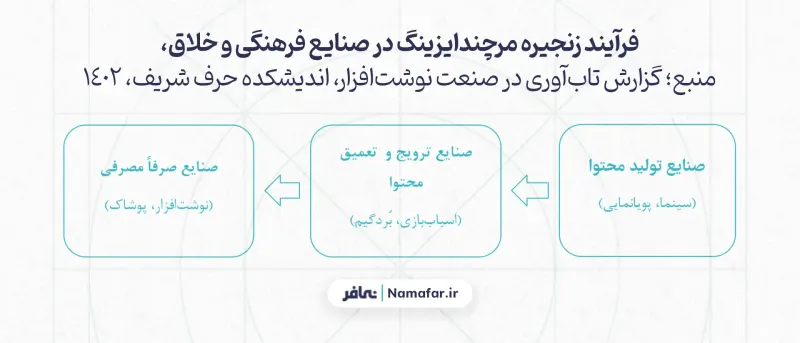
At the heart of the subject of cultural merchandising, the types of cultural industries can in general be classified in three categories; first, industries such as cinema, animation and comics that themselves set about producing content and characters. The second category, that type of cultural and creative industries such as toys and board games that carry out the work of promoting and of course deepening the produced character. The third category of this classification includes sectors such as stationery and apparel that merely play the role of consumer of a content.
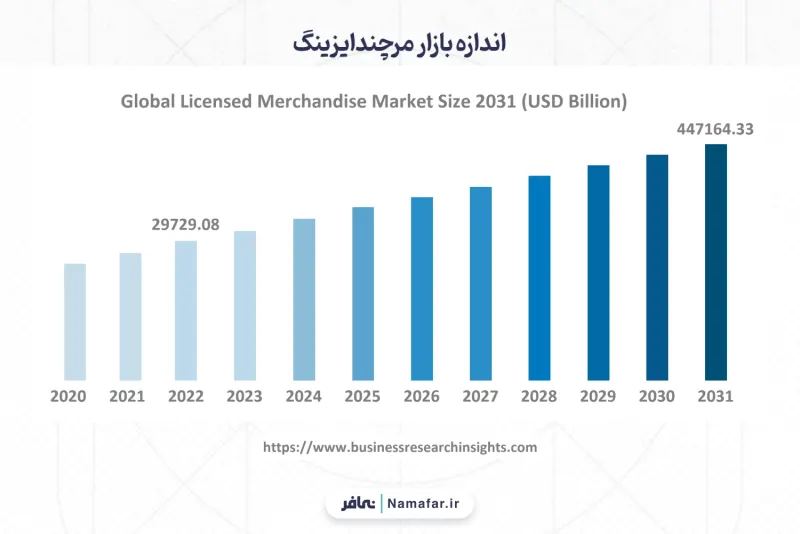
The merchandising chain for the origin and destination industry and in general the cultural and creative industries is a creator of value. An important part of the income of large companies such as Marvel, Disney, License Global and Pokemon is obtained by way of developing the merchandising chain. The size of the global merchandising market in 2022 was equivalent to 29 billion and 730 million dollars and it has been forecast that in 2031 it will reach 447 billion 164 million dollars.
Merchandising-chain sales of the Frozen animation were 4 times its box office (477 million dollars in sales in the United States and Canada, about 976 million dollars in sales in the foreign market). This animation was made with a cost of 150 million dollars and at the box office sold to the amount of 1.5 billion dollars and in the merchandising chain 6 billion dollars. This matter shows the importance of profitability by way of developing cultural market-making in the industries market even more than common revenue models or traditional methods. In Iran too, especially in recent years, the characters of popular and widely viewed animations such as "Dolphin Boy" or "Bacheh Zerang", by entering the toy industry (dolls) and the stationery industry (notebooks, backpacks, writing items and so on), provided channels for creating economic value. The production cost of the Bacheh Zerang animation was about 500 thousand dollars and its sales at the box office and in the merchandising chain have been estimated respectively at 1.2 billion dollars and 340 thousand dollars. Despite this successful example, it is observed that this animation's merchandising sales compared with its box office are negligible.
But in general the merchandising market in Iran, because of weakness in character-making and inability to commercialize, does not have a thriving market and its cycle is defective. In addition to the fact that the poverty of domestic characters or their lack of durability and survival itself has led to the entry of foreign content and a change in the audience's taste, it has also not been placed in a related, sequential and interlinked chain with other industries, and in a word the merchandising matter has not been attended to. For example, the quantitative and qualitative growth of an industry such as comic strips in successful countries with a brilliant record has led to the development of merchandising and the synergy of industries derived from it such as animation, cinema, stationery, toys and so on. This is while support for comic works in Iran, in the least case, has stopped within the industry. This matter leads only to the growth of the industry and that in the short term, and one cannot imagine a horizon for the development of the industry in the long term.
Therefore the ecosystem of the country's cultural and creative industries on the one hand needs the creation of a deep connection between synergistic industries (the tourism industry with handicrafts, industrial design with the architecture industry and so on) and on the other the facilitation of creating and consolidating a parallel merchandising chain in the industries especially in the children-and-adolescents field. In that case one can think of empowering the export of cultural goods and products beyond national borders and strengthening international competitiveness.
Strategy 2: Exogenous connection (linking the cultural and creative industries to large industries)
Cultural and creative products, especially at the beginning of the value-chain process —procurement and production— are in a close linkage with large industries. The raw materials of products such as stationery, toys, handicrafts and so on are produced and supplied dependent on industries such as petrochemicals, oil and so on. One of the issues of arenas such as handicrafts and toys is weak access to raw materials and the high cost or weak quality of these materials, which pushes the industry toward imports. This same issue can be the outcome of an inefficient and inappropriate relationship of the cultural industries with large industries that supply raw materials such as oil and petrochemicals.The operational program for connecting the cultural and creative industries to large industries can be realized in three executive instances of the section below:
1. The formation and creation of a petrochemical park of the cultural industries in order to use the advantages of the petrochemical industry: Production: Cultural and creative products, especially at the beginning of the value-chain process —procurement and production— are in a close linkage with large industries. The raw materials of products such as stationery, toys, handicrafts and so on are produced and supplied dependent on industries such as petrochemicals, oil and so on. One of the issues of arenas such as handicrafts and toys is weak access to raw materials and the high cost or weak quality of these materials, which pushes the industry toward imports. This same issue can be the outcome of an inefficient and inappropriate relationship of the cultural industries with large industries that supply raw materials such as oil and petrochemicals. Therefore by creating a petrochemical park of the cultural industries and benefiting from its advantages such as guaranteed feedstock one can direct the flow of investment toward the cultural and creative industries.
2. Creating a connection between the cultural and creative industries and the food industries (investment by the food industries in a small-scale toy production line:) Investment: Pioneering countries, by investing to create a connection between the cultural and creative industries and the food industries, create new and different experiences for consumers. This matter in addition to investment requires a new and technological production line but also has a large injection of return on capital. Some companies, by placing a toy together with food products, have created a novel form of marketing for the industry and of income generation. Among them one can mention the company Foodi Forks, which is a producer of products combining foodstuffs and educational and entertaining toys for children that help their learning and growth. In line with the connection of the cultural and creative industries with the food industries, one can also point to this matter that some characters in food products have the capability of promotion through industries such as animation and cinema. For example the character "Cheetoz" not only in the arena of product advertising but as a character in the field of making animations has the capability of being developed.
3. Promotion: In line with the connection of the cultural and creative industries with the food industries, one can point to this matter that some characters in food products have the capability of promotion through industries such as animation and cinema. For example the character "Cheetoz" not only in the arena of product advertising but as a character in the field of making animations has the capability of being developed.
Conclusion
If we want to diagnose the inappropriate place of the cultural industries in Iran's economy, the detachment of these industries from one another and also from non-cultural industries is one of the cases that must be pointed to. The cultural industries must interact with one another. This interaction includes that same cultural merchandising that causes content produced by industries such as cinema, animation or comics (comic strips) or books to be reflected in industries such as apparel, stationery and toys. Or to be deepened or merely consumed. It must be noted that this convergence and coherence can create a profit several times the original profit of a content, for example cinematic or animated. Its example is the Frozen animation, which was produced with a capital of 150 million dollars and at the box office sold 1 billion dollars. But from merchandising it had 6.5 billion dollars in income.
The cultural industries also need to be connected with industries such as petrochemicals and oil so that they can obtain their raw materials with quality and cheaply. Otherwise the cultural industries become dependent, expensive and in some cases low-quality industries.
Short link: nmfr.ir/arr
Machine-translated from Persian by Namafar; the Persian original is authoritative. Read the original in Persian