Tourism, meaning temporarily leaving one's place of daily life for various reasons, is one of the sources of economic and cultural growth in today's societies. The branches of this industry are expanding day by day (such as medical tourism, cultural tourism, disaster tourism, sports tourism, business tourism, religious tourism...) and it is expected that in the future it will find even more diverse branches as well. One of the lesser-known branches of tourism is called "agricultural tourism or agritourism." In this branch of tourism, people go to visit a garden, farm, or livestock operation. The growth of this tourism can hold the promise of sustainable rural development. For example, tourists who go to villages for entertainment and to visit agricultural activities and products provide more job opportunities for rural residents. This is provided that this type of tourism does not, through excessive human interference, lead to the destruction of villages.
The global agricultural tourism market; current growth and future outlook
The intensification of the harms that arise from living in large metropolises annually draws many people to travel and short-term stays in villages around the world. According to Straits research, while in 2021 the global value of the agricultural tourism market was equal to 395,45 million dollars (mainly because of the effects of the coronavirus pandemic and people being quarantined in their homes); it is forecast that by 2030 this industry will find growth of 141 billion dollars (that is, annual growth of 4/13 percent from 2022 to 2030). According to research, in 2023 the agricultural tourism market had a value of 9.7 billion.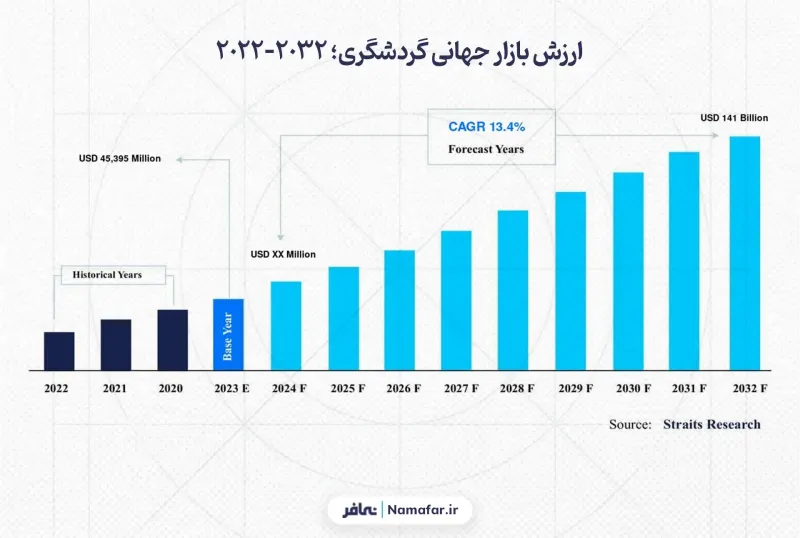
Technological advances have played an important role in the growth of this industry's global revenue; so much so that researchers have forecast that connecting the tourism industry with technology can, by 2030, bring GDP to 500 billion dollars. Research by McKinsey's Advanced Connectivity Center and the McKinsey Global Institute has shown that advanced high-speed connectivity will bring global GDP in the next decade to 2 to 3 trillion dollars.
In the same vein, various organizations began to invest increasingly in this tourism industry. For example in February 2023, John Deere — a leading producer in the production of agricultural machinery — in cooperation with the American Farm Bureau Federation, developed agricultural tourism through the integration of technology. This cooperation focused on using advanced agricultural equipment to expand participants' experiences and create diverse educational tours on farms. Also in October 2023, Airbnb — a virtual marketplace in the field of renting lodging places — in cooperation with Farm Stay USA, by offering diverse experiences, began its support for small farmers.
Types of agricultural tourism
As stated, agricultural tourism, by providing sources of income, education, and recreation and entertainment, brings mutual benefits for tourists and farmers. Researchers have placed agricultural tourism activities in four general categories, which we describe below:- Direct market, meaning the direct sale of agricultural products to the consumer, which is mainly carried out in two ways: one, tourists' presence on the farm and harvesting of the crop by themselves, which is also called U-Pick, you pick, and pick-your-own, and the other, a stall for selling products on the farm by farmers.
- Education, which can include agricultural education (such as teaching the farm's history and activities such as milking, feeding chickens and chicks, or harvesting fruit and vegetables to people) or non-agricultural education (forming workshops such as pottery, woodworking, essential-oil extraction, painting, and so on). It has been forecast that this segment of agricultural tourism activities will have the fastest growth rate: an annual growth rate of 2.13 percent between 2022 and 2030.
- Recreation, entertainment, and events, which is considered to include the broadest and most popular segment of agricultural tourism; so much so that this segment in 2021, with 35 percent, had the largest market share, and it is forecast that between 2022 and 2030 it will experience annual growth of 11 percent. The growth of this segment is related to the increase in tourists' inclinations toward sports activities such as hiking, horseback riding, fishing, hunting, and so on. Other activities that fall in this segment can be considered to include holding celebration and party ceremonies, wildlife photography, and traditional events specific to each region.
- Hospitality meaning the provision of catering and lodging services to tourists.
In this regard, various organizations and tourism tours are held to organize tourists of various ages for greater familiarity with the segments of agricultural tourism. This matter is especially of great importance regarding people of younger ages; because by learning patterns of living that help preserve the environment, are village- and nature-friendly, and have a dynamic view of the relationship between city and village, one can also forecast the guarantee of sustainable rural development and even the development of the whole country for future generations. This matter in developed countries is held in the form of summer and educational camps for children. For example the organization AuerFarm — a nonprofit educational center located in Bloomfield — holds summer tours for children aged 3 to 15 that include artistic activities, gardening, hiking, scientific experiments, play, and so on. Other activities of this organization include educational tours, holding celebrations and birthday ceremonies, lodging, and so on.
North America; the leader in agricultural tourism
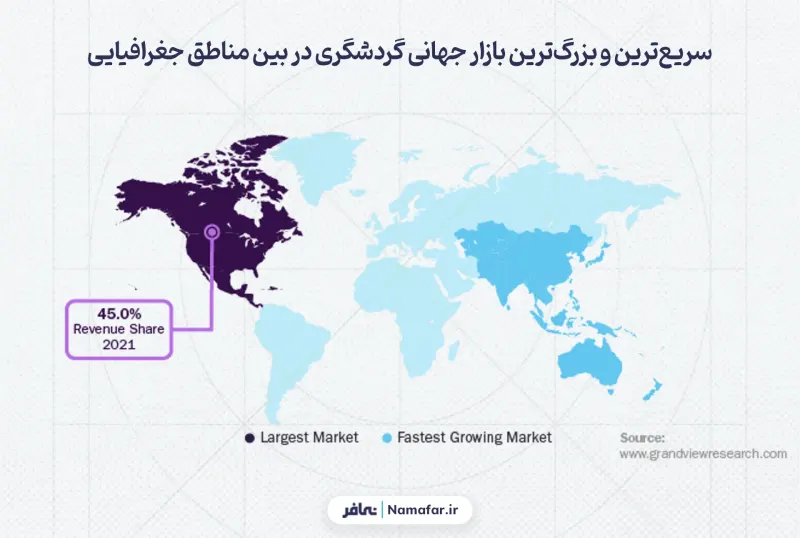
The North America region in 2022 was the leader of the agricultural tourism market, the main reason for which went back to the extensive tourism network in the countries of the United States, Canada, and Mexico (this region's share in 2021 and 2024 of the market was equal to 45 and 40 percent, respectively). In 2023, this region had growth equal to 7.3384 million, and it is forecast that between 2024 and 2030 it will have annual growth of 2.11 percent. California, Vermont, and Ontario have been the three countries that have attracted the most tourists in this region. It should be noted that among the various types of agricultural tourism, as expected, "recreation, entertainment, and events" has been the largest and "educational" the most profitable tourism segment in this region.Nevertheless it is expected that the regions of Latin America, West Asia, and Africa will have the fastest growth in agricultural tourism. The reason for this is the increase in disposable income and the improvement of economic conditions, especially in African countries. For example researchers have forecast that the Asia-Pacific region between 2022 and 2023 will experience annual growth of 8.12 percent. In Figure 2 you see the trend of the global agricultural tourism market by geographic region.
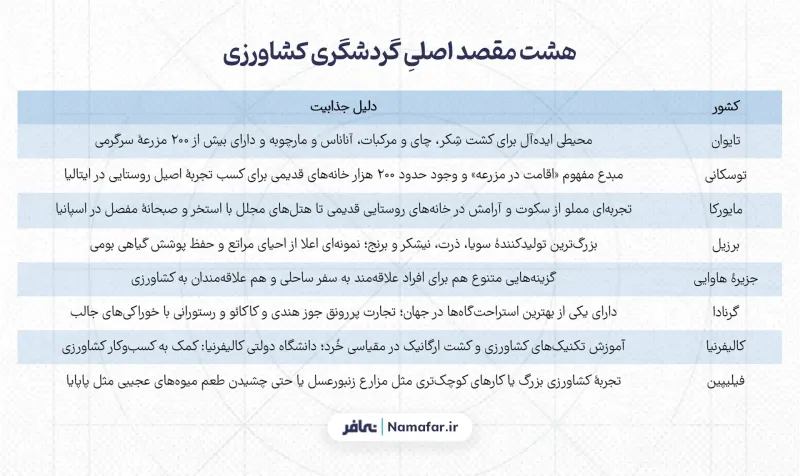
This point is noteworthy that 8 countries have accounted for the most agricultural tourism destinations among tourists worldwide. The list of these 8 countries in order of priority and the reason for their attractiveness for tourists is shown in Table 1:
The role of agricultural tourism in sustainable development
The concept of sustainable development is simply a process that provides a desirable future for future generations that is accompanied without harming the natural environment and its resources. Agricultural tourism has an important role in preserving and reviving sustainable development in various dimensions. In the economic dimension, by diversifying sources of income, creating numerous job opportunities, and supporting local goods and services; in the social and cultural dimension by preserving traditions and indigenous culture, direct connection between locals and tourists, and gaining cooking and food experiences; and in the environmental dimension by sustainably preserving the land and not wasting resources and preserving biodiversity. Of course this matter can be accompanied by many challenges and problems; including inadequate superstructures and resources, improper management, or insufficient educational programs to strengthen people's skills.Final word
Agricultural tourism is one of the thriving sources of sustainable rural development that experiences continuous growth every year. Countries make huge investments in this industry and provide diverse tours and educational programs for domestic and international tourists of various ages. Even many universities including California have created an educational farm for learning topics related to creating agricultural businesses. This point becomes important when we look at the large-scale migration of our country's rural residents to various cities; a phenomenon that has been accompanied by many large and small consequences both for the desirable life of the village and the city and for the weakening of the sustainable relationship between these two environments. Therefore placing this industry and reviving it in every country's policymaking is of great necessity and importance.Author: Niloofar Saghabashi
Short link: nmfr.ir/17u
Machine-translated from Persian by Namafar; the Persian original is authoritative. Read the original in Persian