Iran's tourism industry statistics in 1403 (2024/25)
According to a report by the World Tourism Organization, in the first quarter of 2024 Iran recorded 60 percent growth relative to the same period of the previous year. Also, in the first half of 1403 (2024/25) it had more than 4.1 foreign tourists. This figure is considered a notable jump relative to the same period of the previous year; because in the entire first seven months of 2023 fewer than 3 million tourists had traveled to Iran.
Scattered statistics announced on Iran's tourism in 1403 (2024/25)
Of total inbound tourists to Iran, 87 percent of them were from three countries: Iraq (with a 54 percent share of all tourists), Afghanistan (with a 23 percent share), and Turkey (with a 10 percent share). Statistics show that over the years 1386–1403 (2007–2025) the highest annual number of inbound tourists to Iran was in 1398 (2019/20) with 8/8 million tourists, and given the first-half figures, it appears this 8 million record was approached.
According to Anoushirvan Mohseni Bandpei, deputy of the Ministry of Cultural Heritage, during the past solar year (March 2024 to March 2025) Iran hosted 7.4 million foreign tourists. The official target is that over the next four years the number of foreign tourists increase to 15 million people. In this regard, more than 2,500 projects are underway, including 500 new hotels and about 3,000 ecolodges. Of these 7.4 million foreign tourists, 1.2 million people came to Iran for health tourism, and according to Seyed Reza Salehi Amiri, Minister of Cultural Heritage and Tourism, their average spending was between 2 and 3 thousand dollars.
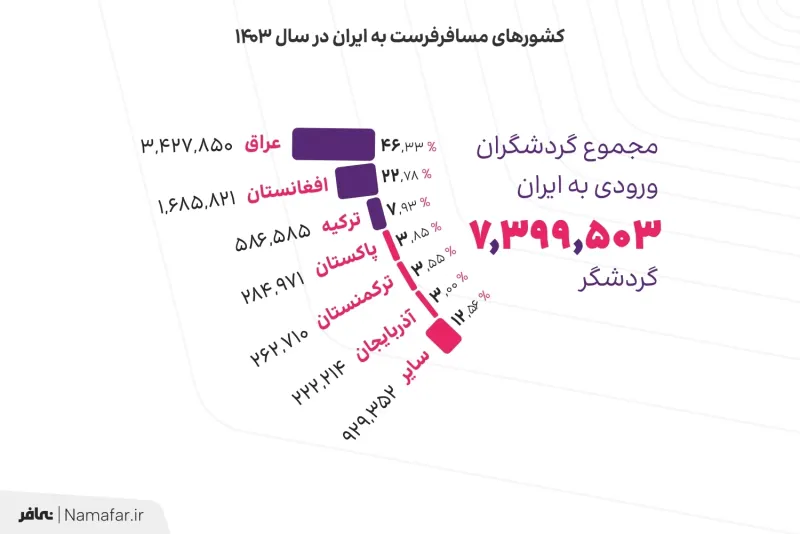
About half of inbound tourists to Iran in 1403 (2024/25) were from Iraq. After Iraq is Afghanistan, and given the extensive presence of that country's nationals in Iran, probably only a small number of the people who have come to Iran from that country can be called tourists. In the list of the 10 countries with the most travelers to Iran, apart from Iraq and Afghanistan, the remaining 8 countries account for a small share of the number of travelers. Therefore, it is not far-fetched to claim that Iran, except from Iraq and slightly from Turkey, has negligible inbound tourists from other countries. Even many of the people who come to Iran from Pakistan pass through our country with the intention of reaching pilgrimage destinations in Iraq in periods such as Arbaeen and leave no trace in Iran's tourism economy. It is interesting to know that in 1403 (2024/25), from 16 countries of the world, only one person entered Iran.
Through what types of borders do inbound tourists enter Iran?
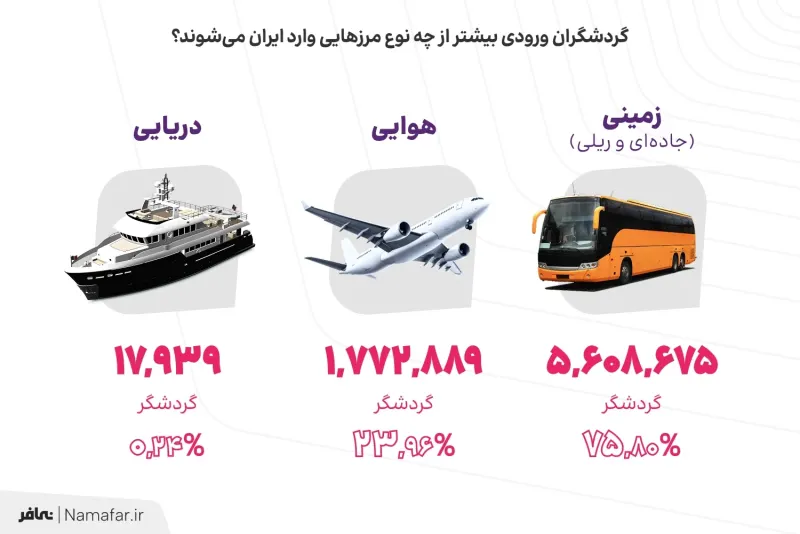
In 1403 (2024/25) most foreign tourists chose land borders to enter Iran, and more than 1 million 700 thousand tourists also came to Iran by air. When most of a country's tourists are from neighbors, it is entirely natural that most trips too are by land and not by air.
Gender of inbound travelers to Iran in 1403 (2024/25)
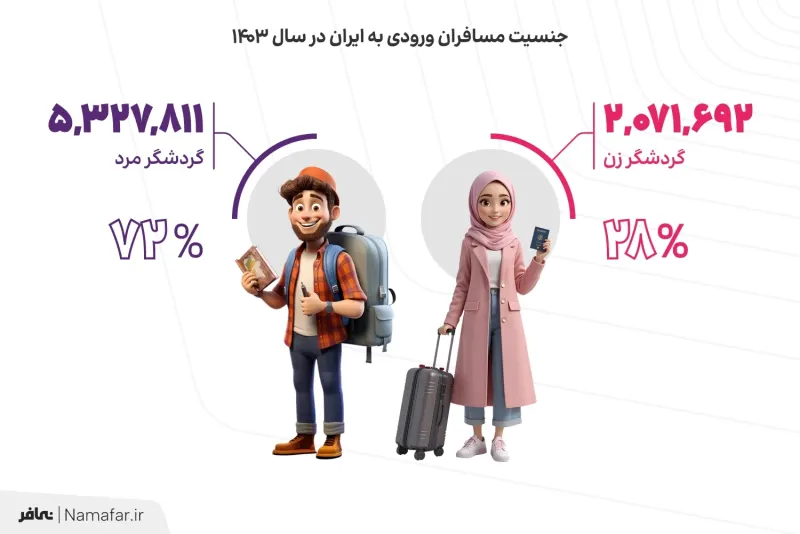
One of the strangest tourism statistics of Iran in 1403 (2024/25) is that of about seven million inbound travelers to Iran, more than 5 million and 300 thousand people were men and only more than 2 million people were women. That is, in the community of inbound tourists to Iran the number of women is less than half that of men. Perhaps we cannot figure out the exact cause of this statistic without conducting statistical research; but it can be guessed that most of the arrivals from Afghanistan are men who set out for Iran because of work, and probably a high percentage of Iraqi travelers too consist of men who, for pilgrimage or medical reasons and without their women, make their way to our country.
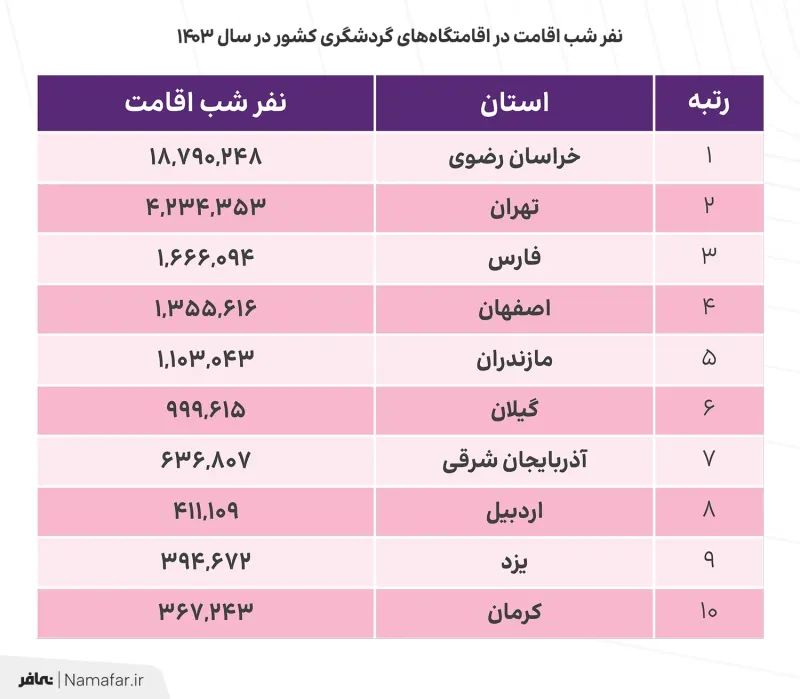
The table of person-nights of stay in the country's tourist accommodations in 1403 (2024/25) shows that Razavi Khorasan, with more than 18.7 million person-nights of stay, is considered Iran's main religious tourism hub. Tehran with 4.2 million, Fars with 1.6 million, and Isfahan with 1.3 million person-nights rank next. The northern provinces of Mazandaran and Gilan, with more than one million person-nights, are also popular summer destinations. East Azerbaijan, Ardabil, Yazd, and Kerman have also been placed among the country's ten top tourism destinations.
It is worth noting that "person-nights of stay" statistics are not necessarily equivalent to the number of travelers. Probably the number of travelers to Mazandaran and Gilan is greater than to Isfahan and Fars, but because they have shorter stays (2-3 nights versus 4-7 nights), their person-night figures are lower. Also a large share of travelers to the north stay in villas and informal accommodations that are not counted in this statistic. Tourism in the north is also seasonal, whereas Isfahan and Shiraz welcome tourists in all seasons. The type of tourists is also different. For example, Shiraz is one of Iran's medical tourism hubs, but the northern provinces are considered merely a leisure destination.
Statistics on types of tourist accommodations in Iran in 1403 (2024/25)
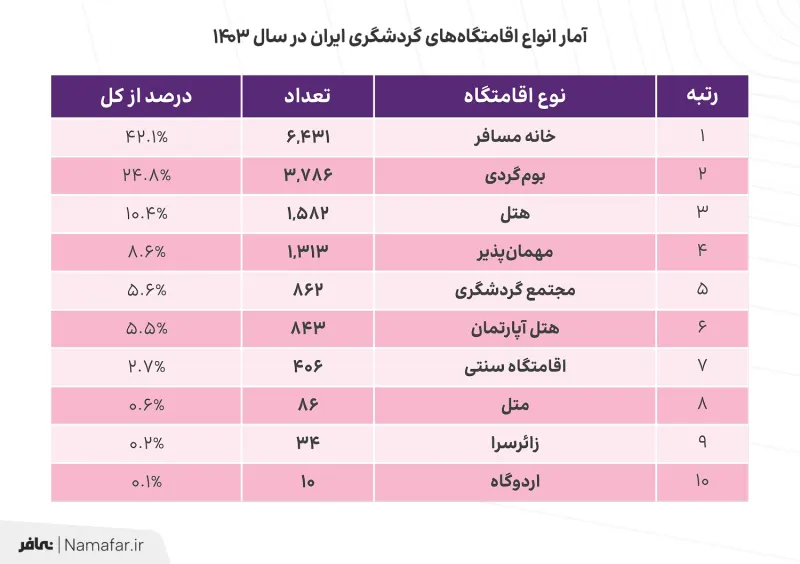
The mix of Iran's tourist accommodations is a reflection of this country's mass-tourism strategy and investment constraints. The nearly 67 percent predominance of guesthouses and ecolodges indicates a focus on cheap and domestic tourism which, although it is considered positive for the general public's access, creates limitations in attracting high-income foreign tourists. The small share of standard hotels (only 16 percent) compared with leading tourist countries is one of the key factors in Iran's low per-capita tourism revenue. While ecolodges can be a unique attraction for sustainable tourism, the shortage of luxury hotels and large tourism complexes prevents competition with regional destinations such as the UAE and Turkey. This structure shows that Iran is still at the stage of developing tourism infrastructure and, to achieve revenue targets, needs to attract significant investment in the standard hotel sector.
From a financial perspective, Iran's tourism revenue in the year ending March 2024 was about 7 billion dollars, which covers only 33 percent of the 21 billion dollar target set in the Sixth Development Plan. This is while neighboring countries, such as the UAE and Turkey, had 52 and 50 billion dollars of revenue from tourism in 2023, respectively.
According to international reports, West Asia in 2024 has been one of the leading regions in terms of tourism growth. For example, Morocco's projected share through the city of Marrakesh in this country's GDP by 2026 will be about 8.6 percent. Cities such as Mecca, Abu Dhabi, and Marrakesh have accounted for a share above 7% of GDP growth from tourism, and the share of Iran's capital has been projected at only 4.4%.
Challenges and policies
According to the 20-year vision document, Iran was supposed to reach 20 million foreign tourists by 1404 (2025/26); a figure that so far, according to official statistics, has been achieved only to less than one third of it.
The Iranian tourism industry is also facing geopolitical challenges and sanctions. These factors have hindered a full return to the pre-2019 pace of tourism. In addition, Iran's image in global media has at times been accompanied by negative and politically biased narratives that affect tourists' decisions.
To overcome these problems, policies such as visa waivers for nationals of 33 countries, facilitation of visa issuance processes, and a tourism card scheme to simplify tourists' foreign-exchange transactions are being implemented. Also more than 2,500 tourism projects across the country are being pursued to upgrade infrastructure and attract domestic and foreign investors.
Cultural capacities and world heritage
Iran, possessing 28 tangible cultural heritage properties and 26 intangible cultural heritage elements registered with UNESCO, ranks among the world's top 10 countries in terms of tourist attractions. Places such as Tehran's crowded bazaars, Isfahan's great mosques, and the poetic gardens and tombs of Shiraz are part of this treasure that can become a driving engine for attracting tourists.
Conclusion
The trends of 2024 show that Iran has been placed on a path of tourism growth. A 60 percent increase in tourist arrivals in the first quarter of 2024 and the presence of 4.1 million people in the first half of the year are a sign of the gradual return of global trust in Iran as a safe and rich destination.
Nevertheless, the striking gap between Iran's revenues and those of the countries of the region emphasizes that success depends on stronger policymaking, infrastructure upgrades, effective international marketing, and improvement of the global image.
Iran, with its rich cultural heritage, diverse natural landscapes, and the hospitality of its people, has the capacity, if reforms and strategic planning continue, to consolidate its position as a prominent actor in the global tourism market.
Machine-translated from Persian by Namafar; the Persian original is authoritative. Read the original in Persian