In contemporary culture, the place of video games as an entertainment tool has gone beyond its origin and become a vital aspect of a modern society. The influence of this medium has penetrated how users interact, learn, and communicate, and has left unique perspectives on virtual and digital life. Also, the storytelling techniques of game makers and the role-playing of players during gameplay have established a deep bond between consumers and producers of this industry.
Turning to statistics and examining them is essential for understanding the impact of video games on businesses and the outlook for interactions among digital creative industries and entertainment. By exploring video game statistics, the exponential growth of this industry is readily discoverable. It is obvious that the background of this research is identifying consumer behavior and the main approaches to video-game market development.
In this note, more than 70 statistical articles from the video game industry from 2020 to 2024 have been analyzed and examined. From demographic statistics across various game titles to games' revenue figures. We have also reviewed emerging trends and technological innovations in making new games, the most important of which we will discuss below.
Global gamer population
In the third quarter of 2023, gender statistics for video games showed that 89.6% of female users and 92.6% of male users on the internet spent ages 16 to 24 with various video game devices. This figure has declined with increasing age. So that 85.2% of women and 89.1% of men aged 25-34, 80.2% of women and 85.1% of men aged 35-44, 74.5% of women and 79.9% of men aged 45-54, and 69.6% of women and 70.8% of men aged 55-64 spent part of their daily time on video games.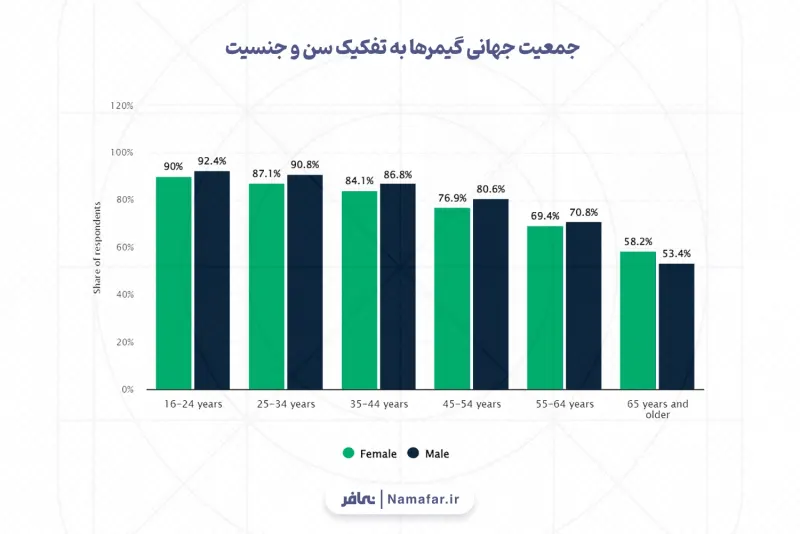
Regarding console games, video game statistics in the UK region from September to November 2022 showed that approximately three out of every ten men in this region had experience playing with game consoles. Meanwhile, in the United States, as of December 2023, about 41% of console gamers were typically female.
Statistics on video game consumers show that the Asia-Pacific region has the highest number of gamers. So that they accounted for 52% of the global gamer population in 2023, which is more than 1.7 billion players. The expansion of the gamer population can be attributed to various factors, including technological advances such as mobile games, online multiplayer platforms, and the integration of virtual and augmented reality. Cultural shifts toward accepting games and introducing cultures through video games have also contributed to this population growth. More advanced accessibility options in games have broadened the range of access for players and have also made various game titles accessible to people with disabilities.
Growth of the video game industry market
The video game industry, which is expected to reach $256.97 billion by 2025, offers a suitable field for innovation and audience engagement for businesses and marketers. Market trends in this dynamic and multifaceted industry are such that one important branch is the continued growth of digital game sales, which continually overtake physical game sales. In fact, 89.55% of games sold in 2023 were downloaded digitally; while the remaining 10.45% were physical copies of games. Today the shift toward digital platforms has intensified with the help of online stores and the increase in digital games.
At the same time, this industry has experienced significant growth and also fluctuations in profitability, especially with a 14.2 percent increase between 2022 and 2023, which is a promising sign for the future of video games. This increase in profitability occurred because of the expansion of social and recreational games, as millions of people turned to gaming during COVID-19 lockdowns. Mobile game industry statistics show that this segment alone will generate about $98.74 billion in revenue in 2024. Looking ahead, the video game industry is expected to continue its growth path.
User engagement and use of video game platforms
In recent years the video game industry has seen a striking increase in the number of active users on various platforms. According to Newzoo's report on the global video game market, the global gaming community in 2023 was estimated at about 3.31 billion people. Mobile games also had a considerable share in recent years, so that statistics show that in 2023, mobile games accounted for 72% of total video game revenue. In the game console segment, PlayStation 2 has become the best-selling video game console of all time in the video game industry. This legendary console, as of February 2024, has sold more than 158 million units worldwide. Notably, Nintendo's Nintendo Switch, with sales of more than 137.7 million units as of 2024, has been able to take a serious look at claiming PlayStation 2's place.Popular game platforms and titles
The popularity of video games is influenced by various factors including population growth, improved access, social interactions, and changes in cultural structures. Some platforms have gained many fans in recent years. PlayStation 5 has seen sales of about 46.6 million units worldwide, while Xbox Series X and Series S, with sales of about 21 million units, are in the next position. Meanwhile, Nintendo Switch has been in the lead and since its release in 2017 has sold more than 132.5 million consoles worldwide.
In the field of game streaming platforms, Twitch has a special place; this platform, with about 8.36 million active streamers as of January 2024, is at the top of streaming platforms. YouTube Gaming, although not as popular as Twitch, has a considerable number of users; this platform, with an average of 544 thousand concurrent viewers, experienced good growth in the third quarter of 2022.
In 2024, the video game landscape has been defined by prominent titles. Grand Theft Auto V, the best-selling console/PC game, as of November 2023 has sold more than 190 million copies, covering three generations of consoles and PCs. Minecraft, with sales of more than 300 million copies as of October 2023, has experienced good sales not only in the gaming world but also in the market of various other media.
The Tetris franchise, with sales of 520 million copies across various platforms since its initial release, remains the best-selling game of all time. As of January 2024, the most-played titles on Steam by average concurrent players include Counter Strike 2, Dota 2, PUBG: BATTLEGROUNDS, Baldur's Gate 3, and Team Fortress 2.
Average time spent on gaming
The average time spent on video games has remained almost constant over the past few years. In 2022, 22% of adults aged 18 to 29 spent six to ten hours a week on video games. A December 2023 survey also showed similar figures. Also, PC and console game revenue in 2023, while growing 2.6 percent, saw a decline in play time compared with previous years. But it should not be forgotten that games' $93.5 billion in revenue in 2023 and its 12 percent revenue increase relative to 2022 is confirmation that there is no direct relationship between time spent on games and revenue generated from them.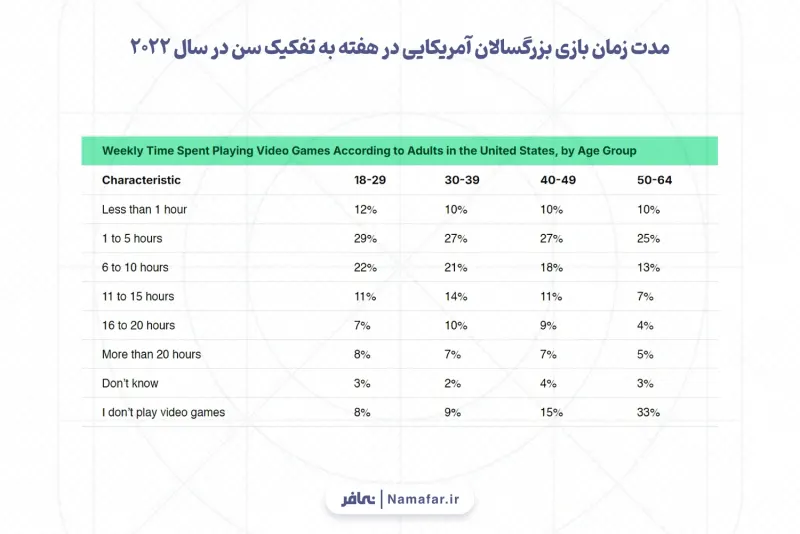
In-game payments
In-game purchases have become a considerable source of revenue for merchants of the game industry. It is predicted that players' global spending on paying for additional in-game content will exceed $74.4 billion by 2025. In 2023, revenue from in-game payments for mobile titles alone was estimated at $89.7 billion, accounting for 97% of this segment's global revenue. The remaining 3 percent is allocated to digital revenue from purchasing the full version of games, which includes mobile versions of popular older franchises such as the early versions of the Final Fantasy series.Rising popularity of independent games
Independent games, often made by small teams or individual developers, have gained particular popularity among players because of innovative gameplay mechanics and unique artistic styles. According to the CDC analytics database survey of the state of the game industry in 2024, 32% of game developers in 2023 reported that they work in independent studios. Also, 57% of these people work in studios with 50 employees or fewer. Just as larger studios have more staff, in past years three-quarters of AAA game developers have worked in studios with more than 250 employees; while independent developers in the same proportion worked in studios with 20 people or fewer.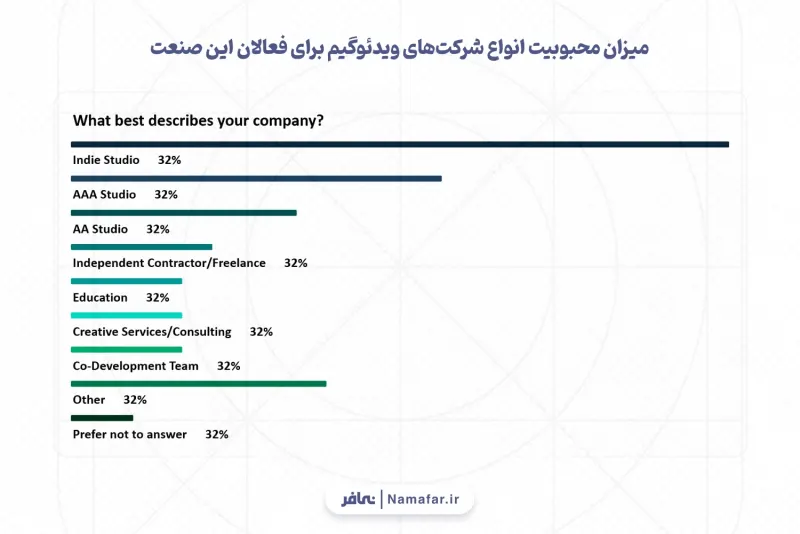
Advertising in video games
Regarding marketing strategies in the video game industry, collaboration with influencers and in-game advertising have been very effective. The global in-game advertising market, which in 2024 is valued at $109.60 billion. It is predicted that this figure will reach $145.50 billion by 2027. Also, revenue from advertising in mobile games has been on an upward trend, and the number of mobile game advertisers in 2020 increased by about 8 percent relative to 2019. Given statistics from the past three years, experts have predicted that mobile game advertising spending in 2025 will reach $131 billion.Growth of PC gaming continues
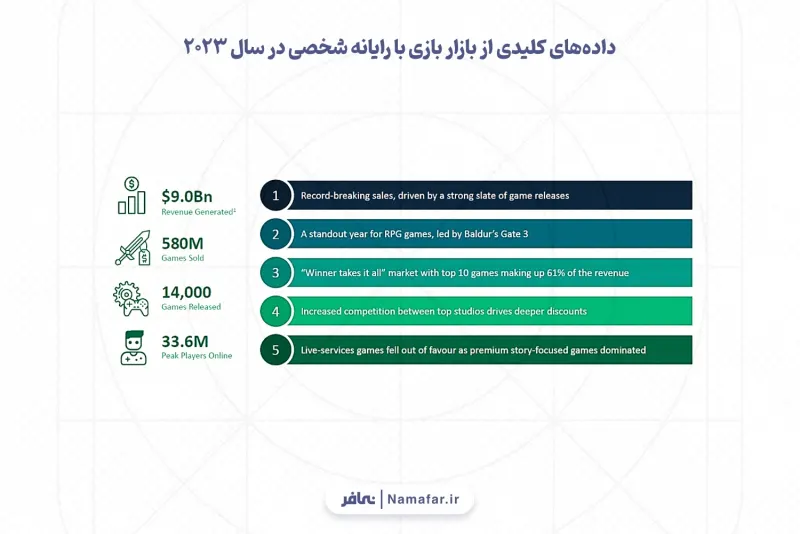
The PC games and computers market in 2023 set new records; a $9 billion revenue record, sales of 580 million units, 33.6 million online players, and the release of 14,000 game titles on the Steam platform are only part of the PC platform's successes in the video game market. In fact, this platform's performance in recent years has been significantly outstanding.The main reason for this is the increase in the release of new titles for PCs, which has exceeded expectations and been about 2 times that of 2019. In addition, the number of games released on the Steam platform after the start of the COVID-19 pandemic grew rapidly and by 2023 had almost reached the 14,000 mark. Overall, 66% of games in development in 2023 were designed for PCs, while 35% of games were distributed on PlayStation 5 and 34% on Xbox Series S/X.
The impact of video games on consumers' purchasing behavior
The role of video games in influencing consumers' shopping baskets has expanded greatly, so that in-game advertising, virtual goods, and game-related products play important roles in shaping players' purchasing habits. The global virtual goods market, whose value in 2023 was $81.13 billion and is predicted to reach $294.13 billion by 2030.For example, in-game advertising introduces players to new products and has an indirect effect on their perception. These effects lead to impulse purchases by the consumer. Virtual goods such as skins, weapons, and other in-game items are another major source of revenue, so that many players are willing to spend real money to improve their gaming experience. In addition, game-related products including clothing, collectibles, and hardware also contribute to the economic impact of the game industry.
A 2022 study showed that 80% of active users in games want to have next-generation game consoles and also want decorative items from their favorite games, while only 54% of casual players seek to buy these products and collectible items. In addition, 41% of game-market buyers place men's or boys' clothing with their preferred game design as a gift or souvenir alongside their game shopping basket. Interestingly, 35% of these same people also consider additional side purchases for themselves besides gaming products.
Among other impacts of video games on consumers' purchasing behavior is the existence of multiplayer games. These days multiplayer games that allow a large number of players to engage in the game simultaneously have become very popular. These games often emphasize cooperation and teamwork and strengthen player interaction. There are prominent massively multiplayer online (MMO) games whose socializing aspect is one of the main factors of purchase appeal for consumers.

Content appeals and their direct impact in games
Several key factors affect the success and popularity of games and their related content. Games that target audiences with diverse tastes usually benefit from features such as an engaging story, beautiful visual graphics, simple controls, and long-term goals. On the other hand, the emergence of streaming platforms such as Twitch has transformed the games industry and caused these content appeals to be shared more; so that in January 2024 there were more than 8.36 million active streamers and about 76% of all game content in 2023 alone was streamed on Twitch.The Twitch platform in 2023 accounted for 2.86 billion hours of live streaming. The number of live game-streaming audiences is predicted to reach 920 million people by 2024, and Twitch will account for more than 140 million unique monthly visitors. In the third quarter of 2022, platforms active in game streaming accounted for about 7.2 billion hours of content watched.
In addition, based on the Game Transfer Phenomena (GTP) framework, the narratives in games play an important role in their visibility. These titles strengthen the sense of realism of games among users and carry the game narrative beyond digital borders. Gradually these influential contents create the potential for making various adaptations of games. A potential whose roots should be sought in engaging storytelling, innovative gameplay, and the influence of content creators. It was in 2023 that the success of the titles "Pikachu Workshop" and "Super Mario Bros." on the cinema screen earned Nintendo a profit of $1,457,704,129.

Average annual revenue of video games
The video game industry has long been considered an important lever in the global economy and generates billions of dollars in revenue for societies. In 2022, the global games market size reached nearly $347 billion, of which about $248 billion related to mobile games.As of November 2023, Nintendo, with a value of $53.69 billion, was the leader in the global games market, followed by Electronic Arts at $35.96 billion. Among competitors, one can mention Take-Two Interactive Software, Inc. at $26.26 billion and Roblox Corporation at $23.65 billion. Roblox Corporation, which went public on March 10, 2021, reached a market value of $37 billion on the first day of trading. Despite significant declines in 2022 and 2023, this company remains one of the main players in the industry.
Activision Blizzard, which was once the flag-bearer of this industry, faced a decline in value due to legal issues and by October 2021 reached about $46.98 billion in revenue. However, in early 2023 a revival occurred and its market value reached $67.06 billion. Microsoft's acquisition of this company in January 2022, after regulatory approvals, had a large impact on increasing Activision's share profits. However, by the end of 2023, Tencent, with revenue of $7,442 million, was introduced as the world's number-one games company by revenue. Sony, Apple, and Microsoft ranked next by a wide margin.
Overall, revenue in the video game industry is supplied from various sources, including game sales, in-game purchases, subscriptions, advertising, and esports. Also, free-to-play (F2P) games that are initially free and generate revenue through advertising, in-game transactions, and optional purchases constitute a considerable share of games revenue.

Video games and social interactions
In recent years, video games have gone beyond simple entertainment and become a living social platform in which connections among users flourish. A Statista survey in 2023 showed that 88% of players acknowledged that video games had connected them with like-minded people and expanded their social circle, and there are also reports showing that through the gaming experience, new friendships and relationships have formed.In the United States, video games have become widely common, so that four out of every five consumers have participated in online social events related to gaming in the past six months. This survey also emphasized the social aspect of games, so that 60% of American players stated that games help them stay in touch with friends and family, and 50% of these same people have also met other important people through gaming. The rise of social media and online communities has also helped form cohesive gamer communities; communities that pursue a goal higher than competition and in which real and lasting friendships have formed. Also, the increase in the video game experience during the COVID-19 pandemic was a vital way for users to connect during lockdown.
The impact of video games on mental health and physical health
The impact of video games on mental and physical health is a complex subject that in recent years has attracted a great deal of attention. Based on University of Oxford studies in 2022, there are positive relationships between video games and people's overall health. However, video games can also have physical risks. Common injuries from overuse such as carpal tunnel syndrome, which is also known as "gamer's finger" disease and is common among gamers. In addition, there are reports of a relationship between increased play time and reduced player health. Also, video game addiction statistics in 2023 showed that between 1.7% and 10% of the US population suffer from these issues.Despite these possible drawbacks, some studies show that video games can have positive effects in areas such as physiotherapy. In fact, a global survey referred to in the "Power of Play" database report showed that a large number of the 12,847 players surveyed in 12 countries believe that video games help reduce stress (71%), reduce anxiety (61%), and cope with feelings of isolation (55%). Also many respondents claimed that video games provide a healthy outlet (64%), bring happiness (63%), and help get through challenging times (52%). In addition, more than half of these people (67%) reported that video games have helped form new friendships and social relationships.

Emerging technologies in the video game industry
The video game industry is always dynamic and influenced by new trends and technologies that shape its future. Virtual reality (VR), augmented reality (AR), and mixed reality (MR) technologies are among the most important emerging trends of this industry, whose current impact is observable and which will have promising consequences for this industry.Installed-base sales of VR games have been growing steadily and by the end of 2023 reached 30.8 million people (+15.6% compared with the previous year). United States games statistics in 2023 show that this country had 65.9 million VR users and 110.1 million AR users (with an estimate of 171 million VR users worldwide). Forecasts show that by 2027, both AR and VR gadgets will reach more than 100 million users globally. These technologies have erased the borders between the virtual and real worlds and offer users unprecedented levels of interaction in games.
Decline of blockchain integration in video games
These days blockchain has become one of the well-known technologies in the game industry and guarantees users' security and peace of mind in games. In some cases, this technology has facilitated secure transactions and reduced cheating by other players. Despite the considerable growth of this technology in recent years, blockchain investments in the video game industry declined significantly in 2023.The total value of investments in the blockchain domain reached $1.4 billion, indicating a 72 percent decline compared with the previous year. This decline coincided with 214 disclosed blockchain investments in game companies over the course of the year. However, according to a Grand View Research report, it is predicted that investment in these types of technologies will expand at a compound annual growth rate (CAGR) of 68.3 percent from 2023 to 2030.
Multi-platform games
According to Newzoo's report in the PC and console games domain in 2023, players who are active on several platforms—PCs, console, and mobile—are called "tri-platform players." These users' activity in the video game domain shows higher levels of engagement and spending in games.Studies show that approximately one quarter of PC and/or console players participate on all three of these platforms. This indicates a considerable segment of the gaming community that spends a great deal of time and financial resources on gaming. These data show that using multiple platforms has a direct relationship with increased play time and spending. In addition, demographic views show that 62% of these tri-platform players are men, of whom 46% are between 10 and 25 years old. This statistical community's favorite entertainments include video games (67%), watching films and television series (57%), and listening to music or playing it (49%).

Artificial intelligence tools are changing game development
Over the past year, the popularity of artificial intelligence technology has increased sharply thanks to platforms such as ChatGPT, Copilot, and Midjourney, and many game companies have increasingly allocated their resources to this domain. Results of a CDC survey show that 49% of developers use generative AI tools in their workplace. In this way, 31% of them use them personally and 18% have reported that their colleagues use them. A considerable majority (84%) of these people had concerns about the ethical implications of using generative AI, while 12% of them reported that they have no concern about the use of AI platforms.Popular job titles in making video games
In a 2023 survey, the most common job titles in the game industry were game designers and programmers, who accounted for 34% and 33% of respondents respectively. Production and project-management roles also followed them at 31% of respondents. Other notable roles included business and finance at 20%, visual arts at 19%, and narrative/game-story writing at 14%.Workforce challenges in the game industry
The game industry in recent years has faced considerable layoffs. In 2023, about 10,500 game-industry workers lost their jobs, and this trend has continued in 2024. In the first two months of the year, more than 7,800 layoffs were announced. Large companies such as EA and Unity Software have contributed to these figures; in fact EA reduced 5% of its workforce and Unity Software laid off approximately 25% of its employees. These layoffs have severely affected the industry and its employees, and a hard period is predicted to await game developers.Final word
As the games industry continues its evolution, on the one hand it is influenced by technological advances, changing market dynamics, and shifts in consumer behavior, and its challenges must be identified. This trend is at a sensitive point and has provided a good opportunity for growth and innovation. Embracing emerging trends such as immersive technologies, blockchain integration, and the growth of independent games, while facing workforce challenges and regulatory landscapes, will be important for industry stakeholders.It is expected that by 2025, the value of the global games industry will reach $321 billion, just as forecasts of the video game market in 2024 estimated $282.30 billion in revenue. This growth, which is expected to continue at an annual rate of 8.76% between 2024 and 2027, has come about under the influence of technological advances, increased connectivity to broadband networks, and continued demand for immersive gaming experiences.
We hope that the making and development of video games in Iran will also take shape with greater adaptability between creators and the expectations of players in the video-game community. The games industry, with flexibility and creativity, can meet the challenges and complexities of the future and ensure its importance and place in the digital age and beyond.
Namafar invites you to read the note the best Iranian game companies.
Translation of the article "70+ Video Game Statistics You Need to Know in 2024: Market Growth, Emerging Trends, and More"
Machine-translated from Persian by Namafar; the Persian original is authoritative. Read the original in Persian