Tourism in many cases is at odds with a sustainable economy. That is because masses of tourists mean masses of leftover waste, the possibility of forest fires, noise pollution, and all kinds of damage to a region's geographic and cultural fabric. For this reason, in recent years tourists have been looking for ways of traveling that align with the values of sustainability and environmental protection. They want to leave the least possible damage and footprint in a place; as if they were not travelers but native members of a region, and that region were not a tourist destination but their home and their native land. This is the core idea of the concept of "ecotourism," which is the focus of the present note. Ecotourism seeks to realize tourism in a region in such a way that, at first glance, no one notices the presence of tourists there. In this way the region's indigenous culture and indigenous nature suffer the least damage from the presence of travelers.
What is ecotourism?
The International Ecotourism Society (TIES) defines ecotourism as responsible travel that is attentive to protecting the environment and improves the well-being of local people. This requires specialized training for ecotourists before they enter any place. Ecotourism sites are usually not the focus of every kind of tourism; that is, unlike mass tourism, in which large numbers travel to a particular destination, ecotourism is small in scale, with the least damage to the natural environment. In addition, this form of tourism has other incidental benefits, both for the individual tourist and for local people. For example, it brings direct financial benefits for local communities, raises cultural and environmental awareness, and, through the exchange of experience between indigenous people and tourists, increases a sense of cohesion and social connection.The history of ecotourism
According to some, the word ecotourism was first used in 1980 by a person named Ceballos-Lascurain. He, who a year later became the founder of the Mexican Association for Nature Conservation and the most influential figure among nongovernmental organizations (NGOs), considered ecotourism equivalent to travel undertaken to examine, study, and enjoy nature and to become acquainted with the culture of the local people of each region. For years he was an adviser to the International Union for Conservation of Nature (IUCN) and the World Tourism Organization (UNWTO). After that, many joined the ecotourism movement, including wildlife biologist Megan Epler Wood and Russell Mittermeier, who is now president of Conservation International, and Thomas Lovejoy, who is referred to as the "godfather of biodiversity."Martha Honey—a journalist and historian—in an interview at a travel blogging conference in Cancun, Mexico (2014), recalled the preservation and continuity of ecotourism's core ideas from 1980 to the present; that is, protecting nature and respecting local people. "The Slow Food movement, organic agriculture, altruistic travel, concern about the trafficking and sexual abuse of children, fair trade, carbon-footprint offsetting, and animal welfare are all branches and offshoots of ecotourism." In addition, we have witnessed countless symbols of the presence of ecotourism; from Jonathan Tourtellot, chief officer of the Destination Stewardship Center—a nonprofit endowment center for sustainable tourism—and Jeff Greenwald, founder of Ethical Traveler, to Hitesh Meta, founder of economic design.
Different types of ecotourism
Ecotourism includes various activities, some of the most important of which we note in this section.- Wildlife watching: such as safaris and wildlife refuges, exploring bird habitats, and so on
- Hiking and trekking: long walks in nature; Great Smoky Mountains National Park in the United States, with more than 800 miles of walking trails, and Mont Blanc on the border of France and Italy, with 170 kilometers, are two ideal destinations for tourists.
- Marine ecotourism: such as diving and snorkeling and watching whales and dolphins. Smiling Seahorse is a specialist diving company for holidays in Thailand's Similan Islands that, by adopting a responsible policy, uses only environmentally friendly products on its boats.
- Community-based ecotourism: in this type of ecotourism you become acquainted with the culture of local people and honor it; for example, you take part in their traditional ceremonies, buy their handicrafts, listen to their stories, and so on.
- Adventure ecotourism: doing adventure sports such as kayaking, zip-lining, or cycling; traveling to deserts and arid regions, and so on. For example, Costa Rica's national parks and the Pelion Peninsula in Greece provide an ideal setting for a kayaking experience—provided you leave no footprint on nature!
- Photography tours: researchers have issued guidelines for "responsible photography," that is, without any negative footprint or disruption of the environment; including: keeping a sufficient distance from subjects, using the camera zoom, and not baiting animals.
- Volunteer activities: volunteer activities combined with travel give tourists the opportunity not merely to observe the environment but also to play an active role in protecting and restoring it. Tourists can, by helping to build houses or schools, helping the poor, protecting endangered wildlife, and cleaning up the environment, have a substantial impact on it. Of course, tourists may not be very familiar with the realities of local communities' lives and may imagine their problems as overly simple and trivial, or even cause those communities to become overly dependent on them. One must be alert and aware of these warning signs and similar cases through further education.
The bright and growing horizon of the ecotourism market
Given the explanations provided, tourists' growing desire for a meaningful encounter with cultures, environments, and local communities has steered them toward the experience of ecotourism, which brings them a deeper understanding of the environment. The current market value of this type of tourism in 2023 reaches 210 billion dollars, and it is forecast that by 2035, at a compound annual growth rate of 11.7 percent, it will reach 820.8 billion dollars. In Chart 1 you can see the projected growth trend of the ecotourism market from 2023 to 2035.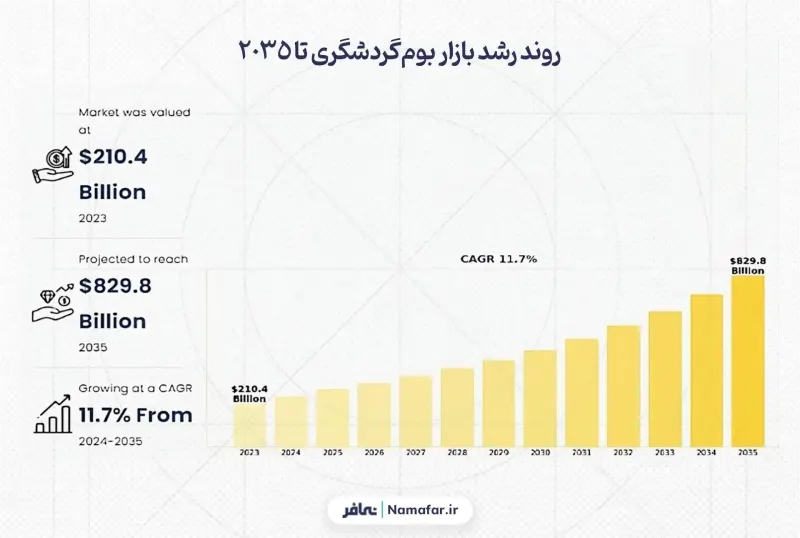
Preferred ecotourism options
Research by Allied Market, with a precise analysis of various ecotourism market trends, has shown that in 2023 group travel led relative to solo travel and will probably remain more popular through 2035 as well. Also, Generation Y (the millennial generation, most of whom were born in the early 1980s through the late 1990s) has shown the greatest interest in this type of tourism, both now and in the future; because for them, travel to distant and unknown destinations and breaking the monotony of life is all experience and excitement. Ultimately, tourists prefer to travel through travel agencies rather than independently, because they can benefit from these agencies' expert and informed advisers and minimize the potential risks of travel.Asia-Pacific: ecotourists' priority
Among geographic regions, Asia-Pacific has had the greatest popularity among ecotourists. In 2021 the size of this market was 64,417.9 million dollars, and it is forecast that at a compound annual growth rate of 14 percent it will reach 150,908.3 million dollars by 2027. In 2023, China, Japan, Australia, and India were the most in-demand destinations for outbound travel among high-income groups; so much so that households with incomes above 10 thousand dollars booked and purchased more than 70 percent of these trips. As Figure 2 shows, after the Asia-Pacific region, with the highest number of tourists, come the regions of Europe, North America and Latin America, the Middle East, and Africa, respectively.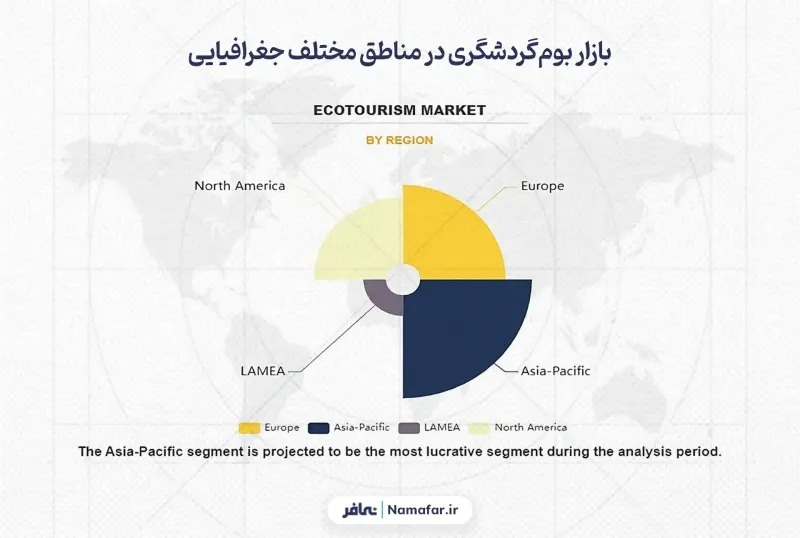
The other face of ecotourism: its negative consequences for the environment
Ecotourism, despite the importance it has in creating values of sustainability and protecting the environment, by being turned into a marketing and sales strategy by large companies can show its other face. Reports show that many ecotourism areas in African countries belong to tourism companies. These companies turn pristine, untouched areas into national parks, destroy wildlife habitats, and leave indigenous people with even greater poverty and misery. For example, 70, 50, and 40 percent of land in Kenya, Tanzania, and Uganda, respectively, is occupied inappropriately. These kinds of tourism—such as playing with dolphins, grooming animals, or feeding them—bring only windfall profits for large companies and irreparable damage for the environment.
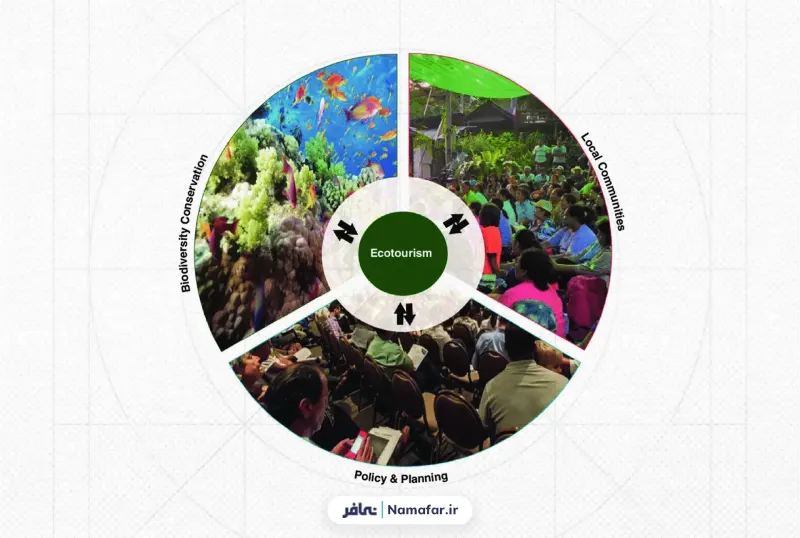
In this regard, research by the World Animal Protection organization has shown that behind a simple dolphin's smile there can be between 400 thousand and 2 million dollars in profit. For this reason this organization recommends that responsible ecotourism means avoiding buying tickets to watch animals held in captivity. "Animals are capable of understanding various emotions such as pain, fear, suffering, and even grief. Therefore it is not ethical to inflict pain and suffering on them, just for a few moments of entertainment and recreation." Megan Epler Wood, one of the active figures in ecotourism, believes that the path this tourism is taking and must take depends a great deal on governments' commitment to creating safe destinations and giving guarantees to local people. She describes her own pure experience for the future of ecotourism as follows:
"On a trip to Egypt, after a night's stay in one of its oases, we immersed ourselves in its crystal waters and then ate lunch in a small hut decorated with rugs and local handicrafts and run by indigenous guides. It was one of our most authentic encounters; a place where local people and tourists, far from everything else, shared their culture and customs. Truly, this is the future of ecotourism."
Final word
In recent years, with rising public awareness of environmental dangers and crises such as pollution, climate change, animal extinction, and so on, interest has grown in types of travel that, besides protecting the environment, create a bond with local cultures and people and bring them a deeper understanding and connections. But we must be aware and alert to the possible consequences of our own behavior in these areas, especially the harm that large tourism companies inflict on them. With sufficient awareness of responsible and sustainable tourism, we can imagine a bright future for the environment and its survival for future generations.The Namafar editorial team invites you to read the note tourism industry statistics in Iran.
Short link: nmfr.ir/h2o
Machine-translated from Persian by Namafar; the Persian original is authoritative. Read the original in Persian