The name of the country of Saudi Arabia is often intertwined with rich oil resources; a resource whose discovery in 1938 turned this country into one of the wealthiest places on Earth. Statistics have shown that 50 percent of this country's GDP in 2023 related to oil and gas; compared with the United States of America, whose share is only 8 percent. Nevertheless Mohammed bin Salman, crown prince and prime minister of Saudi Arabia, and his deputies in 2016 planned a project titled "Vision 2030" to reduce the country's growing dependence on oil revenue. In this vision, diversifying the oil-based economy to create a vibrant society, a thriving economy, and an ambitious nation has been given attention. In this regard, investment in the fashion industry has been raised as one of the important axes of this vision. The attention and initiative of Saudi politicians toward the fashion industry brings at least two narratives of change and transformation for the country: a narrative of economic change by creating more job opportunities and increasing non-oil GDP, and a narrative of cultural change by reducing dependence on imported products through the intersection of Saudi Arabia's traditional clothing and the global fashion current and the global transmission of the country's culture and values.
Profile of the fashion industry in Saudi Arabia
It is expected that the value of the fashion industry in Saudi Arabia will increase by about 48 percent from 2021 to 2025. Among the immediate results of this industry's growth was job creation for 230 thousand people, more than half of whom (52 percent) are women. Of this number, 90 thousand people became engaged in core jobs (such as model, jewelry designer, and tailor) and 140 thousand people in indirect jobs related to fashion (such as clothing seller, textile machine operators, and so on). Figure 1 shows the fashion industry market in Saudi Arabia by its various segments, namely clothing, luxury brands, footwear, and accessories. It is forecast that between 2022 and 2025, the luxury brands market will grow 30 percent.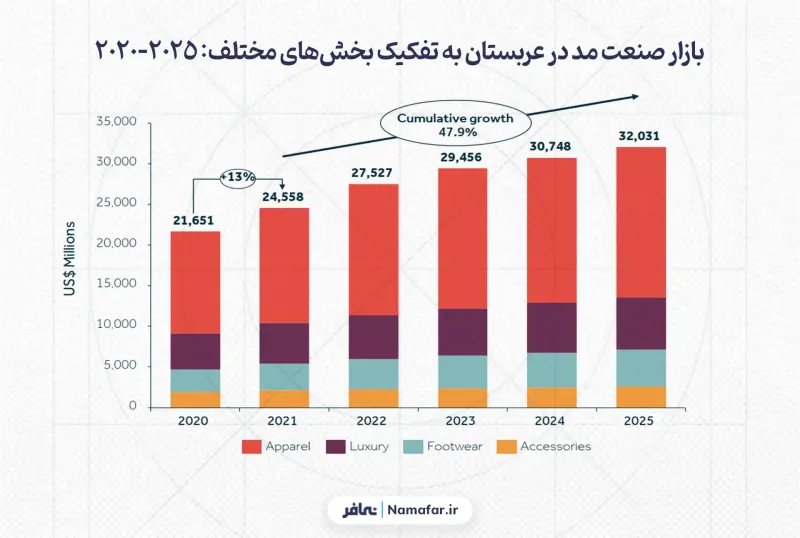
Online sales; a popular platform for buyers after COVID
The COVID-19 crisis fundamentally transformed many of people's habits, including their shopping style. So much so that a survey in the years 2020 to 2022 indicated a doubling of people's interest in online sales. The country's national policy in Vision 2030 has also set its sights on a 70 percent increase in online sales in the fashion industry. It is forecast that online commerce in the fashion industry, with 74 percent growth, will go from 2.34 billion dollars in 2023 to 4.08 billion dollars in 2027. It should be noted that in 2023, the highest online sales related to clothing at 36.1 billion dollars. Figure 2 shows the online market of various types of clothing in Saudi Arabia in the two years 2023 and 2027. As can be observed, pants, with 39 million dollars, accounted for the highest online sales in the country. It is forecast that this sales will grow by about 44 percent by 2027.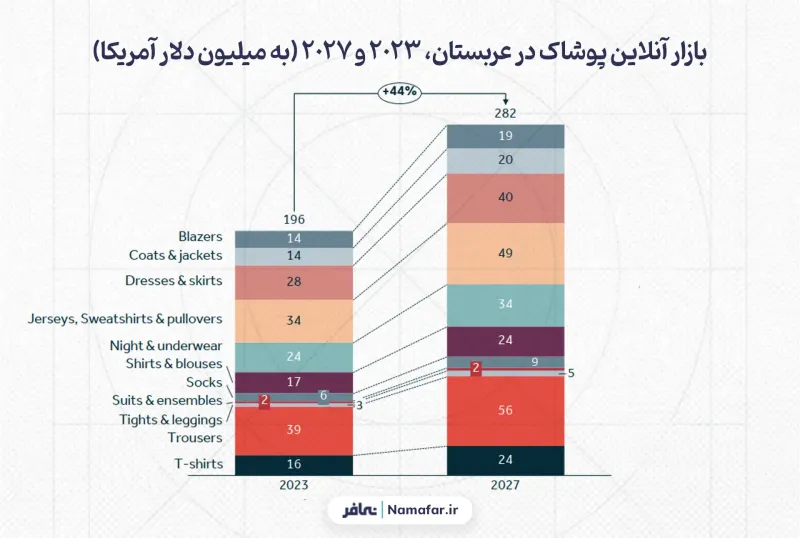
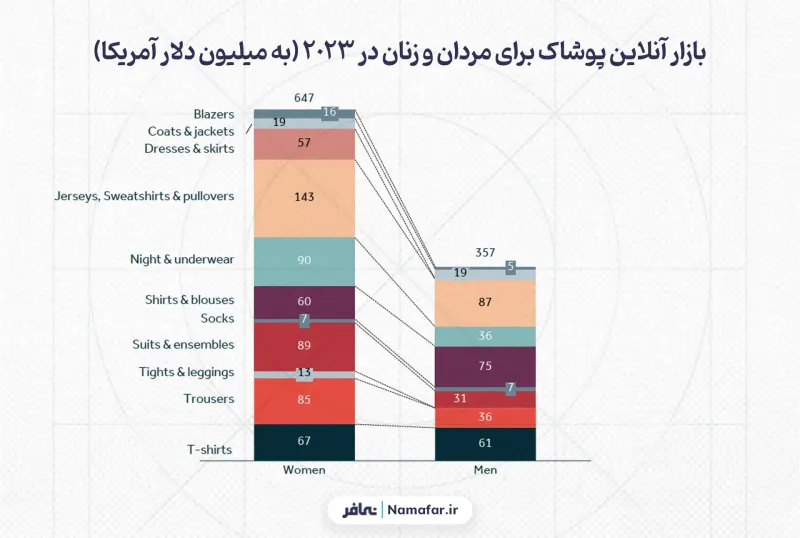
On the other hand, the breakdown of clothing for women and men is shown in Figure 3. According to what you see in the figure, in 2023 the men's clothing market was 357 and women's clothing 647 million dollars. For women, shirts, tracksuits, and sweatshirts with 143 million dollars, and evening wear and underwear with 90 million dollars, had higher sales. For men this order includes sweatshirts and tracksuits with 87 million dollars and shirts with 75 million dollars.
Striking growth of sportswear
Society's growing awareness of the value of health and the attention of the country's Ministry of Sports to people's physical activity have caused sportswear sales in 2022, as the most dynamic fashion segment in the country, to reach 1.3 billion dollars. It is forecast that by 2027, sales of this clothing and its main sub-items will grow 21 percent. Extensive marketing by international brands such as Adidas and Nike in Saudi Arabia is also considered one of the other reasons for the striking growth of sportswear in this country. Adidas, with 29 percent of sportswear sales, is the leader among other brands in Saudi Arabia. Also the Nike brand is very popular because of its financial support of the Saudi team in the 2022 FIFA World Cup. Other brands, including Fila, also have striking dynamism with pop-up stores — temporary stores that are often set up in unexpected places and for a limited period of time — and the support of the country's native celebrities for it. Figure 4 shows the value of the sportswear market in Saudi Arabia in 2022 and 2027.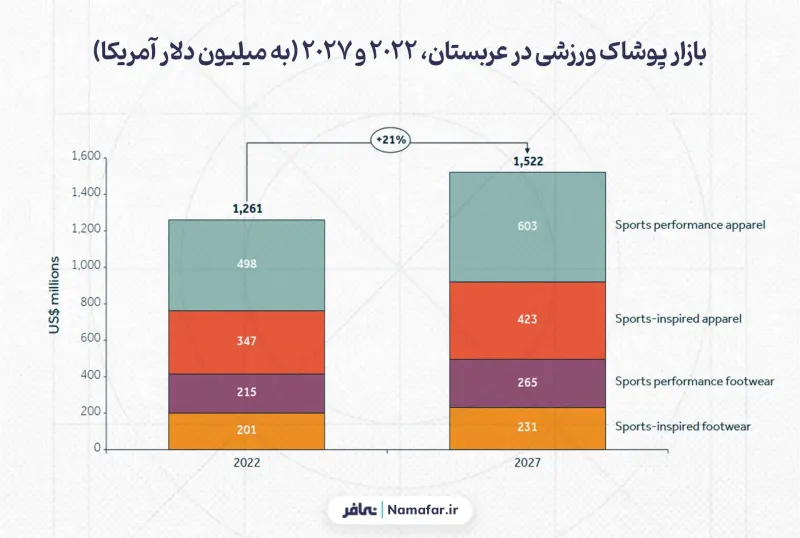
International fashion festivals: a global narrative of indigenous talent and cultural exchange
In 2021 Saudi Arabia's largest exports were to the countries of Switzerland (332 million dollars), the United Arab Emirates (175 million dollars), and France (115 million dollars). The largest exports to the countries of Switzerland and France were jewelry (99.8 and 96 percent, respectively) and to the UAE were jewelry (63 percent) and clothing (36 percent). On the other hand, China, with 6.2 billion dollars, is the largest importer of fashion products to Saudi Arabia. Goods imported to Saudi Arabia often include sweatshirts, coats, shirts, and skirts. Researchers, while acknowledging the importance of imports and mutual connection with various countries, are unanimous on this point that Saudi Arabia should pay greater attention to exporting goods to other countries and the global transmission of its traditional culture and values. Cakmak, former head of fashion at the Parsons School of Design in New York and current CEO of the Saudi Fashion Commission, believes that young people, by studying in various countries, bring those countries' cultures with them. These cultures, in combination with the country's traditional values, can help the better and more creative evolution of Vision 2030. The "100 Saudi Brands" program has been one of the important measures in this regard. This program is held by displaying the innovative works and designs of Saudi designers, from ready-to-wear and evening wear to handbags and jewelry, at international fashion weeks in Paris, Milan, and New York. Mona Al-Shabeel, one of the designers in this program, says: "One of the distinctive aspects of Saudi Arabia's fashion industry is the abaya—a long, loose robe that women wear. Saudi designers, with a new design of this clothing, turned its traditional design into a fashion statement. We experimented with the abaya with different fabrics, cuts, designs, and colors and invented a modern and up-to-date style that is not exclusive to only one culture and one society."Sustainability and environmental preservation: a core value in Saudi Arabia's fashion industry
The United Nations Environment Programme considers the fashion industry responsible for 8 to 10 percent of global carbon dioxide emissions; more than the shipping and air transport industries. A survey by the Future of Fashion Events (2022) also showed that 84 percent of fashion designers, government officials, and instructors consider preserving the environment a necessary matter for their audiences and customers. For this purpose Saudi Arabia considers reducing carbon dioxide emissions essential as part of the "Saudi Green Initiative." In 2022 the National Center for Waste Management noted that for this purpose it would recycle ihram garments that are discarded after Hajj al-Tamattu. In line with this goal, noteworthy measures have been taken by various organizations and activists to reduce carbon dioxide emissions and preserve the environment. One of these measures is the creation of a "public exchange shop" by the Fashion Commission to raise society's awareness in using second-hand clothes and reducing waste. Also the Saudi Basic Industries Corporation (SABIC) has brought to market products that help greater environmental sustainability; including special foams for shoes and recycling processes with low carbon emissions. Ghaydaa Majdaly, a fashion designer, is among the other people who, with 3D technology and discarded products including plastic water bottles, has built a device for better preservation of the environment. She has said in an interview: "I use leftover fabrics to make handbags or accessories. Likewise I placed a blouse that was unused in my 3D machine and created a new product from it."Future of the fashion industry in Saudi Arabia
At the close of this note, this question is raised: "What will the future of the fashion industry in Saudi Arabia be like and what path will it take?" In answering this question one can, with some latitude, put forward this proposition that if the fashion industry in Saudi Arabia pays attention to several fundamental axes, it will have a dynamic future ahead of it: attention to the values of sustainability and environmental preservation and the continuation of creating goods with recycled materials and low pollution emissions; making use of technology's possibilities whether in designing products, in introducing and disseminating them globally and domestically, or in marketing and sales. According to research, most of the new generation (Generation Z and millennials) spend time on social networks and are influenced by influencers' lifestyles. Therefore, appropriate and timely use of technology's possibilities can be fruitful in branding and better product quality. For example the Adidas brand, with a 3D-printed sole in athletic shoes, makes possible better analysis and monitoring of the athlete's performance. This matter, in parallel with educating the new generation both in local fashion design universities in the country (such as King Abdulaziz University and Princess Nourah bint Abdulrahman University) and in granting them academic scholarships, completes the puzzle of the future of the fashion industry in Saudi Arabia.Final word
Saudi Arabia in Vision 2030, by investing in various sectors including the fashion industry, is pursuing the intention of diversifying its oil-based economy. In this note we tried to familiarize you with the status of the fashion industry in this country and to speak of its various transformations. If the government and private organizations devote special effort to the fashion industry in Saudi Arabia and make use of the young generation to introduce it and brand it internationally in the global market, a bright and growing outlook is conceivable for it. In this regard, attention to the value of sustainability and environmental preservation and attracting audiences' attention through various platforms and media is also of great importance.Short link: nmfr.ir/a0z
Machine-translated from Persian by Namafar; the Persian original is authoritative. Read the original in Persian