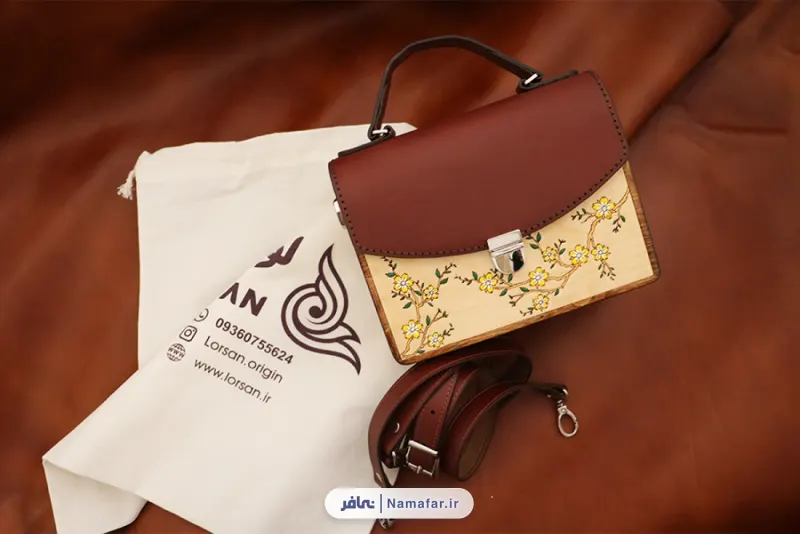
The Lorsan collection is a producer of various leather products such as bags, eyeglass cases, and leather wallets in the city of Mashhad, which claims to have gathered experienced artists and craftspeople from across Iran to create a new and distinctive style by combining leather and wood as well as authentic Iranian miniature painting.
Marzieh Tajvidi, 37 years old, CEO of Negar Pushan Rezvan Company under the Lorsan brand, through 3 years of uninterrupted effort has been able to find a suitable place among large production collections of various creative products. In what follows you will read the full text of this interview:
Where did the idea and motivation for forming this business come from?
One of our family friends had a wood workshop, and he always did beautiful artistic work with wood, and whenever I went there I had a strange feeling and became very excited. It was there that I thought of starting work that would relate to women and somehow create a change in women's style. In fact, a change of the kind of authentic Iranian-Islamic design and motif, and that would contain authenticity. That is why I chose the bag. In 1400 (2021/22) I started the work with the help of my husband and my daughter.
At what level is the scope of Lorsan's work at present?
In the first year, issues of prototyping and initial commercialization were raised. After that we entered the incubator of cultural products and pilgrimage of the Science and Technology Park of Khorasan Province and there we began activity as a pre-incubation company and entered the product commercialization phase. A product that would be popular with people and, while being Iranian, would be distinguished and, apart from being a work of art, would also be practical.
Are you currently based in the park?
We are a member of the Khorasan Razavi Science and Technology Park center.
How do your interactions with the park work, and has it been effective in your mutual growth?
From a spiritual standpoint, because of membership in a large organization and the existence of intellectual and advisory support, it has been beneficial.
What actions can the Ministry of Science, as the authority overseeing the parks, take in the field of creative industries?
The first issue is a change of attitude. They should not think they must support only technological and high-tech products. Sometimes seemingly simple products need strong, large-scale support for their sales and marketing development; such as industrial design, dimensions of audience recognition, type of advertising, marketing, and type of pricing, each of which requires its own science. So in my view the first step is a change of mindset, and the Ministry of Science can support creative industries by facilitating participation in various reputable pavilions and exhibitions and also the export of products, organizational and administrative sales to government institutions and government agencies, and large companies. Because many creative industries have very good potential in exports and have added value from every standpoint.
Also, facilitation in the field of organizational and administrative sales to government institutions and government agencies, large companies. In addition, teaching exemptions should be considered for faculty members. For example, if faculty members are CEOs of 5 creative companies, there is no exemption for them, whereas if faculty members own a technology company, they are covered by the exemption.
As an expert, what recommendations do you have for accepting creative companies into the parks?
Behind a seemingly artistic or seemingly creative product, there are certainly high-tech issues and knowledge-frontier issues in the fields of marketing, customer recognition, and behavioral analysis; otherwise there will be no creative product, or it will not have the capacity to grow.
Is accepting creative companies into science and technology parks useful relative to other knowledge-based industries?
Unfortunately the place of creative industries has not been well recognized. Science and technology parks are responsible for supporting companies that can be growth-oriented through creative and technological methods, or that have a technology-based product. But behind creative products, if there are no innovative and knowledge-frontier concepts in the fields of marketing, industrial design, and product development, they will not succeed. Therefore technology is not only in the nature of the product but also exists in product support and development.
What are your marketing and sales channels for your products?
The first sales were from the Instagram page, which took place by inviting relatives and friends. Because they were initial productions, they were of medium quality. But because the work was distinctive, we had good sales until our work expanded. Now we also sell our products wholesale to gallery owners and boutiques in other cities. Among our other loyal customers are the handicrafts around Imam Square in Isfahan and near Eram Garden in Shiraz.
Since 1400 (2021/22) we have had an active presence at the International Handicrafts Exhibition and the International Exhibition of Iran's Export Capabilities in Tehran, and through various collaborations such as the authentic Hariran brand we have exported to Canada, Russia, Dubai, and Germany. Also in the first year of starting the work, that is, 1400 (2021/22), at the Fajr Fashion and Clothing Festival we won second place nationwide as the top design in the bag section.
What is your distinguishing feature and value proposition for customers?
The main distinguishing feature between the Lorsan collection and other well-known brands in the market is the use of miniature painting and authentic Iranian colors. Also, in addition to diverse bags for women, gifts for men are also being prepared; these gifts are decorated with motifs on belts, handbags, and keychains and are packaged inside beautiful packs and ready to ship. Using different techniques such as miniature painting, relief work, and cross-stitch on wood has made many of our works diverse. This diversity and creativity have caused the products to be met with a great reception from many customers.
Regarding the material of the products as well, the bags are made of leather and wood and a blend of motifs and color. The woods that are used are not MDF, but beech, Russian wood, and so on. The leathers are completely natural, and the miniature painting on the bags is done with acrylic paints.
How many people are employed at Lorsan?
The Lorsan collection has fifty employed people, some of whom work at home and some in the Lorsan workshop, directly and indirectly.
We have three workshops in Mashhad.
Have you also received facilities from the government?
We received three hundred million tomans from the Science and Technology Park of Khorasan Razavi Province.
What is your recommendation for people who want to enter the field of creative industries?
Correctly identify the audience, go after blue-ocean markets, meaning markets that have fewer competitors. Create proper and appropriate value with regard to the audience.
What challenges do you face?
In production, one of our constant challenges is purchasing raw materials. Unfortunately the fittings we use are not produced in Iran and all are imported from China and are affected by the dollar price. The leather dyes come from outside Iran, and every month we go to buy, the prices have changed. We cannot increase our products' prices every month and we are forced to sell the work at a lower profit.
In exports as well, unfortunately we have a difficult process, and we who are producers do not have the necessary tools at our disposal, and there needs to be personnel who guide our work in this direction. Of course we have anticipated this in our future work plan.
Machine-translated from Persian by Namafar; the Persian original is authoritative. Read the original in Persian