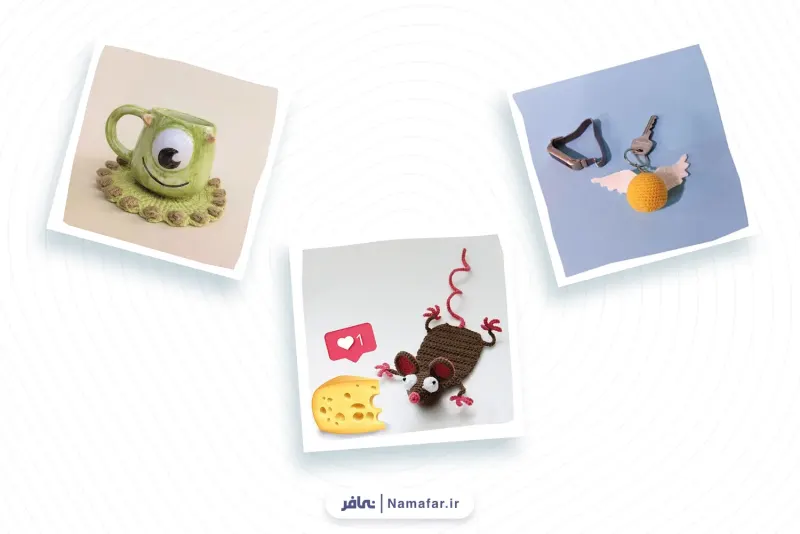
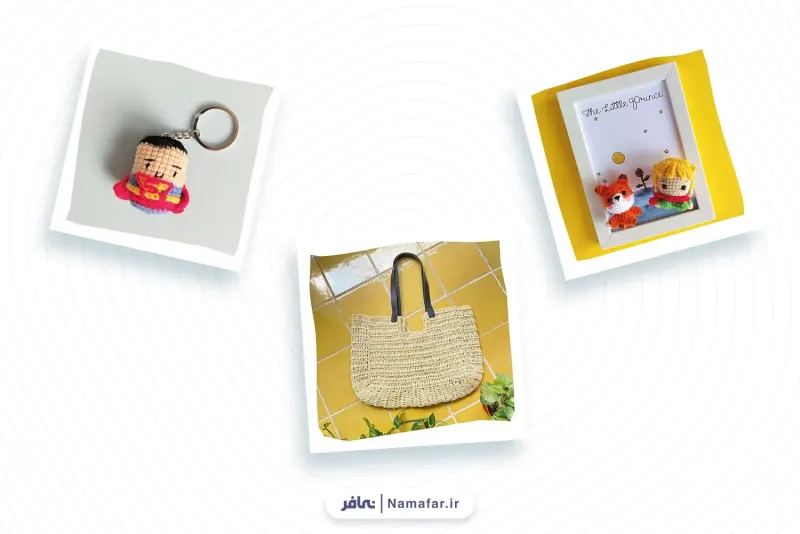
Bafdanium is a creative and innovative company with the slogan of a workshop as wide as Iran that started its activity with the production of keychains and continued with diverse accessory and gift products such as mugs, knitted wall pieces, and large-size dolls. Yalda Mohammadi, born in 1372 (1993/94), is the CEO of the creative company Bafdanium. She says creativity in business can generate wealth by creating strong links and the interaction of economic and cultural values.
In what follows you will read the full text of this interview:
Where did the idea and motivation for forming this business come from?
The original idea for this work was my husband's. Together we created a platform so that from anywhere in Iran anyone, only by having a smartphone and access to the post office, can collaborate with us. Our group started activity in year 96 (2017/18) with the help of women who are heads of household or who contribute to family income, and with the production of knitted bookmarks under the Choq Alef brand. In 1396 (2017/18), with the help of 3 knitters, we produced knitted animal bookmarks, and now we carry this work forward with a 40-person team of knitters, most of whom are heads of household and contributors to family income. In 1401 (2022/23), with the addition of workforce, we launched the Bafdanium website so that we would also have direct sales. At the beginning of the work, we ourselves did the illustration and all the stages, and in connection with packaging and, accordingly, the needs that arose in the work process, we acquired the necessary skills.
How is the marketing and sale of your products carried out?
Bafdanium's product sales market is divided into three categories. Collaboration with culture and arts stores, Digikala, and direct sales through the website and Instagram. At present our online sales account for a small share. Part also relates to organizational gifts. The start of our marketing was traditional and in person. From the very beginning, with good marketing, we were able to place our store stand in reputable stores nationwide such as the "Shahr-e Ketab" stores and have collaborated with them to this day. By visiting culture and arts stores, we expanded the range of customers. We designed professional catalogs and tried to have our work seen in a short time. At the beginning our production volume was very small relative to our demand, so a number of stores were in the demand queue. At present we operate with 26 chain stores nationwide (15 branches in Tehran, 2 branches in Isfahan, 4 branches in Fars, 2 branches in Mazandaran, one branch in Gilan, one branch in Bushehr, one branch in Kish). The start of our work was Tehran and specifically the Enghelab area.
What is your distinctive feature and value proposition for customers?
Since our production is entirely hand-knitted and handmade, mass production is not possible in it, and this reduces the number of competitors. In addition, Bafdanium's produced product is a blend of modern art with local authenticity. More importantly, a popular social story exists behind each of the products that confers high social value on the products. We are also very sensitive about the quality of the products and the delicacy of production, which increases the final value of the products.
How many people are employed at Bafdanium?
Our knitters are women who live in underserved areas. Through the collaborate-with-us section on the Bafdanium website, they submit a request for collaboration, and after meeting the necessary conditions, the necessary training is given to them. Other members are also attracted to Bafdanium through the Divar platform, Telegram groups, and other social networks. On the basis of orders received, we divide the volume of demand among the knitters. We give homemakers orders each month according to the volume they can work, in such a way that it does not harm their home life. So far our group has been able to create employment for more than 30 people, and our goal is to create a basis for raising the number of personnel and providing for the export of this hand-knitted art worldwide. Part of the products is also produced by women who are in prison.
Are you currently based in the park?
From Shahrivar (August–September) 1402 (2023/24) we became a member of the Golestan Province Innovation Factory and are based there, and I can say that the start of our professional work coincided with our membership and establishment in the Gorgan Innovation Factory.
How are your interactions with the park, and has it been effective in your mutual growth?
Without a doubt, activity in an innovation factory places at people's disposal infrastructures that are very influential. Presence in the parks helps creative and technology companies be seen and have their voice heard more loudly. Many visits take place and it creates opportunities for acquaintances, assistance, and consultations that were beneficial for us. One of the greatest benefits of membership in the innovation factory was networking, and as a result of it collaboration experiences were created. Even so, conditions for creative companies are not the same as for knowledge-based companies.
What actions can the Ministry of Science, as the custodian of the parks, take in the field of creative industries?
The Ministry of Science can create a transparent legal platform for creative industries. Legal frameworks have not been created for creative companies, and the lack of transparency in these areas creates confusion in the field of exports, and managerial planning similar to that for knowledge-based companies must be carried out to improve the legal standing of creative industries. The most related body to us is the handicrafts office, which does not recognize us at all. There it has a traditional official framework that we do not fit into. It would be better for financial funds to be created for creative companies. Training and empowerment should be placed in priority. More targeted and more principled professional training courses should be held by the innovation factory. Export consulting should be placed at the disposal of creative industries. Technical and vocational training classes should be held for applicants.
As an expert, what recommendations do you have for the admission of creative companies into parks and innovation factories?
At first we had no familiarity at all with the infrastructures of creative industries; through membership in the science and technology park we became familiar with creative industries. Innovation factories can bring together various resources and organizations such as accelerators, startups, creative companies, venture capitalists, service-provider companies, and so on, and cause transformation and change in a region's innovation ecosystem. Presence in the parks leads to connection with local communities and the growth of the local economy. The diversity of produced products increases. Most companies in the parks are active in the IT field, and the number of companies active in the domain of soft technologies and handicrafts is small. If the number of creative industries increases, they can act in a very innovative way and succeed in attracting talent.
Did you also receive facilities from the government?
We received the amount of 300 million tomans from the Gorgan Innovation Factory.
What plans do you have for the future?
Currently, toward developing and expanding the work, in the various sections of illustration and creating distinctive and personalized features, we have customization capability, and the goal ahead of us is export to European countries and the Persian Gulf region.
Machine-translated from Persian by Namafar; the Persian original is authoritative. Read the original in Persian