The New York Times headline in 2002 caught everyone's attention: "Nollywood." An ironic term that referred to Nigeria's film industry and its comparison with Hollywood. Africa's most populous country, where most people have a daily income of less than $2 a day, had now become the second country in the film industry after Indian cinema (Bollywood). Even during the COVID outbreak, video film production in this country continued. According to information from Nigeria's National Bureau of Statistics (NBS), the number of films produced in the second quarter of 2021 by Nollywood reached 635 films, equivalent to 53.93 percent growth. The coastal metropolis of Lagos hosted the production of more than 383 films in the first two months of this year.
But how was Nigerian cinema able to achieve such growth and, in a sense, even overtake Hollywood? Growth that both changed Nigeria's cultural face and had a major impact on this country's economy.
History of the film industry in Nigeria
Before Nollywood, Africa's film industry was a local activity that appealed only to domestic audiences and did not go beyond the country's borders. Even Egypt's classic films in that country's brief period of political and artistic freedom in the late 1950s, although they were considered artistically successful and won awards, were not commercially successful and were distributed only in art-house cinemas in Europe and America and at film festivals. But the course of Nigerian cinema's transformation after 1990 had three distinct periods:
-
The celluloid era: early Nigerian cinema (1960–80)
1960, after the country's independence, was the year when the film industry in Nigeria was able to grow independently of foreign filmmakers. These films, which were shot on celluloid, drew inspiration from the storytelling style of the Yoruba traveling theater tradition. Dramatic stories that dealt with issues such as religion, witchcraft, and the supernatural. The pioneers of this period's productions were filmmakers such as Ola Balogun, Adeyemi Afolayan, Francis Oladele, Hubert Ogunde, and Eddie Ugbomah. In the 1970s, with economic boom and an increase in the number of cinemas in cities, demand for film production and exhibition also increased. However, the decline in the value of the Nigerian naira (the country's currency) in the 1980s made filmmaking equipment hard to obtain. A decade later, celluloid film production also stopped.
-
The VHS era: the rise of Nollywood (1990–2000)
The Nollywood period began in 1992 with the arrival of videotapes and home video systems (VHS), recognized especially with the production of the film Living in Bondage. This film was made directed by Chris Obi Rapu and starring Kenneth Okonkwo and Nnenna Nwabueze. The film's story is about an unlucky businessman who sacrifices his wife to a satanic cult in order to become a wealthy man. This film was distributed directly to VHS and in a short time achieved striking success, transforming the cinema distribution model in Nigeria.
However, in the mid-2000s, the Nollywood model showed its problems. The films were mainly low-budget works made with $25 thousand or less. These sums were usually financed through small loans from private investors or out of directors' own pockets. Although higher budgets were sometimes provided with foreigners' support, they in turn limited African filmmakers' independence. Film piracy was also widespread; so that in the early 2010s it was estimated that for every legal copy of a film, there were between 5 and 10 pirated copies on the market.
-
The digital era: New Nollywood after 2009
The problems that arose in the previous period led to the emergence of a new model in Nollywood filmmaking that was referred to as "New Nollywood." Directors such as Kunle Afolayan, Kemi Adetiba, and Tunde Kelani made great efforts to improve the filmmaking industry in this period. For example, the film The Figurine, directed by Afolayan, was made in 2009 with a budget of nearly $330 thousand. Writing this film's screenplay took five years and shooting it three months, which was considered a relatively rare phenomenon. This film attracted international attention, and critics praised the quality of its story, acting, and production. The distribution strategy of these higher-budget films was theatrical release to increase revenue before the film's DVD release, because early release of films on DVDs facilitated their piracy and illegal distribution.
An overview of the film industry in Nigeria
Nigeria, after Bollywood, is considered the world's second hub of the film industry. In 2019 a total of 700 films were produced and censored in this country, but as the chart below shows, this figure is small compared with the number of films produced in 2020 and 2021.
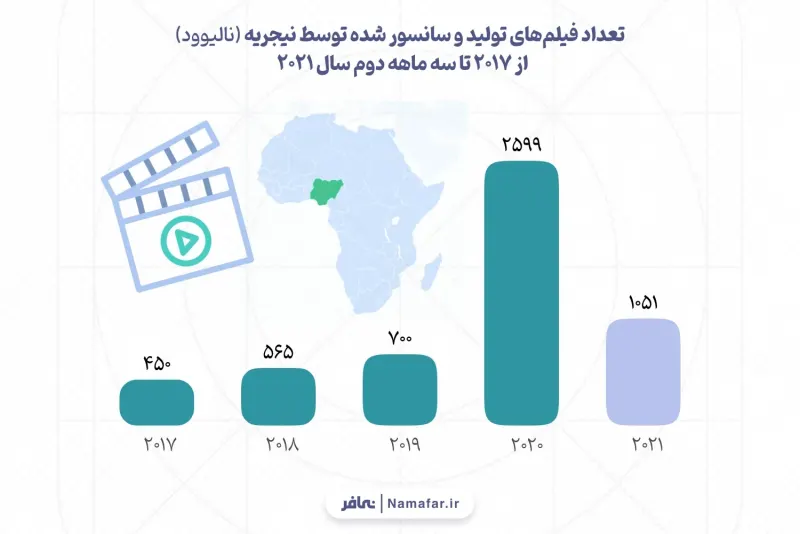
The dominance of streaming services in later years increased Nollywood cinema's revenue still further. Based on data from cinema sources, Nollywood's box office in the first quarter of 2022, with a 50 percent increase relative to 2021, had more than 1.26 billion naira in revenue. This figure, compared with 843 million naira in the first quarter of 2021, shows a striking record after the COVID pandemic. BusinessDay has estimated that if the 2,978 films produced in all of 2021 are multiplied by 100, we will arrive at a figure equivalent to the employment of more than 297 thousand people in this industry. (The figures in the table above for 2021 consider up to the second quarter of this year, which totaled 1,051 films.) Jobberman — a career development and recruitment company in Nigeria — has also predicted that by 2025 more than 27 million additional jobs will be created by Nollywood.
The importance of the Nollywood industry in Nigeria's economy was such that Steve Umanovfeme, in a report from the International Monetary Fund in 2016, noted that "we were only able to understand this importance when we revised Nigeria's GDP in 2014." Arts, entertainment and recreation, financial institutions, public administration, education, human health and social services, the music industry, and telecommunications were among the sectors that were reviewed. Based on this revision, Nigeria's GDP increased from an initial estimate of $285.5 billion in 2013 to $510 billion, of which $660 million related to the Nollywood film industry.
This flourishing of Nollywood cinema continued in later years as well; so that 2023 recorded the highest level of film sales; in the first half of this year alone, relative to the first half of the previous year, the film sales chart was 62 percent higher. 2024 too, despite the difficult conditions that filmmakers faced in financing their productions and that audiences faced in buying and consuming films, the dynamism of cinemas was notable; so that according to Nigeria box office data, by December 15, 2024 more than 935 thousand tickets had been sold; that is, more than 3.5 billion naira in revenue. This amount indicates a 125 percent increase in revenue and a 46 percent increase in ticket sales relative to the previous year. Films such as All's Fair In Love with 136 million naira, Lakatabu and Farmer's Brid with 200 million naira, and Queen Lateefah with 336 million naira have been among the 2024 box-office titles. Ticket sales are expected to increase further with the rise in cinema traffic over the New Year holidays.
Nollywood's impact on world cinema
The Nollywood film industry, with its rapid growth, has considerable potential for cultural exchange and economic development around the world. As Toyosi Etim-Effiong, founder of the talent management agency That Good Media, has said: "It is time for the world to receive our stories and our content." At the 2023 Essence Film Festival, held in New Orleans, she was responsible for introducing Nollywood to the world. Nigerian actors, directors, producers, and other important stakeholders from around the world were present at this grand event. At this festival, conversations were also held about the film industry, including the need to strengthen relationships, create platforms for Nigerian talent, promote diversity, discover unknown talents, advance economic development, facilitate cultural exchanges, and empower key stakeholders.
Given what has been said, experts believe that Nollywood's popularity on the global stage is rooted in at least two fundamental factors, although it is not limited to them:
-
Use of the facilities and services of advanced technologies
On August 25, 2023, Nollywood director Editi Effiong shared a list of executive producers of his film "The Black Book." These producers included founders and investors of African startups such as Nadayar Enegesi (Eden Life), Olumide Soyombo (Voltron Capital), and Ezra Olubi (Paystack). Publication of this list showed that technology founders play an important role in financing films.
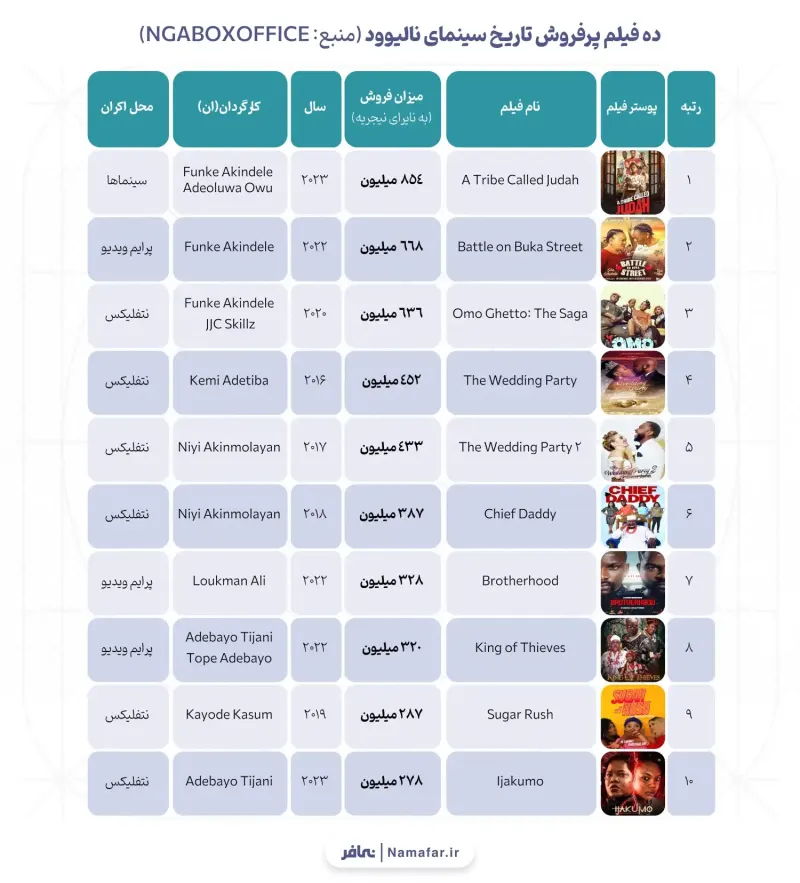
Anita Eboigbe, a film journalist and writer, stated in the same vein, "Right now, there are monopolies everywhere that can only be broken through with more money. When we get to streaming platforms, there are still many unresolved problems in negotiations. All of this comes down to how the process is managed, and to solve these issues, we need money." Given this, investment in streaming platforms such as Netflix and Amazon Prime and collaboration with local studios such as Inkblot and EbonyLife, by improving the quality of films, have been among the factors effective in the global success of the Nollywood industry. The list below, which includes the 10 highest-grossing Nollywood films, is evidence of the importance of investments in this country:
BusinessDay sees this strong emphasis on using technology in filmmaking as a sign not only of more films being produced in the future but even of their higher quality. In a striking example one can point to Iboyi, who began shooting with 4K sensor cameras and now works with 5K and 6K sensors. He says the future of film resolution will be even bigger than this and he does not want to be caught unawares. "You cannot make a film the old way and expect a viewer who has just watched a good film on Netflix or another foreign film to watch your drama. Something has to be exceptional, and this is only possible when you tell your own stories with new technologies. The main point is that the better films you make using new technologies with precision, the more people you will astonish with your stories, and the more people become interested in your films, the more revenue you will have."
-
Excitement for winning prestigious film awards
Every individual likes to be the best in their professional field. Nigerian filmmakers and actors were no exception to this rule and compete with one another to win prestigious awards such as the Africa Movie Academy Awards (AMAA), Best of Nollywood, and the Africa Magic Viewers' Choice Awards (AMVCAs). Film schools such as the National Film Institute in Jos, which is run under the Nigerian Film Corporation (NFC), have trained internationally award-winning filmmakers such as Mak Kusare and Kenneth Gyang. Emem Isong's Royal Arts Academy and Del-York Creative Academy are among the other leading film schools in Nollywood. The late Amaka Igwe, the lady of Nollywood studios and filmmaker of Best of the Best African television and cinema programs (BOB TV), has also made a considerable contribution to the sustainable development of the film industry in Nigeria.
This excitement has even spread to top filmmaking studios so that they can share in Nollywood's global success. FilmOne Entertainment is among these studios, which, by releasing 12 films in 2024, is recognized as the top film studio in Nigeria. This studio has successful collaboration with other studios, including Anthill Studios, belonging to Niyi Akinmolayan, director of successful films such as "The Wedding Party 2" and "Setup." This studio released three films in 2023. Of course other well-known studios such as Greoh Studios, Euphoria 360, and Funke Ayotunde Akindele Network each produced three films in this year (2023): the films Brotherhood, King of Thieves, and Battle on Buka Street, each of which was among the box-office hits.
What challenges does Nollywood face?
Despite everything we have pointed to, Nollywood's growth has not been and will not be free of facing challenges. Illegal sales and film piracy; insufficient capital for producing, marketing, and selling films; limited access to distribution networks (both domestic and global) are part of these challenges that can lead to reduced investment and discourage filmmakers from producing quality films in the future.
Of course, there can still be hopes for effective management of and confrontation with these challenges. In 2023 Muhammadu Buhari, the president of Nigeria, passed a new copyright bill under which intellectual property rights in the digital space can be protected. Although many filmmakers still criticize the insufficient income from the distribution of their films on global streams, it should not be forgotten that these are among the reasons for the emergence of the global Nollywood brand. So that in the 2000s, thousands of Nigerian and Ghanaian films were distributed internationally from a YouTube channel. In 2011, this channel began producing content by launching its own streaming platform, iROKOtv. Netflix too has licensed many Nollywood films since 2015 and has produced content in this cinema since 2020. In addition, many Nollywood films have been broadcast on satellite and cable television channels across Africa and have been dubbed into various local languages. Nollywood TV, a satellite television channel associated with CANAL+, offers French-dubbed versions for Francophone African countries.
Final word
Nigeria's film industry, known as "Nollywood," is today one of the key elements of the country's cultural and economic prosperity; an industry that, after Bollywood, as the world's second cinema hub, can provide Nigeria as one of the cultural attractions and even a thriving venue for the growth of "film tourism." Statistics show that this country produces nearly 2,500 films every year; compare this figure with Hollywood's annual production of 300 to 900 films so that you can better grasp the breadth and flourishing of Nigeria's film industry. Among the factors effective in this success and the emergence of the global Nollywood brand are its collaboration with global streams and an independent narration of African cinema for audiences around the world, far from the common stereotypes that American films depict. In addition, filmmakers' and studios' hunger to win prestigious international awards has also helped this cinema flourish further. Of course, like any other phenomenon, the emergence, expansion, and survival of Nollywood cinema have not been and will not be free of challenges. Planners and policymakers must be able, by devising measures for effective confrontation with copyright infringement of works and providing sufficient financing to filmmakers, to guarantee a bright future for Nollywood cinema.
Machine-translated from Persian by Namafar; the Persian original is authoritative. Read the original in Persian