The 10 million dollar Labubu market in Iran: fact or myth?
"One million Labubu dolls worth 10 million dollars have been sold in Iran!" This is a claim that has been circulating in the country's media space in recent days. But an examination and analysis of official sales data from Pop Mart (the maker of Labubu) and regional statistics shows a different account. Across the whole of Europe, the Middle East, and Africa, a combined total of about 1.1 million Labubu dolls have been sold; so it seems highly unlikely that the Iranian market alone would have accounted for a figure close to that same number. Such a gap between the data strongly calls into question the claim of millions of Labubu sales in Iran, especially as Pop Mart's CEO has also stressed that Labubu has so far had no serious market in the Middle East. So what is the reality of the Iranian market? The evidence shows that it is not original Labubu dolls, but counterfeit versions known as "Lafufu," that have made up the bulk of the market. Namafar's data-driven estimates indicate the presence of about 200 thousand Lafufu dolls in the country, with a market value of around 100 billion tomans. Therefore the real Labubu (Lafufu) market in Iran is far more limited than the exaggerated claims and perceptions.
What is Labubu, and what shape and signs does it have?
Labubu, or Labubu, is the name of a character in Pop Mart's "THE MONSTERS" toy series; it has no particular meaning and was created by Kasing Lung, a Hong Kong artist. Labubus are vinyl faces attached to plush bodies and have a distinctive appearance: pointed ears, large eyes, and a mischievous smile that has exactly nine teeth. According to Labubu's creators, this doll is tender-hearted and always wants to help but often accidentally gets the opposite result. Labubu dolls have been produced in several types—"Labubu Energy," "Labubu Macaron," "Labubu Classic," "Sitting Labubu," "Lucky Labubu "blind box""—and more, and made available to customers. Even so, the various types of Labubu dolls are not easily distinguishable from one another.
How did Labubu become widespread (a trend) and popular?
Contrary to public perception, Labubu did not become a trend and popular by accident, or overnight so to speak. According to Ashley Dudarenok, founder of the research firm ChoZan, after the COVID-19 pandemic many people in China felt they needed to calm and soothe themselves emotionally, and Labubu, a very appealing but chaotic character, became popular. Of course, at first Labubu's fame was limited to China and it gradually spread worldwide.
Labubu: a popular symbol of entertainment, or an agent of China's public diplomacy?
In recent days and weeks, the revenue and net profit of Pop Mart, the creator and owner of Labubu, have been the focus of attention and discussion in foreign and domestic media. But the rise in revenue and profit of the company that makes Labubu has often given rise to notions and readings far from reality. The root of this, in the first place, lies in incorrect interpretations of Pop Mart's sales data and statistics, and then in not reading and not paying attention to the entire Pop Mart financial performance report and in highlighting parts of that report.
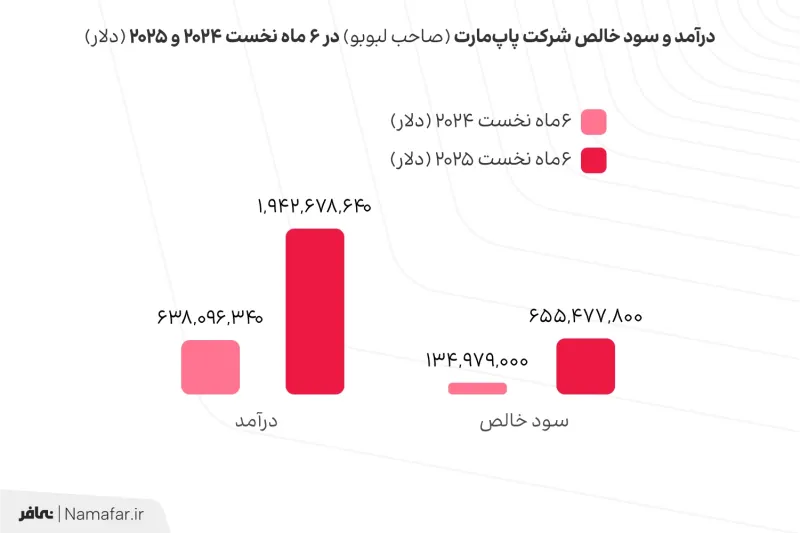
An examination of the "interim results for the six months ended 30 June 2025 of Pop Mart International," published on 19 August 2025 (28 Mordad (July–August) 1404 (2025/26)), shows that Pop Mart's revenue in the first 6 months of 2025 reached 1,942,678,640 dollars; this figure in the first half of 2024 was 638,096,340 dollars, which indicates a 305 percent increase in the company's revenue. Pop Mart's net profit also rose from 134,979,000 dollars to 638,096,340 dollars, which indicates a 473 percent increase in the company's profit.
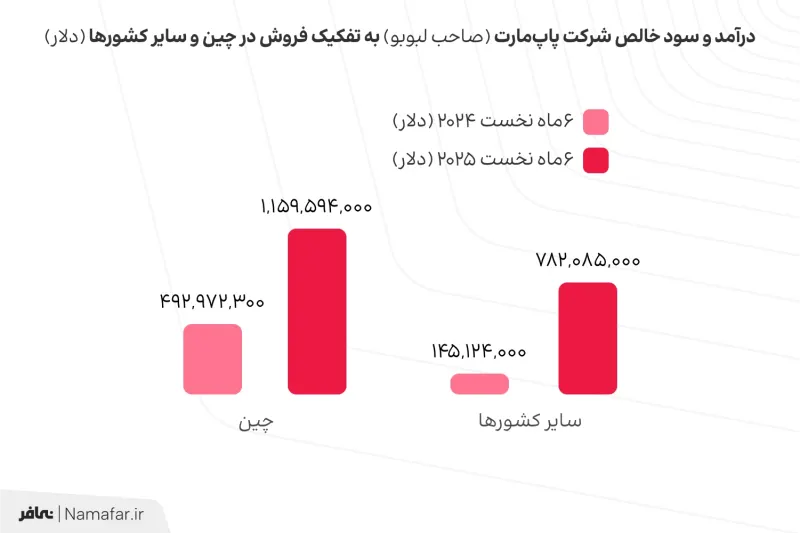
But if this increase in revenue is analyzed and estimated without analyzing and breaking down the domestic (China) and foreign markets, it will bring mistaken notions and analyses. An examination of Pop Mart's revenue and net profit (the owner of the Labubu brand) broken down by sales in China and other countries shows that 1,159,594,000 dollars of this company's revenue was in the domestic Chinese market and the remaining 782,085,000 dollars was in other regions and countries of the world. Therefore 60 percent of Pop Mart's revenue was obtained in the China market and from Chinese customers. On this basis, the growth in revenue of Pop Mart and of Labubu, which is one of its popular products, is rooted first in its success and establishment among the people of China and then among foreign customers and international markets.
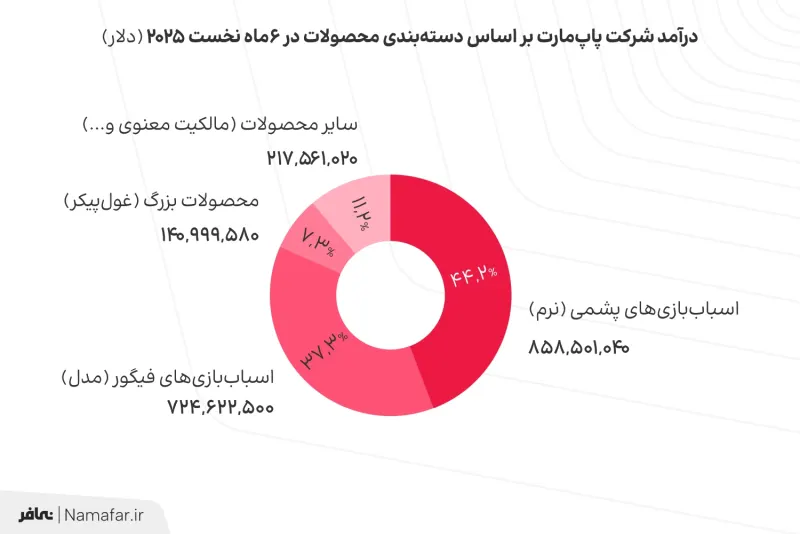
Pop Mart revenue by product category
Pop Mart's products generally include four categories (types): plush toys, figure (model) toys, large (giant-sized) products, and other products (products related to intellectual property rights, and so on). An examination of Pop Mart's revenue by product category and type in the 6 months ended 30 June 2025 indicates a 44.2 percent share for "plush toys" such as Labubu, such that sales of plush toys reached 858,501,040 dollars. Plush toys are soft and gentle and are made from plush fibers, and because of the sense of comfort and stroking they create, they are popular with children. These products are known as soft toys and are suitable for play, collecting, and home decoration.
"Figure toys" refers to small models of characters, animals, vehicles, or particular objects that are designed for display or play and usually have a high level of detail. After plush toys, figure toys, with 724,622,500 dollars, have accounted for 37.3 percent of Pop Mart's revenue. "Other products "intellectual property, etc."" with 217,561,020 dollars and an 11.2 percent share of Pop Mart's revenue, include objects or items inspired by intellectual property rights such as brands, characters, films, or television programs. These products can include dolls, games, and accessories with well-known designs. Also, "large "giant-sized" products," which usually have unique features and distinctive designs and are more complex and more expensive, with 140,999,580 dollars, have accounted for 7.3 percent of Pop Mart's revenue. Large (giant-sized) products are designed for collectors or particular audiences and include complex toys or sets with special assembly.
How much are total Labubu sales worldwide?
An examination of Pop Mart's revenue by the type of its product characters shows that 88.1 percent of Pop Mart's revenue, equivalent to 1,712,000,000 dollars, belonged to sales of these doll characters. Labubu, or Labubu, which is known as the "THE MONSTERS" series, with 674 million dollars has taken the place of Pop Mart's best-selling character and doll product. Labubu dolls have been offered by Pop Mart in several types—"Labubu Energy," "Labubu Macaron," "Labubu Classic," "Sitting Labubu," "Lucky Labubu "blind box""—in various sizes, such that the company now offers nearly 100 product types in the "THE MONSTERS" series on its website for customers.
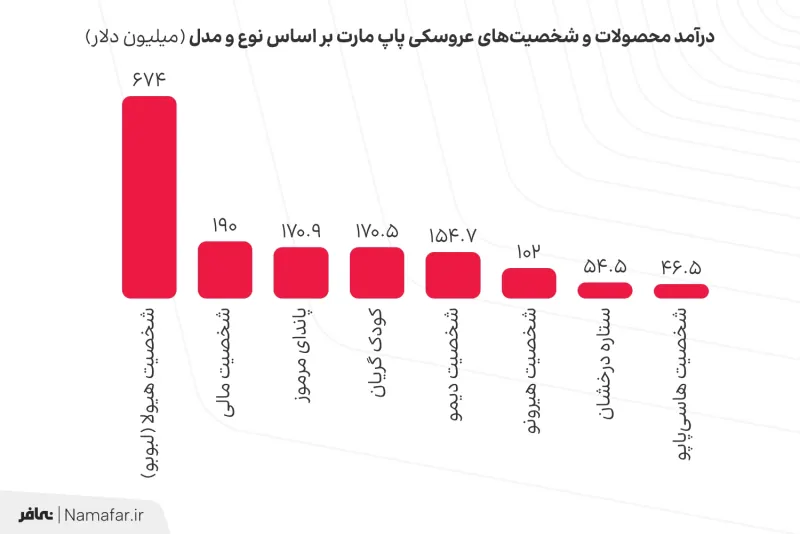
In addition to Labubu, Pop Mart's other popular characters have also been able to find a special place in the global toy market. The "Molly" character, with its simple and appealing design, has generated 190 million dollars in revenue. "Skullpanda," with its distinctive design, has had 170.9 million dollars in sales. "Crybaby," too, with its particular emotions and popularity among fans, has had 170.5 million dollars in revenue. The appealing characters "Dimoo" and "Hirono" have also had 154.7 million dollars and 102 million dollars in sales, respectively. The characters "Twinkle Twinkle," with 54.5 million dollars, and "Hacipupu," with 46.5 million dollars, are among the most popular toys. These figures indicate the growing popularity of fantasy characters in the toy industry.
Pop Mart revenue by geographic regions and countries
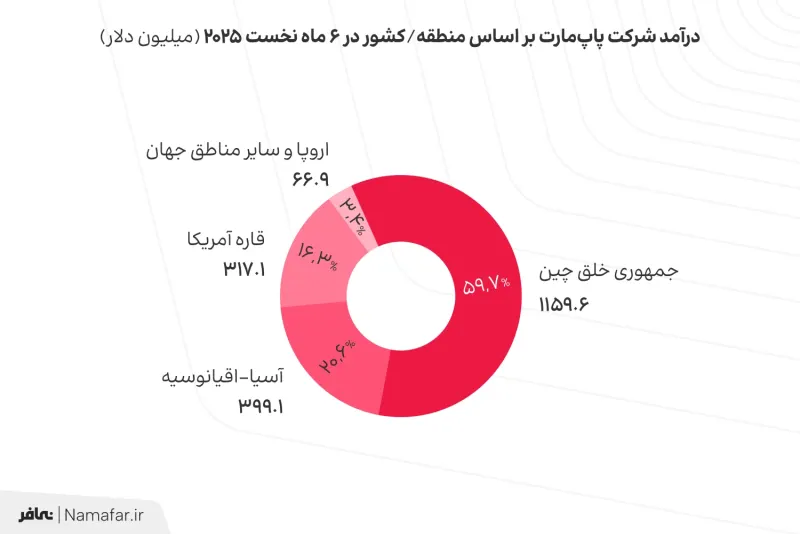
In the first six months of 2025, Pop Mart saw striking revenue growth in four geographic regions "broken down in the report." The "People's Republic of China," with a prominent share of revenue, accounted for 1,159.60 million dollars (59.7 percent of total revenue). Meanwhile "Asia-Pacific," with 399.1 million dollars (20.6 percent), is still among Pop Mart's main markets. This region is one of the largest and most dynamic economic regions in the world, comprising East Asia, Southeast Asia, South Asia, and Oceania. Important countries in this region include Japan, South Korea, India, Australia, Indonesia, Malaysia, and the Philippines. "The Americas" has also experienced considerable growth, with revenue of 317.1 million dollars (16.3 percent). This region includes various countries, including the United States, Canada, Mexico, the countries of Central America, and South American countries such as Brazil, Chile, and Argentina. Finally, "Europe and the rest of the world" has also had a 3.4 percent share of Pop Mart's total revenue, with 66.9 million dollars. In Pop Mart's breakdown, European countries as well as other regions such as the countries of the Middle East, Africa, and other parts of the world that lie outside Asia, the Americas, and Oceania have been treated as Europe and the rest of the world.
How many Labubus have been sold worldwide?
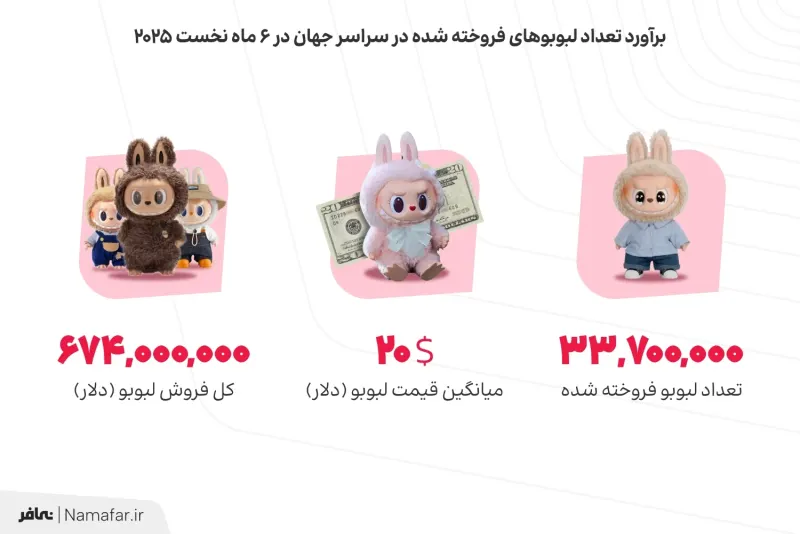
Analyzing Pop Mart's revenue from Labubu sales, or THE MONSTERS, and intersecting it with the two variables "average Labubu price" and "Pop Mart's regional and geographic revenue distribution" has made it possible to obtain the amount and number of Labubus sold. Although recently even a human-sized Labubu doll (131 centimeters) was sold for 150 thousand dollars at the Yongle international auction in Beijing, an examination of the price trend of ordinary types of Labubu dolls shows that the average price of each Labubu is 20 dollars. Of course, this figure differs in various regions and countries and with supply and demand and so on, and this number relates to Pop Mart's official stores and sales website. On this basis, in the 6 months ended June 2025, 33.7 million Labubus were sold worldwide.
Sales of 1 million Labubus in Europe, the Middle East, and Africa!
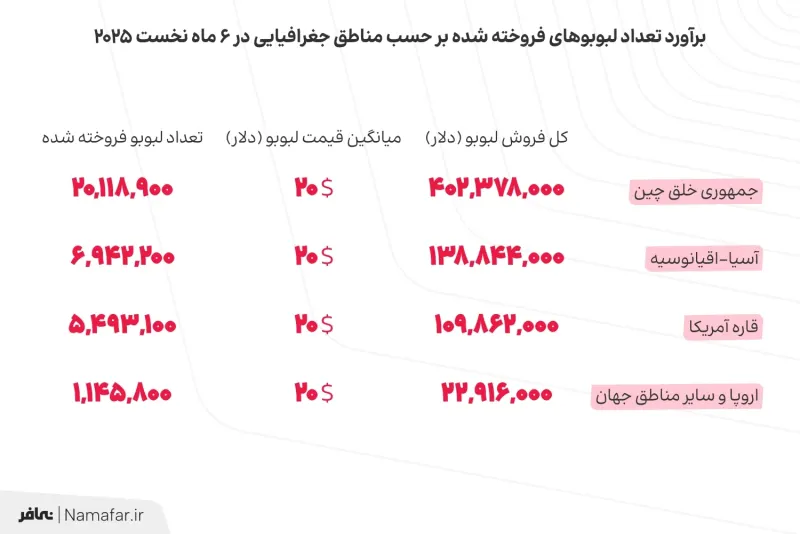
In China, Labubu has generated more than 402 million dollars in revenue; if on average each doll is priced at 20 dollars, 20 million Labubus have been sold in China. In Asia-Pacific, Labubu sales were 138.8 million dollars, and in total more than 6.9 million dolls were sold at this same average price. Similarly, in the Americas, where 109.8 million dollars was obtained from Labubu sales, the number of dolls sold was 5.4 million units. Reached. Finally, in Europe and the rest of the world, sales of 22.9 million dollars means 1.1 million Labubus were sold.
Sales of 1 million Labubus in Iran: spreading statistics and a myth
As calculated, in "Europe and the rest of the world," which in Pop Mart's breakdown treats European countries as well as other regions such as the countries of the Middle East, Africa, and other parts of the world that lie outside Asia, the Americas, and Oceania, 1.1 million Labubus have been sold. The question then arises of how sales of 1 million Labubus in Iran, and that at a value of 10 million dollars, were calculated and put forward! According to Pop Mart, in addition to the development and ease of access of sites and online channels in Europe, the number of Pop Mart stores and agencies in Europe has reached 18 stores. Therefore it is logical that a considerable share of the 1 million Labubus sold in "Europe and the rest of the world" would be in European countries. Also, "Wang Ning," Pop Mart's CEO, recently said in an interview that the company is reviewing and planning to expand its activities in emerging markets such as the Middle East, and this shows that Labubu has so far not even had a serious market in the Middle East.
Have 1 million Lafufu (not Labubu) been sold in Iran?
Lafufu, or Lafufu, is a counterfeit doll similar to Labubu. Lafufu is a name that has become common today among fans of the Labubu doll. Lafufu is a product of the popularity of and rising demand for Labubu that has entered the market at prices much lower than Labubu. CNN, in a report titled "Fake Labubu dolls have become very popular. Can Pop Mart keep going?", referring to the fact that Pop Mart is taking legal action against the sale of counterfeit dolls, reported the company's seriousness and its pursuit of China's customs measures in seizing Lafufus.
In line with the analysis of Pop Mart's data and the emergence and presence of Lafufu dolls, it can now be said with certainty that the market of Iranian sellers and customers is busy buying and selling Lafufu. The question now is whether, if what was meant by sales of 1 million Labubu in Iran was sales of 1 million Lafufu, this statistic is correct. An examination of the volume of production and of Lafufus discovered as smuggled in China and other countries shows that the statistics and figures related to fake Labubus have in practice also ruled out the possibility of selling 1 million Lafufu in Iran. According to a BBC report titled "Are Labubu dolls cute or weird? How Labubu dolls conquered the world," in recent days Chinese customs authorities have announced that they have seized more than 70,000 counterfeit dolls. Therefore the import and arrival of 1 million Lafufu in Iran is also ruled out.
1 million Lafufu means 120,000 kilograms of dolls!
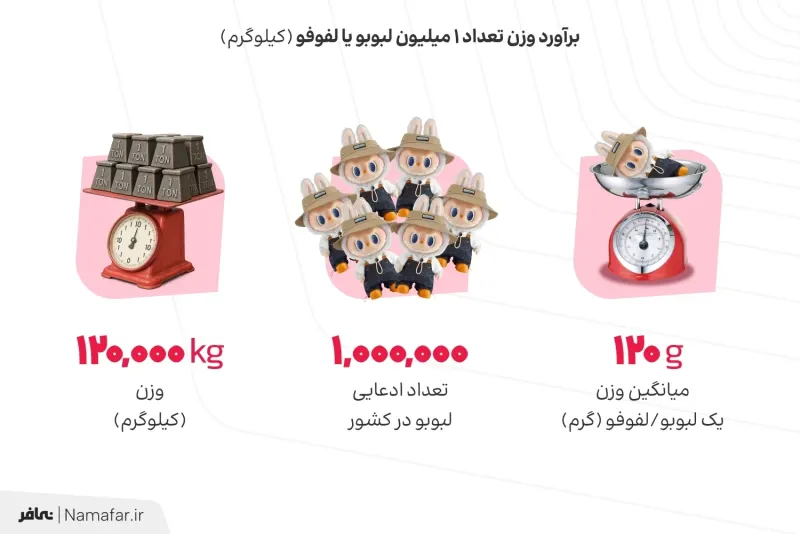
The exact weight of each Labubu doll has not been officially announced and provided by Pop Mart. Even so, reviews and customers' experience indicate that, depending on the type and series, each Labubu is from 89 to 121 grams. But when we talk about the counterfeit version of Labubu, or Lafufu, that has been offered on the Iranian market, its weight can also be heavier given the production materials and so on. Even so, if by default we take the weight of each Lafufu to be 120 grams, the presence of more than 1 million Lafufu dolls on the Iranian market means the entry of 120 tons of Lafufu dolls into Iran, which also seems highly unlikely.
A 100 billion toman market, 200 thousand Lafufu in Iran
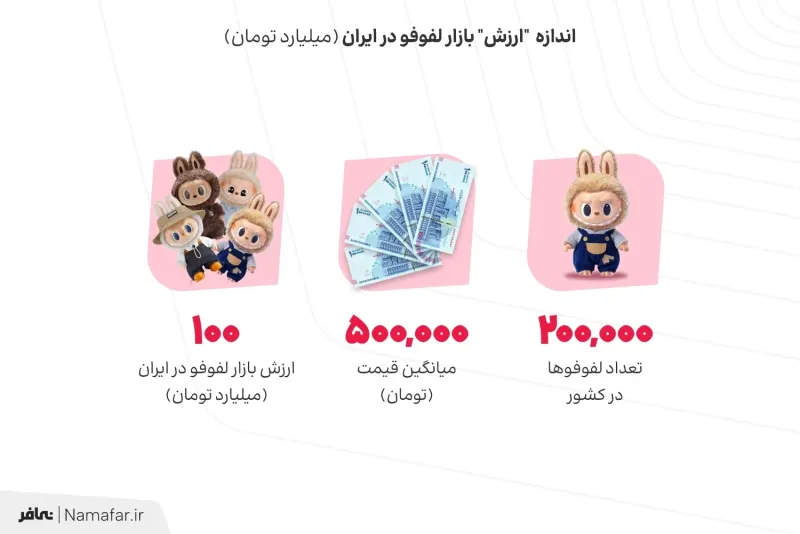
Contrary to field and intuitive data that have reported a 750 billion toman Labubu market in Iran, a data-driven examination of the Lafufu market in Iran indicates the illegal import and production of 200 thousand counterfeit dolls similar to Labubu in various designs and types. Also, the average price of Lafufu dolls is 500 thousand tomans. Of course, at the beginning of Lafufus becoming widespread and a trend in Iran, the average Lafufu price was in the 800 thousand toman channel, and after the extensive supply of Lafufus on the Iranian market, which coincided with the entry and production of a considerable volume of these 200 thousand Lafufu, prices adjusted and are still falling. Of course it should be borne in mind that the estimated 200 thousand Lafufu is the size and volume of the Lafufu market in Iran, a considerable volume of which is in the hands of sellers rather than customers.
Final word
It is clear that the news of "one million Labubu sold in Iran" resembles a myth more than it has reality. Total Labubu sales across all of Europe, the Middle East, and Africa have been about 1.1 million units, so accepting a claim of nearly the same number for one country (Iran), and that mainly on the basis of non-original products, does not seem logical. Namafar's data-driven reviews and estimates show that at most about 200 thousand Lafufu dolls (the counterfeit Labubu version) have been offered or sold in Iran—a figure that has a meaningful gap from the claimed "one million."
The difference between Labubu and Lafufu also plays a key role in understanding this exaggeration; Labubu is Pop Mart's original and best-selling product, which has limited supply and a higher price, whereas Lafufu is a name applied to copy and cheap versions of this doll on Iran's informal market. The Labubu story is an example of the effect of exaggeration and incorrect readings of statistics and figures that can lead to the formation of false perceptions in public opinion. The root of this distortion clearly lies in incomplete or mistaken readings of sales data and in selective attention to parts of official reports. For this reason, a data-based analytical view and realism in assessing noisy markets take on doubled importance, because only by relying on documented figures and precise analysis can the boundary between truth and myth be drawn.
Machine-translated from Persian by Namafar; the Persian original is authoritative. Read the original in Persian