The purpose of legal deposit of books is to preserve, maintain and transmit publications containing intellectual content, including the country's cultural heritage, to later generations. Legal deposit of books is a legal obligation at the national level. Publishers must deposit a specified number of copies of books and articles being published with a national archive. This archive is called the "legal deposit library". In many countries, under the law, at least two copies of published documents must be deposited, although there are also exceptions. In addition, in some countries only printed books are deposited, while in other countries digital copies and other formats are also covered by the law. In many countries, the legal deposit system has been updated and also includes digital copies. Throughout the article, for simplicity, we use the phrase "book deposit" instead of "legal deposit of books".
To read the article on books and reading, click here.

Benefits and fruits of book deposit
Just search Google in the sweet Persian language for "legal deposit of books" and you will be faced with millions of results except ones on legal deposit of books! If book deposit is implemented in the country as an efficient legal practice, it will certainly lead to the enrichment of the country's libraries. Countries such as Britain, with only half our literary capital, have libraries several times the size of ours. The first step in this direction is raising public awareness.
- We will expand the culture of reading further, and those who are members of that library, if they need them, will use those books. Even we ourselves, whenever we decide again, can by joining that same library use those same books again and read them again.
- From a religious point of view, as the prophets and Imams have said: this act is recorded in our file as a deed whose reward continues after us, and for as long as these books are read its reward is written for us, whether we are alive or not.
- For ourselves we free up space on our bookshelves for new books and, in a way, according to the law of the universe, we cause useful new books to flow toward us sooner and more, and this itself means taking a large step for our own further progress.
The WIPO legal deposit survey
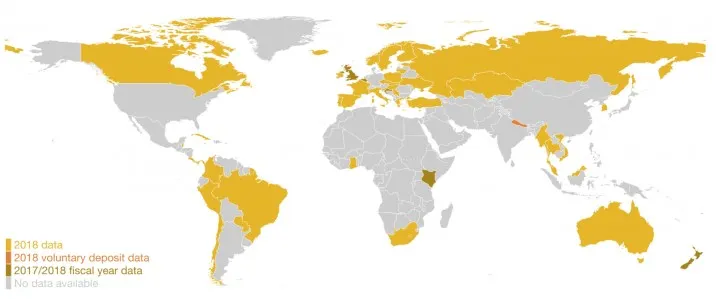
The World Intellectual Property Organization, or WIPO for short, is one of 16 specialized agencies of the United Nations under the UN General Assembly. The aim of this organization is to protect the intellectual property of a work. To complete and confirm publishing industry data gathered through the IPA-WIPO survey, WIPO conducted the book deposit survey in 2019. The national legal archives of 55 countries/territories responded to the survey. Among them, 52 countries had shared their book deposit data for 2018.
Limitations and advantages of gathering data on legal deposit of books
Gathering data on book deposit entails the following limitations:
a) In some jurisdictions, deposit of published copies is mandatory, whereas in other countries it is voluntary;b) In some countries, deposit of both print and digital copies is mandatory, while in other countries such an obligation exists only for print copies;
c) Data on revenue and the number of copies sold from such a system are not available. Nevertheless, addressing some of these limitations in order to derive comparable data is possible.
Despite all the limitations mentioned, gathering these data has several advantages. The most important of these advantages are:
a) Reliable data that are easily accessible through a national legal authority;b) Comprehensive coverage compared with survey data;
c) That it includes copies that the author themselves has published.

Assumptions adopted when collecting the data
To address some of the data limitations mentioned, the data are based on the following criteria:
Data from countries whose book deposit system proceeds on the basis of voluntary payment have been excluded;
Only data on printed books (titles) have been counted and other formats have been excluded;
To avoid mistaken calculations, the count is on a per-title basis (in some countries, depositing becomes mandatory when more than one copy of the book is printed).
Despite the effort made in this report to harmonize the gathered data, care must be taken when comparing data across countries, because in some countries deposit includes only print copies, while the number of countries where book deposit includes print and digital copies is large. The following points should also be considered when examining the data:
A publisher must carry out book deposit when a copy of the book has been made available to the public, whether for sale or free of charge.
In Portugal, publishers are legally obliged to deposit 11 copies of published books. In Malaysia, the number of copies that must be deposited with the National Library of Malaysia is five.
In 2006 the law in Germany changed and book deposit became mandatory for all electronic copies. Likewise, Japan also changed its law in 2013. From this date, the deposit law is mandatory for all books, journals, magazines and other published copies in the National Diet Library of Japan.
The Netherlands and Switzerland responded to the survey, but stated that they have no book deposit system in operation. Nepal's data are also not included in the report for this reason. Data for Austria, Germany and Japan are also not included in the report, because books (titles) cannot be separated from other published copies. Data for the United States are also not included in the report, because it has a selective procedure for copyright, which means that not all published books are covered by this system.

How many books were deposited in national archives in 2018?
Data on books deposited over the past five years are available for 46 countries/territories. This shows that the number of books deposited with national legal archives rose from 869,496 in 2014 to 1,014,856 in 2018. Part of this figure changed because of the introduction of a new law making book deposit mandatory for digital copies.
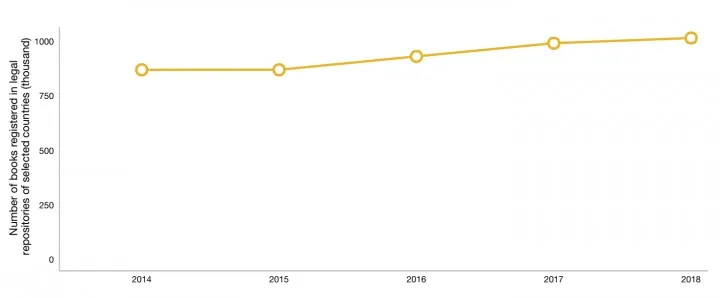
Growth in the total number of book deposits from 2014 to 2018. Types of book formats are taken into account in the chart. The greatest growth in deposits relates to digital books.
The highest numbers of books published and deposited with national legal archives in 2018 belonged to the United Kingdom (210,628), then Russia (116,915), the Republic of Korea (90,620), France (82,313), Turkey (71,074), Spain (67,884) and Italy (60,058). It should be noted, however, that several legal book markets, mainly the markets of the United States, China, Germany and Japan, are not mentioned in this survey.
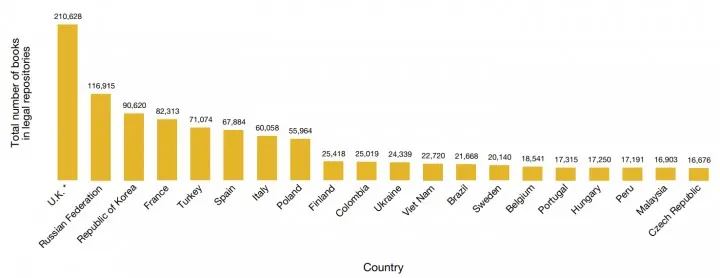
The number of books deposited in different countries. The highest number of books deposited belongs to England. It should be noted that the book deposit law in this country has existed since 1662.
Breakdown data by format are available for 12 countries. The largest shares of digital books in national archives belong to the United Kingdom (61.8 percent), Colombia (59.1 percent), Finland (59 percent) and Paraguay (49 percent). By contrast, the share of digital books deposited with national legal archives in Croatia, Ghana, Kazakhstan, Serbia, Ukraine and Vietnam is less than one percent.
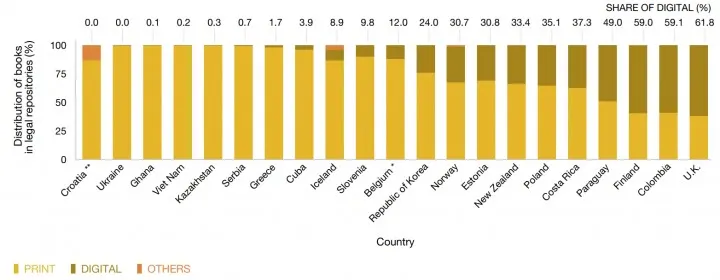
The share of different formats among books deposited in different countries. Note that in England digital books account for a large percentage of deposited books. The law on depositing digital books in England was introduced in 2013.
Closing remarks
At Namafar we strive to carry out proper cultural work on book deposit so that we can play a small part in expanding reading and book deposit and make the book publishing industry as strong as possible. So join Namafar in resharing this piece. You can also access many interesting figures in the field of books from here.
Machine-translated from Persian by Namafar; the Persian original is authoritative. Read the original in Persian