The five highest-grossing films of 2019 had one point in common: all of them relied on visual effects and 3D animation. The five highest-grossing films of 2019, namely Toy Story 4, The Lion King, Frozen 2, Captain Marvel, and Avengers: Endgame, made use of computer-generated imagery and the technology presented in 2019. Therefore, at the start of 2020, the New York Film Academy (NYFA) conducted surveys with the participation of instructors and graduates of the film industry who this very year took part in the production of dozens of feature films, games, and television shows, in order to identify the biggest trends of 2019. By examining the animations of 2019 one can arrive at a picture of animation production in 2020.
A paradigm shift among buyers
If you intend to produce animation, know that you are lucky. At present many producers are buyers of animation productions. In the past decade, the Nickelodeon studio, Cartoon Network, Fox, and Comedy Central have been the major producers of animated series. A large number of these producers, who have had internal growth and development, use the archive of existing IPs.
But at present streaming services such as Netflix and Amazon also play an important role in this industry and are producing animated series more than at any other time. Hulu, TBS, Apple, Disney+ HBO Max, and Quibi have also entered the game and provide small and large services in this field. Competition in the streaming world, the global popularity of animations, and the lower cost of animation relative to productions such as live-action have turned animations into one of the pillars of streaming.
Virtual production
Final visualization of a film has never been as difficult as it is today. Modern films need VFX, digital filming locations, and CG characters more than anything. This means that on-set filming is only a very, very small part of the work. To produce such films, in addition to these items a green screen is also needed. This issue will make the work difficult for directors, because they are not sure which sequences to make with visual effects. This is where virtual production steps into the cinema arena.
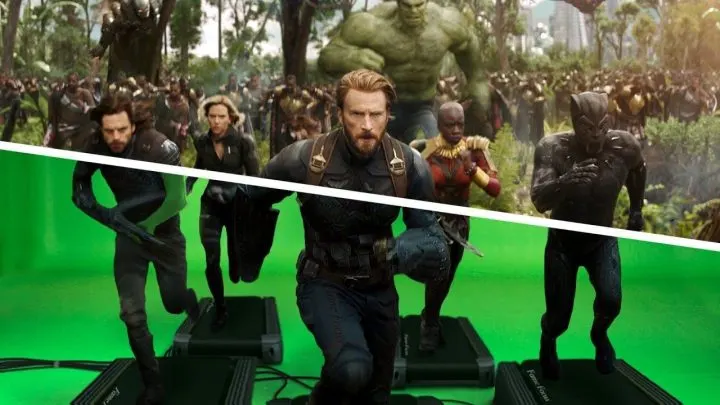 Using visual effects in film—a campaign on a treadmill!!!!
Virtual production is used when you use real-time 3D tracking (Real time) and visualization to see, before the work is finalized, how the final scene or the 3D VFX section will look, while on the other hand you record the actors' reactions to these scenes in real time. For many decades, one of the elementary forms of this technology was used in the advertising sector, such as the first down (a play in American football) on the football field that was carried out on the ground and the view of the match among cuts with several cameras; or graphic weather news that reacted in the moment to meteorologists' movements.
Existing advances in game-engine rendering and real time have made it possible to use VR technology in the production of films such as The Lion King. Guillermo Quesada, a game-design graduate of the NYFA school, showed how a scene that is entirely CG-based will look when it is captured using conventional filming (Lensing) and directing (Directorial) techniques.
Cloud computer workstations (tools)
Despite the decline in GPU costs, a modern workstation can also take as much as 5 thousand dollars from an artist's expenses. If hundreds of artists around the world do not have access to such a workstation, traditional VFX companies are forced to pay high investment costs. That is why artists and VFX companies have turned to "cloud" computing.
The part of shows that usually needs data and resources more than anything else is rendering. If there is no need for a render farm and using a RAM network to produce previews, the company will save hundreds of thousands of dollars and can spend more time on art instead of spending time on computation. This is where "cloud computing" comes into action.
Artists, companies, and supervisors can, merely by paying a cost to purchase advanced computers in order to visualize what they are working on, buy the time they spend computing a preview or rendering an image they are working on, and instead go to the origin (local) workstation to make adjustments and then send the computations to a "cloud network" for the work to be finalized. This process allows small companies to compete with larger rivals and, on the other hand, to spend less money.
Real-time technologies (Real – Time)
Rendering is one of the most time-consuming parts of VFX and/or animation production. Rendering only a single frame for the production of the animation "Frozen 1" took 30 hours. The important point is that 24 frames are rendered per second. On the other hand, for many decades, video games were rendered at 60fps, but their quality did not match expectations and they could not be used for advertising or on the cinema screen. The Unreal game engine changed this rule. By stepping onto the path of real-time rendering that had been popularized through the success of Fortnite by Epic Games, numerous real-time rendering resources entered the field and were used in animation and VFX. With this method, media can be rendered in only a few seconds. Those who are interested in learning this tool can use Unreal software.
 In the Frozen 2 animation, the rendering of scenes has been carried out with far more detail.
AI and machine learning
Today "deepfake" (Deepfake) and "machine learning" (machine learning) are everyday phrases in the news and have had a great impact on VFX. Replacing people's heads with one another, digitally copying or rejuvenating actors, or making sequences of an actor after their death, such as reconstructing Peter Cushing's scenes in Star Wars: Rogue One, requires a very substantial effort and building pixels frame by frame while working with a large number of software programs. This year, a Deepfake plugin for the After Effects software was released. With this plugin and using machine learning, artists can make highly realistic deepfakes. Using this technology requires very little knowledge of coding (or none at all), and you can train its algorithm yourself on your home machine.
Future animations
The future of animation production depends to a large extent on the application of current technologies in this industry. The era of animations such as "My Neighbor Totoro," in which all frames were painted, has passed. Today's animations have come very close to the boundary of reality, and in some cases the boundary between reality and imagery is very slight. Animation streaming is taking shape, and the giants of this industry are looking for new markets. In the end, it is not off the mark to say that the animations of the future are much closer to reality than to animation!
Notes:
This piece was published under the title "Animation Trends in 2020" on the website of the New York Film Academy. Namafar translated and published this piece in Azar (November–December) 99.
Machine-translated from Persian by Namafar; the Persian original is authoritative. Read the original in Persian