A data-driven account of the status of book publishing in 1403 (2024/25)
Contrary to common perceptions, book publishing is not merely an economic or cultural activity; rather it is considered one of the identity-forming pillars of any society. What takes place in the cycle of production, distribution, and consumption of books is a reflection of a country's intellectual, social, and economic status. In this note, relying on data from the "Book Publishing Dashboard" product of Namafar's policy research and data analysis group, we examine existing trends in order to draw a comprehensive and transparent picture of the status of book publishing in Iran. A picture that helps not only publishers and policymakers but also authors, translators, audiences, and cultural actors better recognize their role in this cultural ecosystem. In what follows we address an examination of the trend in the number of titles and print run over past years, the ratio of reprints to first editions, the most-published subjects, the share of translation and original works, the average book price and number of pages, and also the status of book publishing from the perspective of geographic distribution.
Growth in book titles; a fall in print run
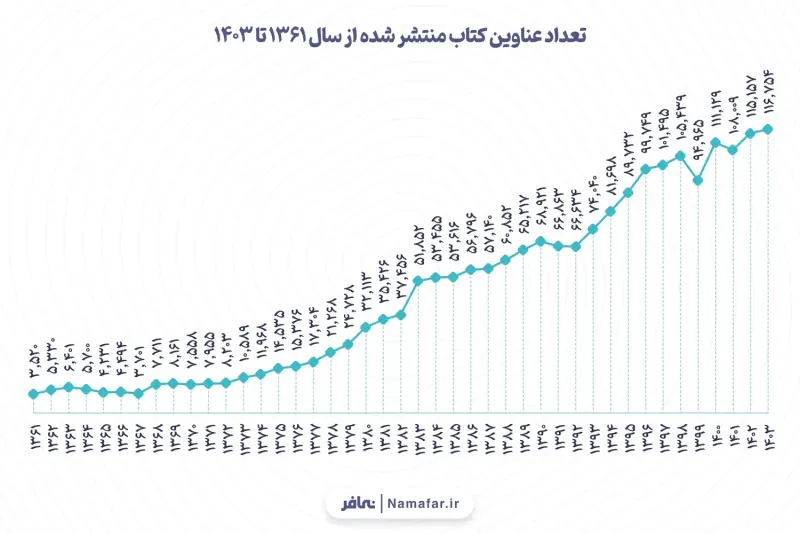
In 1403 (2024/25) a total of 116,754 book titles were published in the country, which is considered the highest figure in the history of book publishing in Iran. This is while the print run of books over past years has had a downward trend and in 1403 (2024/25) has reached 106,078,063 volumes.
This is while an examination of the print run of books from 1361 to 1403 (1982–2025) shows that the print run of books, after 1385 (2006/07)—which recorded the highest print run—has taken a downward trend, so that in 1403 (2024/25) it has reached its lowest level in the past two decades.
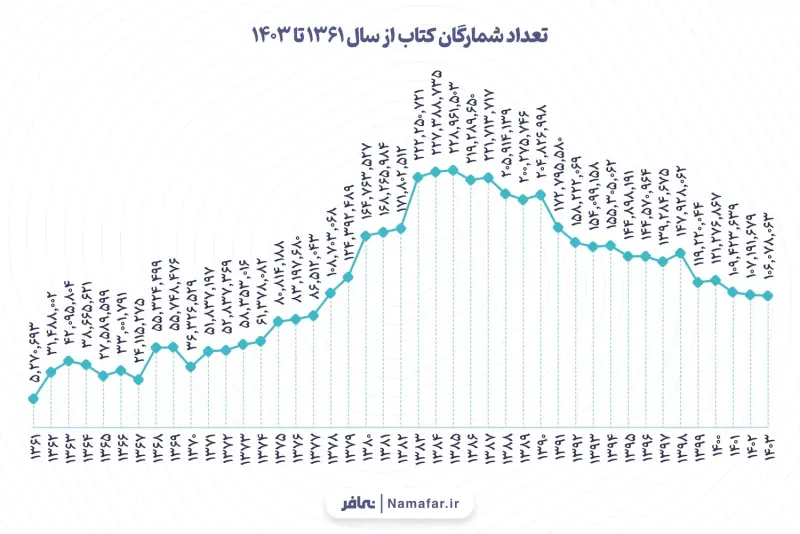
This striking discrepancy between the number of book titles and the print run has an important meaning. The increase in the number of titles indicates growth in book production. That is, more publishers and authors have entered the publishing arena, or professional publishers have published more titles. But the decline in print run means the number of copies printed of each title has become smaller. This occurrence can result from a decline in per-capita reading time, an increase in printing costs and a lack of economic capacity for large print runs, and also publishers' risk aversion, who, knowing the market's limitation, instead of printing thousands of copies, print only a few hundred copies so as not to incur a loss.
The increase in titles in parallel with the decline in print run can also be a sign of the specialization of publishing. That is, instead of printing one popular book with a high print run, tens of books with more specific subjects and for smaller groups of audiences are printed. In any case, these trends show that the book market in Iran, more than going toward deepening and increasing book consumption, is going toward scattered production with a smaller audience. This practice, although it increases variety, can also be a sign of a reading crisis and the absence of a stable market for publishing.
Most titles are first editions!
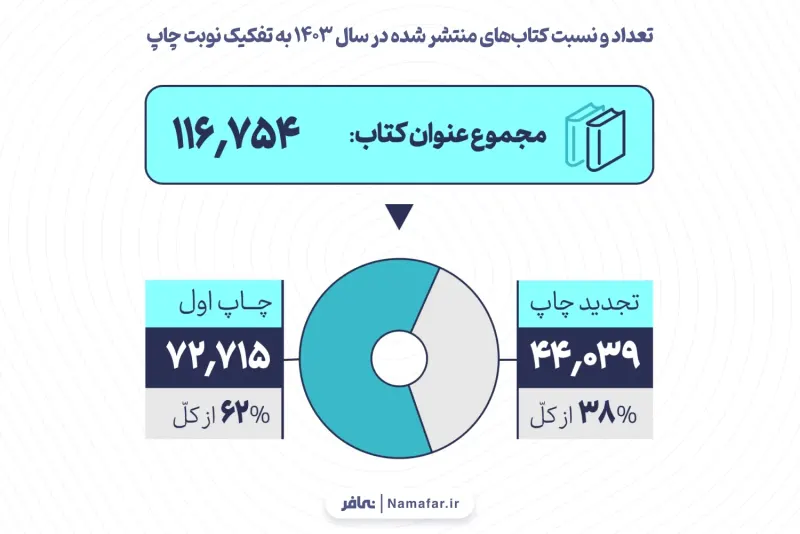
Among the 116,754 titles published, 72,715 titles were first editions and 44,039 titles were reprints. The percentage of reprints relative to all titles published is 38 percent and first editions 62 percent. These figures at first glance may be taken as a sign of the dynamism of publishing and the entry of new authors; but it must be noted that a low percentage of reprints can indicate weakness in the cycle of distribution, marketing, and also audience persistence. In other words, many books after the first edition no longer find an opportunity to be seen and exit the supply circuit.
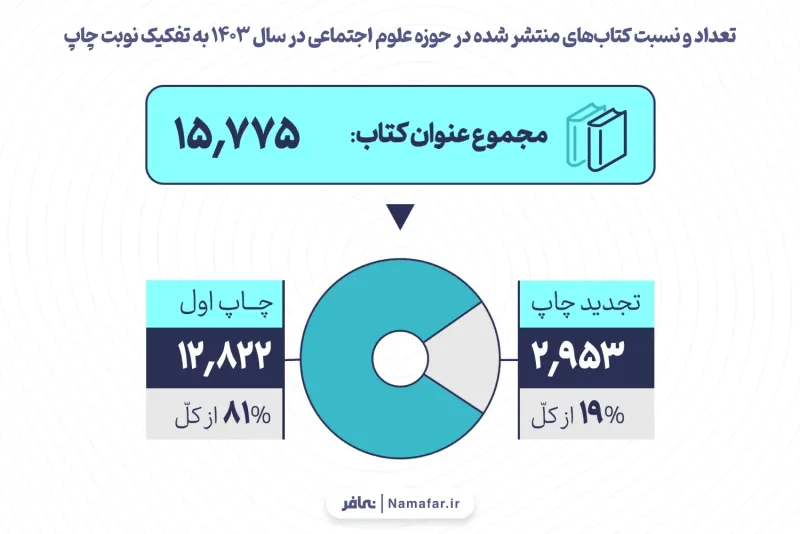
The ratio of first editions to the total, in the field of social sciences, is considerable. In 1403 (2024/25) about 81 percent (12,822) of the books in this field were first editions and only 19 percent (2,953) of them were reprints. In the fields of literature, applied sciences, history and philosophy, language, general works, and religion we also witness such a situation (the high ratio of first editions to the total). Only in two fields, literature and especially educational supplements, have reprints had a greater share than first editions.
The predominance of original works over translation; an encouraging sign?
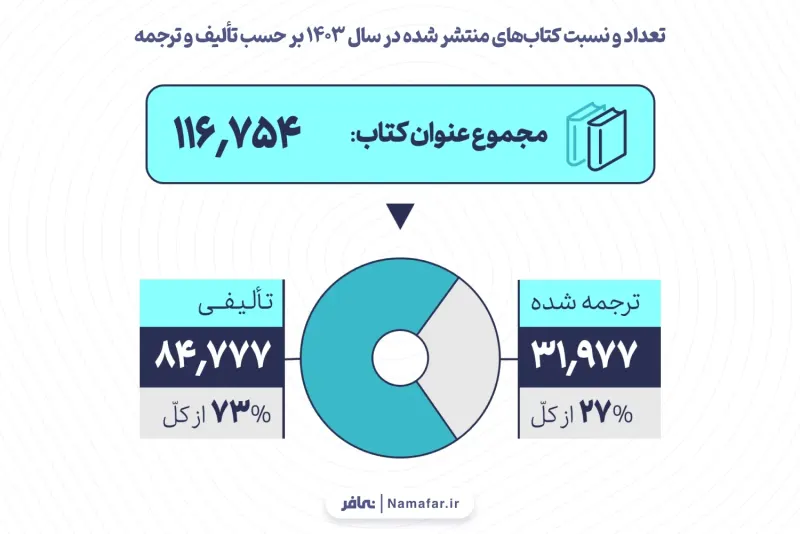
Of the total titles, 84,777 titles were original works and 31,977 titles were translations. That is, about 73 percent of titles published were original works and 27 percent were translations. This statistic on the one hand can indicate growth in the production of domestic content; but on the other hand, it can be seen as the result of the Ministry of Culture and Islamic Guidance's strictness in translation and delay in issuing permits, which has reduced the motivation of translators and publishers.
Tehran is the unrivaled capital of publishing
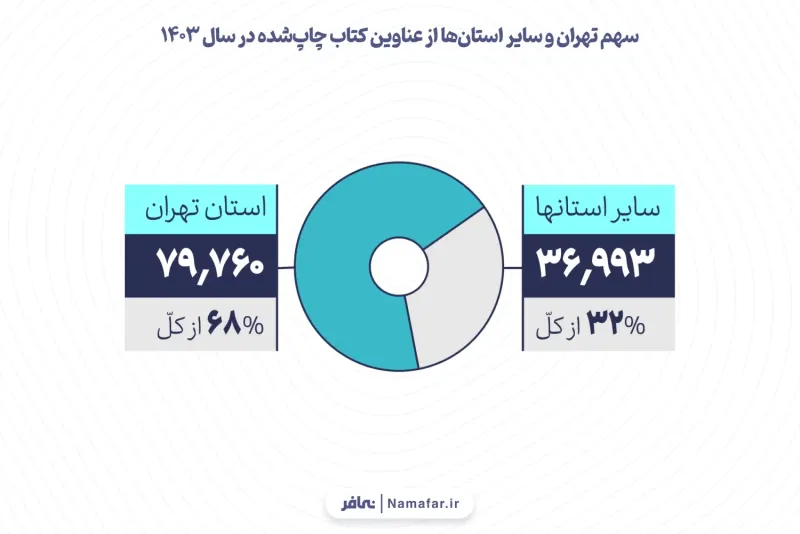
In terms of geographic distribution, about 68 percent (79,760) of all titles published were produced in Tehran and only about 31 percent (36,994) in other provinces. This intense concentration in Tehran speaks of a lack of balanced cultural development and indicates a kind of cultural capital-centrism that is considered a serious threat to local and regional publishing. Because it causes publishing capacities in other provinces to remain neglected and many local and diverse cultural voices to fall into silence.
Popular subjects: children and young adults, literature, and social sciences
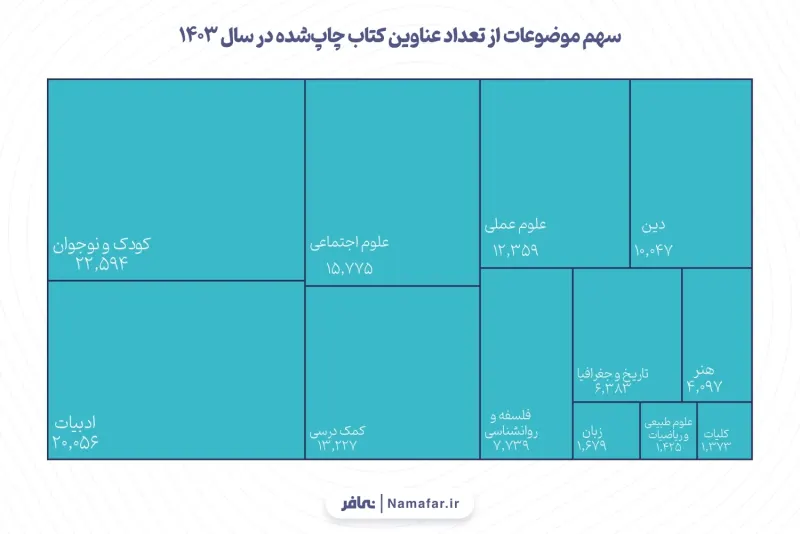
In terms of content, the children and young-adult field, with 22,594 titles, is at the top of subjects, which from the perspective of cultural future-building is encouraging. Although it is essential that the quality of these works be seriously evaluated. After that, literature with 20,056 titles, social sciences with 15,775 titles, and educational supplements with 13,227 titles are in the next ranks. These data show that the public inclination is toward narrative, social, and educational texts; although the low share of some fundamental fields such as philosophy, psychology, and religion can be a warning bell for the cultural depth of society.
The price of books; a reflection of the crisis in the publishing economy
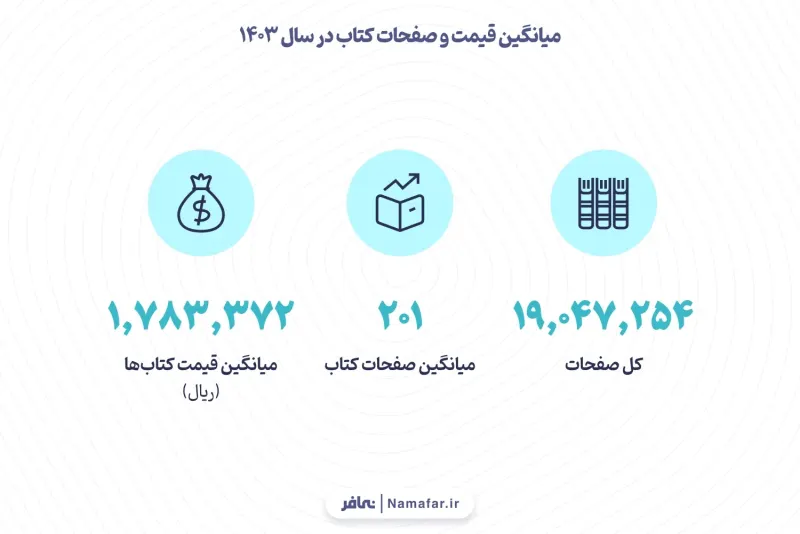
The average price of books in 1403 (2024/25) has reached 1,783,372 rials, which compared with previous years has had a striking jump. Despite this increase, the average number of book pages is only 201 pages. This means a relative decline in content volume against the increase in price; a phenomenon that can be attributed to three factors: the increase in the price of paper, printing, and distribution, the decline in audiences' economic capacity and, as a result, publishers' tendency to publish low-volume books. Among various subjects, educational-supplement books, at about 272 thousand tomans, have the highest average price. After that come general works, natural sciences and mathematics, social sciences, and philosophy and psychology. The lowest average price belongs to the field of religion, at about 98 thousand tomans.
Publishing and cyberspace; opportunity or threat?
The increased role of cyberspace and electronic books is not yet clearly reflected in these statistics. While today's audience has turned to platforms such as Taaghche, Fidibo, and Ketabrah, official publishing policymaking is still dependent on the traditional model of physical printing. This gap can explain part of the reasons for the book market's stagnation. Without adapting publishing infrastructure to the digital lifeworld, one cannot hope for a dynamic future in the publishing industry.
Final remarks
In this note we examined the status of book publishing in Iran based on data from Iran Book and Literature House in 1403 (2024/25). On this basis, we found that:
- In 1403 (2024/25) a total of 116,754 book titles were published in the country, which is considered the highest figure in the history of book publishing in Iran. This is while the print run of books over past years has had a downward trend and in 1403 (2024/25) has reached 106,078,063 volumes. This subject shows that the book market in Iran, more than going toward deepening and increasing book consumption, is going toward scattered production with a smaller audience, which can be a sign of a reading crisis and the absence of a stable market for publishing.
- Among the titles published in this year, 62 percent were first editions and 38 percent were reprints. Also about 73 percent of titles published were original works and 27 percent were translations.
- In terms of geographic distribution, about 68 percent of all titles published were produced in Tehran and only about 31 percent in other provinces.
- In terms of content, the children and young-adult field, with 22,594 titles, is at the top of subjects. After that come literature, social sciences, and educational supplements.
- The average price of books in 1403 (2024/25) has also reached 1,783,372 rials; while the average number of pages is 201. Meaning that we have faced a striking increase in price despite a decline in book volume.
Machine-translated from Persian by Namafar; the Persian original is authoritative. Read the original in Persian